
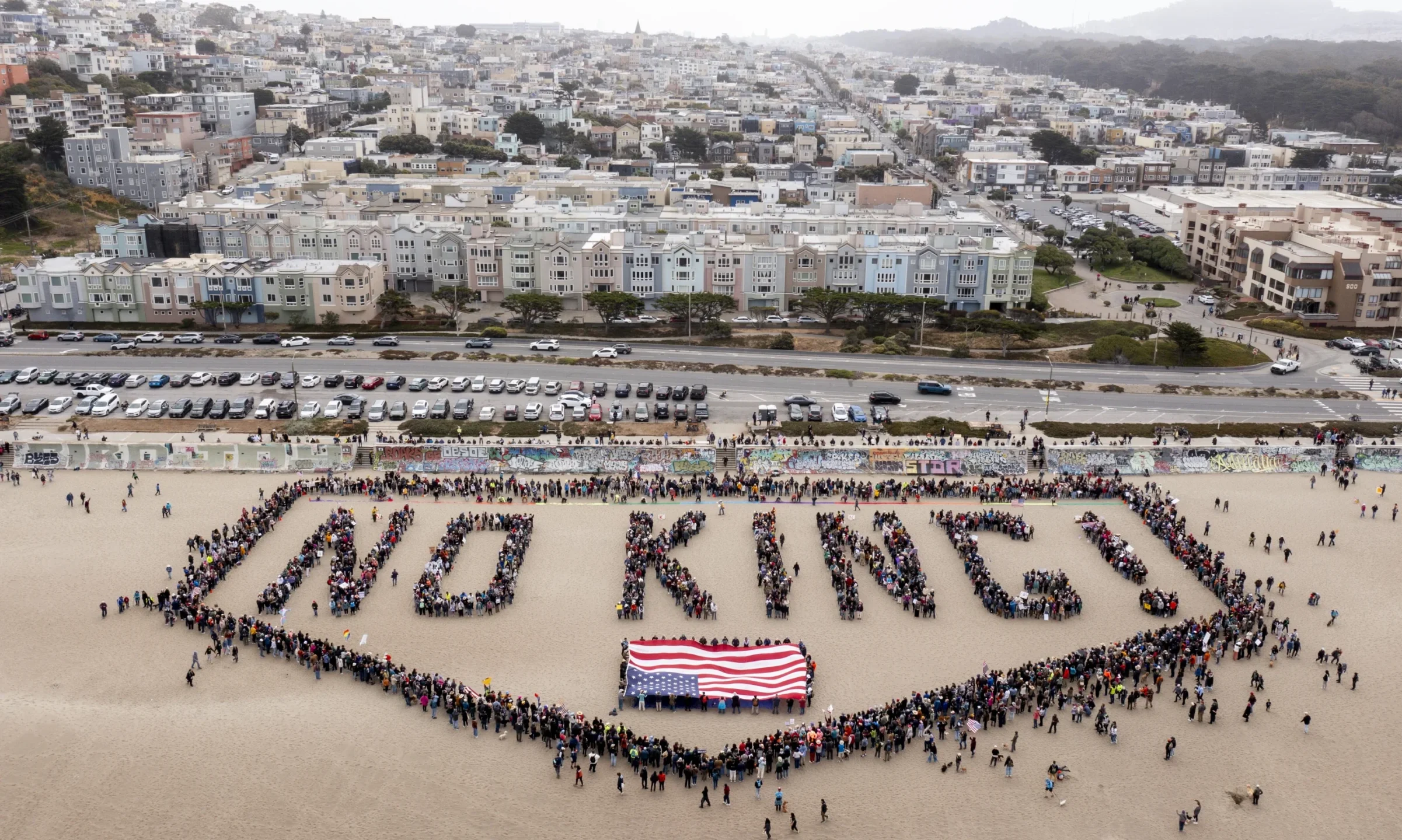
Aerial shots capture more than the sheer scale of the No Kings protests—they capture their pulse. Children, perched on their parents’ shoulders, wave American flags as drums rattle the streets and hearts alike. The turnout is staggering. The energy is electric. And yet, a question uncomfortably simple but impossible to answer lingers: will it matter?
On a crisp Saturday morning in Topeka, Kansas, a crowd of thousands gathers outside the statehouse. Homemade signs accompany a roar of voices, chanting “NO KINGS.” Cars pass by honking in support as inflatable frogs and unicorns march down the streets.
Among the crowd stands Mike Campbell, press coordinator for Kansas 50501, the grassroots political organization leading the protest. When asked why Kansas 50501 was mobilizing the masses for the No Kings protest, he said: “We love our country, we love living in our country, and we want to protect what we have here.”
This scene is replicated thousands of times across the nation. On October 18, 2025, nearly seven million Americans, according to the American Civil Liberties Union, participated in the No Kings protests: a series of peaceful demonstrations against what activists describe as President Trump’s increasingly authoritarian tendencies. In every corner of the country, from metropolises like New York City and Chicago to small towns in Kansas and West Virginia, ordinary citizens turned out to express a shared concern: one man is trying to crack the rules that make up the foundation of American democracy.
The No Kings protests were the largest single-day protests in American history. Why? Professor Laura Gamboa from the University of Notre Dame’s Keough School of Global Affairs recalls the Washington Post’s warning that “democracy dies in darkness.” Gamboa, however, argues that “democracy dies in vagueness.”
“It is sometimes hard to see what the executive is doing as authoritarian. It’s not so clear, especially for people who are not paying attention, maybe people who are more conservative, maybe people who really like Donald Trump,” Gamboa reflects. “[But] when your neighbors are being grabbed from the street, the administration cuts USAID, Medicare no longer works the way it used to, all of these things start to matter, and people start feeling it.”
That sense of something once sacrosanct beginning to erode was the current that carried people into the streets. President Trump’s authoritarian actions—the tariff feuds, the pressure on media and universities, the deployment of the national guard in the nation’s capital—paint him as less of a leader for the people and more as an imperial king. And Americans, since the nation’s founding, have never tolerated kings.

Photo Credits to AP
That defiance became the heartbeat of the No Kings protests. For Long Island Network for Change’s Steering Committee Member Emily Kaufman, the protest served as a “national conversation of No Kings, [one] around the power grab that the Trump administration continues to claw at as they quickly destroy the fabric of our democracy.” Kaufman echoes the core message of the protests: “If you stand against the crumbling of our democracy, then you should be out here with us.”
The message of No Kings undeniably resonated with millions of Americans. But now what? Was this truly an awakening to hold authorities accountable or just another march that roared for a day and vanished with the headlines?
Across the nation, that question began to take on urgency as Americans increasingly felt both overt and subtle attacks on freedoms once taken for granted. Deirdre Schifeling, the American Civil Liberties Union’s Chief Political and Advocacy Officer, traces that anxiety to a significant shift in the electorate. “For the first time ever, voters want a candidate who’s going to protect the Constitution,” Schifeling says. “That has never been a thing, but it is a thing now.”
Schifeling reveals that Americans are not just dissatisfied with President Trump, but afraid. Free speech, a once “sleeper issue,” is now becoming “a front-of-mind issue.” The spark of the No Kings protests, then, was not just outrage, it was an awakening. What Americans once assumed was immutable by political actors—the rule of law, the peaceful transition of power, and basic democratic norm—could in fact crumble. And once that message spread, silence was no longer an option.
If the No Kings protests marked a democratic awakening, Kansas was its proof. Something deeper, Campbell thought, was changing. “People who maybe haven’t been motivated in the past are more motivated now,” he said. “People are getting more and more scared.” Farmers, “a Republican-leaning group,” are now giving “big honks of support” as they drove grain trucks past the rallies. “My dad was a Republican his whole life,” Campbell added, “and he hates Trump because he hates what Trump is doing to the country.”
The traditional archetype of No Kings participants is vanishing as the number of democracy’s defenders starts to multiply. “He’s behaving like his word is the law,” Campbell states, “and we were founded on the exact opposite principle.” Campbell asserts another core message of the No Kings movement, “It’s not what he wants. It’s what the country wants. That’s what you’re standing up for.”
Despite this newfound energy among millions of Americans, both activists and scholars warn that protests alone are not enough to create the change needed to defeat what many critics call the “imperial presidency” of President Trump. Professor Mabel Berezin, a comparative sociologist from Cornell University, acknowledges that “we need these performative moments, but we need more than the performative moments.”

Photo credits to the Los Angeles Times
Professor Daniel Karell, a sociologist at Yale who studies social movements, invites a vital counterargument to the hope that No Kings might mark a democratic awakening. “I take a little bit more of a cynical perspective on this,” he admits. “Democratic norms and institutions are being attacked and undermined. Lots of Americans recognize that. Lots of people who protest in No Kings care about that.” Karell, however, cautions, “During the 2024 campaign, Democrats were very clear about this—that Project 2025 is anti-democratic… [that] Trump was a threat to democratic institutions. But he won. Tens of millions of people didn’t care about that.”
Karell sees the No Kings movement as powerful in visibility but limited in consequence unless it evolves. “Something good about protests is that they motivate people and bring issues to light,” he says. “But in our system, that doesn’t matter unless there are changes in voting or registration, or donations. That’s what ultimately matters.”
The No Kings movement now stands at a crossroads. Yes, it has drawn millions into the streets and revealed the depth of America’s resistance to creeping authoritarianism. But endless mobilization risks exhaustion. Protest after protest, people begin to wonder whether shouting in the streets still matters.
As Karell warns, “Protesting doesn’t actually change anything.” The real challenge, he argues, is what comes next. “There needs to be a step towards something more organized.”
Through an email correspondence, Michael Sozan, a senior fellow at the Center for American Progress, sees that transition already underway. “Day by day, in communities across the nation, everyday Americans are understanding that President Trump is trying to build an imperial presidency,” he explains. The growing sense of urgency, he says, “is why the peaceful mass mobilization movement is spreading.” The October 18th protests, Sozan reiterates, were “the largest single-day protest against the government in U.S. history.”
That magnitude may mark a new stage of democratic resistance. Drawing on research by Harvard Professor Erica Chenoweth, Sozan points out that when roughly 3.5 percent of a population participates in sustained protest, about 12 million Americans, “transformative change” follows. This change has been seen in movements like the 1986 People Power Movement in the Philippines and the 2003 Rose Revolution in Georgia.
“The movement seems to be well on its way,” he says. If the rallies continue to grow in numbers, turn into boycotts, strikes, and other forms of nonviolent noncooperation, No Kings could shift from performance to meaningful pressure.
This sustained pressure was seen throughout the Civil Rights movement. Freedom riders were at protests registering individuals to vote. Charismatic leaders like Martin Luther King Jr. and Malcom X took the initiative to become a face of hope. Karell, interestingly, points to a more subtle form of nonviolent resistance: music.
“If you go back to that time period and you listen to the popular media, the music that was the most popular was about [the] Vietnam [war], [the] Civil rights movement,” Karell observes. Looking back at the No Kings protests, this type of cultural activism was on the rise.
Kaufman attests to the importance of music at the No Kings protest. “We emphasize music at our protests, and we want it to be a fun and celebratory and energizing experience where you come together as a community,” she states. “It is a moment to rejoice together, to celebrate together, and really to celebrate standing up and speaking out and speaking truth to power and energizing us to continue the fight.”
In the Civil Rights era, songs were political acts, hymns of defiance that demanded justice. “We Shall Overcome” and “A Change Is Gonna Come” gave voice to pain and persistence. Today, music remains a tool that is used to amplify No Kings. Songs bellowed through the streets, people danced in inflatable suits. People were not just fueled by rage; they were fueled by joy. Civil Rights anthems leave No Kings with a tool––a way to confront injustice while humanizing the protests.
Still, the No Kings movement’s power is not only in numbers, but also in its ability to unite. Professor Lara Putnam from the University of Pittsburgh shares Karell’s skepticism, but sees another possibility. “Protests can do [one of two] things,” she explains. “They can deepen polarization, but they can also humanize it.”
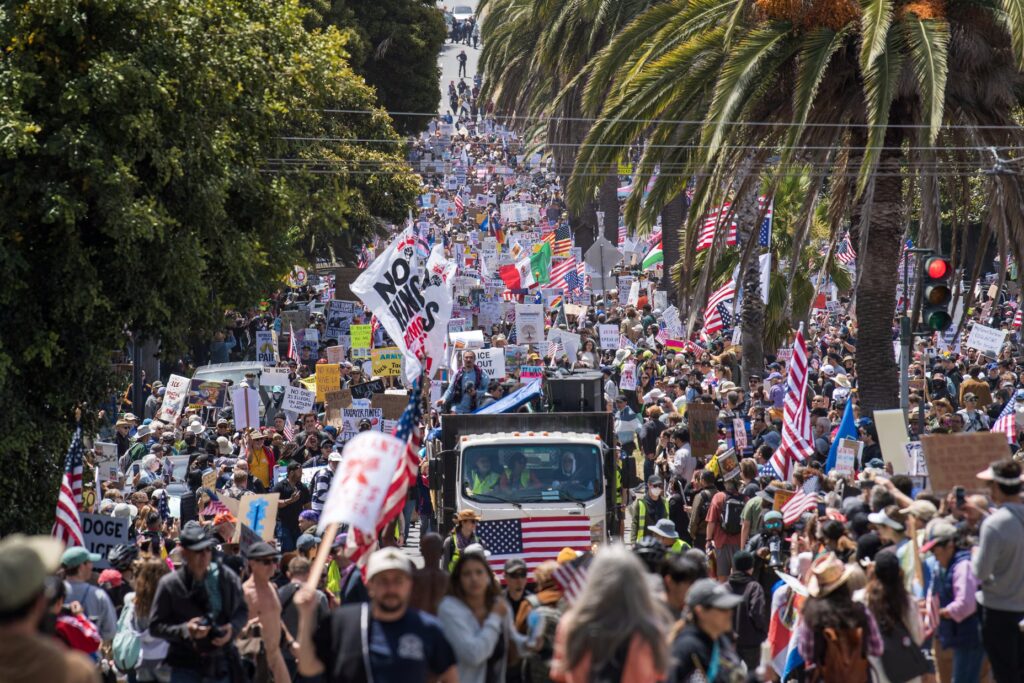
Photo credits to Getty Images
In towns across Pennsylvania, Putnam observed how the demonstrations blurred partisan lines. Neighbors who once avoided political conversations found themselves standing together, not as Republicans or Democrats, but as citizens. “When you see that it’s not crazy people from somewhere else,” she says, “but your own community standing up for something, that changes what’s possible.”
Her point reveals the quiet message of No Kings: that the defense of democracy can begin at the neighborhood level, where shared fear manifests into a shared purpose. For all its noise and unprecedented actions, the No Kings movement’s most radical act may be this rediscovery of one another.
Sustaining the momentum of the No Kings protests is on the minds of many activists. The Kansas 50501 chapter is already exploring avenues beyond the march. “There’s a lot of talk about boycotts centered around Thanksgiving and Black Friday week,” Campbell notes. The goal, he explains, is to create “peaceful disruption to the country” that stretches beyond the 24-hour news cycle, keeping the message alive and engaging citizens in ways that are practical and participatory.
Kaufman suggests signing up for local advocacy groups’ email blast lists that share information about ways to participate. She states that when individuals are “reading this flood of negative news,” they find it “terrifying, overwhelming, and never [know] where to begin.” Kaufman provides relief, telling those individuals “You don’t have to know where to begin.” Long Island Network for Change sends countless opportunities to get involved with its e-blast list members.
To Schiefling, the energy in the streets is a starting point, not an endpoint. She urges citizens to take the protest beyond the signs and chants and into the very architecture of governance. “Demand a more representative…system, a fair system, a system that’s worthy of American democracy,” she says. For her, anger is only meaningful if it becomes a blueprint for reform.
The critique is bipartisan in scope. Schiefling notes that “both Donald Trump and…Senator Sanders had [the lack of a representative system] as one of their main points. So on both sides, the same message comes to fruition. And because it’s true, the system is rigged.” Across the spectrum, Americans sense the same frustration: the rules themselves are stacked against them, and that standing up is only the first step.
Her call is constructive. Schiefling asks citizens to envision what democracy could be, not just what it is. “I would encourage you to help reimagine what our system should be like. Imagine what a real democracy would look like?” The message is clear: the No Kings protests are more than a moment. It is an invitation to imagine, organize, and insist upon a democracy that lives up to its own ideals.
The future of No Kings, then, depends not only on resistance, but renewal. Kaufman puts it simply: “We must be joyful when we can. We must find tangible actions…to stop the fascist creep that’s happening and ultimately turn this around.”
Kaufman’s words capture what No Kings must become—a movement that endures beyond the initial noise and partisan lines. No Kings should continue to find joy, not just in defiance, but in sustained resistance to protect our vision of what America should be.