
Photo credit: Eugene Hoshiko, OPB
On August 15, 2025, hundreds filled the broad walkways of Yasukuni Shrine for the annual commemoration of the official end of World War II. The line moved slowly—but the conversations did not.
Visiting the site for academic research, Ryne Hisada ’27, a Japanese-American student at Yale University, expected a quiet, somber atmosphere in respect for the deceased.
Instead, he found himself surrounded by raised voices. Visitors weren’t whispering about politics, but arguing about it in full volume.
At a shrine often wishfully described as nonpolitical by Japanese elites, Hisada recalls how the population “made no pretensions about [its] connection to politics and national identity.” He continued, “Anyone who knows about Yasukuni knows that there is an obvious political connection. It’s foreign policy. It is also domestic politics.”
Yasukuni Shrine memorializes all 2.5 million veterans who have died in the service of Japan, which includes fourteen Class A war criminals as well as hundreds of Class B and C convicts of World War II. For decades, Yasukuni has been a flashpoint in the intersection of memory, nationalism, and Japan’s struggle to define its postwar identity. But this summer, Hisada witnessed how Japan’s future, in addition to its past, was being contested in its courtyards.
As he stood under the scorching sunlight, Hisada remembers hearing visitors debate not the shrine’s symbolism, but the country’s seemingly new political direction—as seen in the recent Upper House elections. “I was listening to college students discussing the incapable LDP politicians and how exciting Sanseito was,” Hisada recalls.
This intriguing conversation suggested a younger generation increasingly skeptical of the center-right Liberal Democratic Party (LDP)—Japan’s ruling party for nearly seventy years—and a sudden anticipation for Sanseito, the far-right populist party founded in 2020.
The college-aged students Hisada overheard were not alone; the electorate echoed their disillusionment. At the 2025 summer elections, the LDP—and its former coalition partner Komeito—failed to secure a majority in the Upper House just months after another bitter loss in the Lower House.
As such, the political mood Hisada witnessed at Yasukuni mirrored a unique national moment: a ruling party in decline, a fatigued electorate searching for fresh alternatives, and a right-wing fringe suddenly in the spotlight.
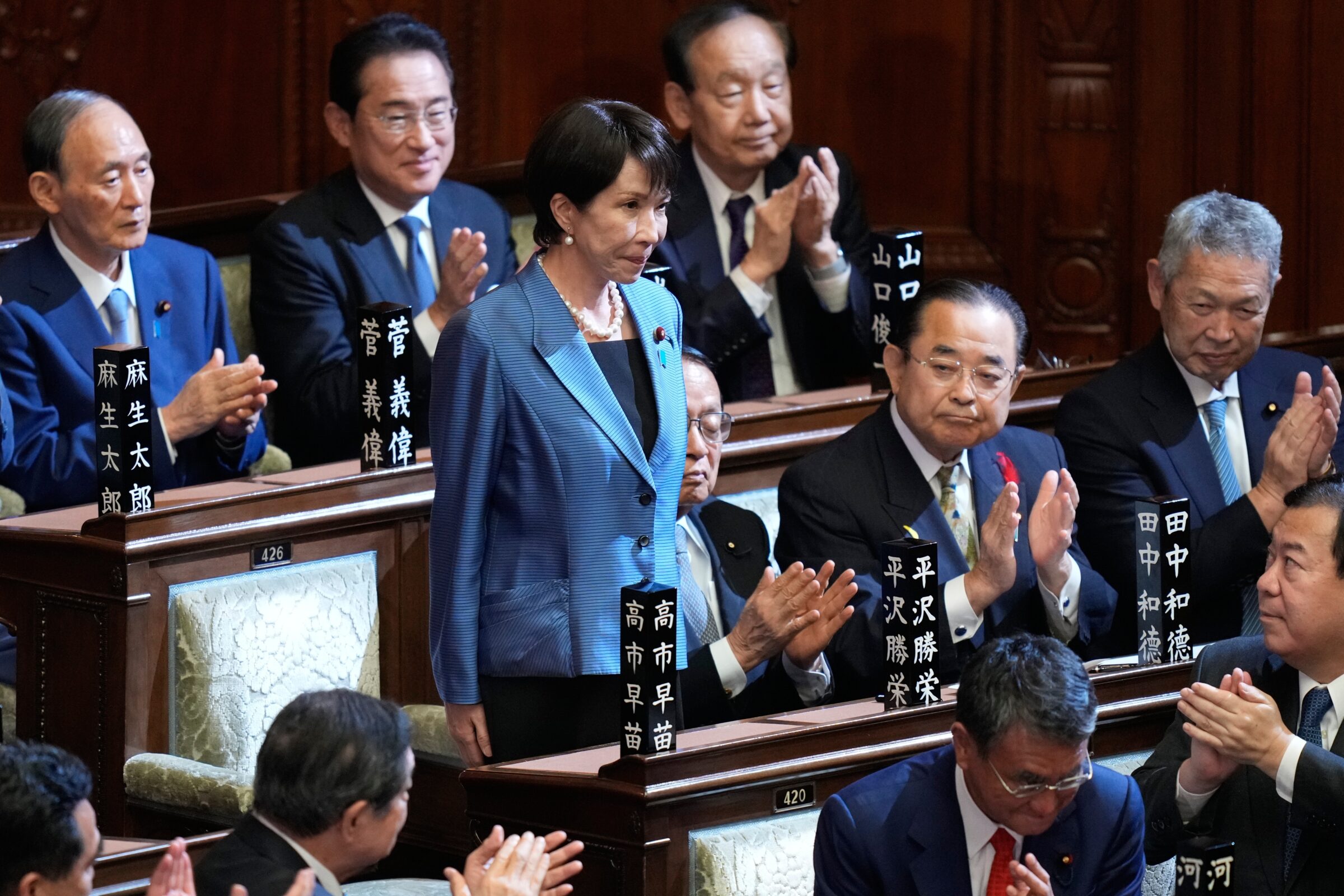
Governing as a minority coalition for the first time in its history, the LDP scrambled to appease popular discontent, consolidate party coalitions, and recover from a divisive slush fund scandal that shook the party in 2023. To remediate these newfound challenges, the LDP gravitated towards an unconventional character—that of motorcycle-enthusiast, heavy-metal-drummer, and self-made conservative Sanae Takaichi.
Elected on a runoff vote with narrow margins, Takaichi confounded many with her rise to party leadership. Nevertheless, her fierce sense of individuality and values placated an increasingly agitated conservative electorate—with promises of stronger defense, tighter immigration policies, and revival of traditional values. Takaichi harnessed existing right-wing and nationalist sentiments to appeal to an increasingly loud fringe of the population. Yet, her historically high approval ratings did not negate the challenging future ahead.
***
At the same time that the LDP was losing influence in Congress in July 2025, another actor rose to the spotlight: the far-right ‘Japanese First’ party Sanseito. Through a conservative platform that boasted anti-foreign sentiments, national pride, and distrust in the establishment, Sanseito satisfied constituents’ growing appetite for decisive, populist rhetoric that validated their concerns with Japan’s status quo.
Hisada shared his belief that Sanseito’s campaign was remarkable for its direct targeting of the population’s growing fears. Through inflammatory rhetoric and a social media campaign of unprecedented scale, the party mobilized large segments of society—especially young people like those he encountered at Yusukuni—who felt that the LDP no longer understood their needs nor spoke their language.
“A lot of young people have just felt left behind by politics, and don’t feel like politicians, especially within the long-running LDP, care about what they think,” said Charles McClean, a professor of political science at Yale University who studies youth political engagement in Japan.
To McClean, Sanseito relies on emotional and straightforward appeals to mobilize previously-disengaged voters around their extremist platform, employing “more effective messaging” than Japanese establishment parties have done in the past.
Although Sanseito’s rise was moderate in absolute terms, catapulting from one to 15 seats in Parliament, their unprecedented electoral victory had rippling effects on the mood of the Japanese public.
According to Yuki Sugita ’28, a Japanese student at Yale University, Sanseito shook Japan’s political establishment and forced the LDP to reevaluate its policy proposals and social media strategy amidst changing popular sentiments on immigration, national identity, and Japan’s economic stagnation.
McClean believes the LDP—which encompasses the center-right spectrum of Japanese politics—had become increasingly moderate since the assassination of conservative Prime Minister Shinzo Abe in 2022.
An extremely consequential leader within Japanese politics, Abe was the only politician who managed to withstand the country’s “revolving door” of majority leaders, push a more conservative agenda within the LDP, and strengthen Japanese-American ties, according to McClean.
Thus, as the party reevaluated its future in the face of its bitter electoral loss, it realized the answer to its leadership crisis lay in the past. The LDP recognized that regaining its footing among the right-wing Japanese electorate would demand a leadership that could carry forward the successful legacy of Abe—the longest-serving post-war prime minister of Japan.
The LDP saw in Takaichi, who was Abe’s political protégé, an opportunity to reclaim its lost voters and reestablish the party’s dominance, continued McClean. He argued that Takaichi wanted to “position herself as the successor of that wing of the party and of that legacy.”
As described by Ko Maeda, a professor of political science at the University of North Texas, the election of “a well-known conservative” to the leadership of the LDP was due to the rise of the ultra-far-right Sanseito. He argues that Sanseito’s unexpected attainment of multiple seats in the Japanese Parliament ““motivated many LDP supporters and politicians to move rightward, leading to the election of Takaichi” in October 2025.
Her rise was, thus, less a rupture than a reflection of broader conservative currents in Japanese politics—a byproduct of the energy stirred up by the rise of far-right parties.
As Amy Catalinac, a New York University political science professor, explained, Takaichi positioned herself as a fresh but firmly conservative leader capable of rejuvenating a decaying party, and, perhaps, also recovering the conservative voter base that had defected to Sanseito in July. Nevertheless, to achieve her goals, Takaichi needed to re-engage a frustrated electorate and reassure them that the party could once again soothe their anxieties about immigration and national security. As a result, she resorted to tapping into conservative sentiments that had long been dormant within Japanese society.
Achieving this balance was uniquely difficult, however, due to Japan’s domestic and international pressures. As explained by Sugita, Japan was concomitantly facing a stagnant economy, a fatigued immigration system, and a looming military threat posed by its neighboring powers such as China, Russia, and North Korea.
As politicians struggle to revive the economy without the foreign labor needed to counter Japan’s declining birthrates, public discontent has increasingly turned outward. Japanese citizens, Hisada said, scapegoat inflation and rising living costs on the recent surge in immigration and foreign tourism. Young people, in particular, “think that a lot of their economic or cultural qualms and discontents are because of immigration,” he added.
At the same time, Japan’s pacifist Constitution—a legacy of WWII under which the country symbolically renounces war—has left many citizens feeling vulnerable in an increasingly volatile region. Faced with rising threats from the military powerhouses of the Pacific, many Japanese now feel powerless without a robust military to back them.
“Japanese people are really terrified,” said Katherine Rupp, professor of Anthropology and Program Director at Yale University’s Council on East Asian Studies. “There is a real sense of fear,” Rupp reflected.
Japanese citizens are, thereby, increasingly agitated and anxious, simultaneously blaming foreigners for Japan’s failures and demanding a tougher defense policy to confront regional threats—an idea that Hisada believes was, for a long time, considered “a far-right ideal.”
These conservative sentiments, however, are not new.
“The majority of people’s viewpoints haven’t changed, but they have started to manifest more above the surface,” Sugita said. “The public has been conservative for a long time, but it has started to manifest more in the last few years.”
As explained by Rupp, the anti-foreign, anti-immigration, and pro-remilitarization sentiments that recently caught international attention have long existed beneath the surface. However, as noted by Sugita, the openness with which both the population and politicians express this conservatism is new. He attributed this upsurge in public conservative discourse to social media, which he argued has facilitated communication between groups and made individuals’ “opinions more public and transparent.”
Takaichi has attempted to cater to this deepening popular mood by combining symbolic actions, strategic policies, and public posturing to recover the confidence of the electorate.
Sugita argues that Takaichi has adopted elements of Sanseito’s communication strategy—direct, emotional, and targeted especially towards young people—to intimately validate people’s growing concerns while retaining the institutional legitimacy of the LDP.
As suggested by Rupp, Takaichi’s outspokenness against tourism in her ancient hometown of Nara, which was Japan’s first permanent capital, underscores her alignment with the arguably prejudiced widespread frustration with foreigners and the overcrowding of cities. Takaichi’s various past visits to Yasukuni Shrine and push for changes in World War II history education, Rupp added, also signal a clear nationalist orientation that appeals to some conservative voters.
At the same time, Takaichi discusses not only her desire to become Japan’s “Iron Lady,” in reference to her self-proclaimed idol Margaret Thatcher, but she also emphasizes her disposition to “cast aside the idea of ‘work-life balance’” and simply “work, work, work” for the Japanese population.
“She’s very conservative. She favors a stronger defense posture, and she also is grappling with this issue with foreigners,” added Professor Catalinac. “So, she may be able to stop the flow of votes away to these [far-right] parties [from the LDP].”
According to Catalinac, Takaichi’s current challenge is to respond to those nationalist sentiments while navigating the LDP’s complex internal landscape. Nonetheless, Catalinac believes that Takaichi’s complicated position as the leader of a scrambling party might “limit her capacity for bolder action” in office, as she is restrained by interparty frictions and the consolidation of an intraparty platform with the LDP’s new partner, the Japan Innovation Party.
Thus, as further emphasized by Professor McClean, Takaichi needs to moderate her conservative impulses to maintain party unity—making her leadership a constant balancing act between conservative ideological inclination and coalition-management.
Nevertheless, Professor Catalinc believes that Takaichi has proven adept at navigating this challenge. She adds that Takaichi “has already achieved a lot in the last month,” including forging an entire new coalition to substitute Komeito, strengthening ties with U.S. President Donald Trump, and expediting substantial increases in Japan’s defense budget. Thus, despite her constraints, Takaichi is managing expectations and offering conservative voters a preview of her promises.
Importantly, her ability to restore the close Japan-U.S. relationship that was embodied by her political predecessor Abe has been a particularly reassuring feat of her premiership.
As Hisada noted, seeing “this image of Trump hugging this new female prime minister on a U.S. warship” instills a sense of security, continuity, and prosperity for the Japanese. The prospect of having “a bright future with American partnership” is important for Japanese people, he added. Thus, through stepping into her diplomatic role with a strong and confident posture, Takaichi offers psychological stability in a moment of great insecurity within the Pacific.
Takaichi’s early success extends beyond her calculated appeals to anti-foreign sentiment and nationalist imagery. It is also a reflection of a sincere attempt to respond to Japan’s increasing defense concerns through, for example, forging a healthy military partnership with the United States. Importantly, as argued by Sugita, Takaichi’s plans to double Japan’s defense spending and impose stricter immigration policies are less extreme than they appear—large proportions of the population support them. Her outstanding approval ratings—over 80 percent—reflect “people’s optimism that she will be a different kind of leader” for the LDP, he concluded.
Nevertheless, McClean cautioned against the precipitated idea that Takaichi’s Japan is headed towards a brand new direction. As to the question of whether Takaichi’s election represents the last chapter in an old book or the first chapter in a new narrative, he demonstrated uncertainty. McClean acknowledged Takaichi’s clear desire to frame her premiership as the start of a new era in Japanese conservative politics. Yet, he stressed that, ultimately, she is also “hoping for longevity” in office. And while “she wants to keep momentum going,” he adds, her long-term political survival may require her to temper the very conservative impulses that helped her rise.
At the end of the day, Takachi must still balance the expectations of right-wing conservative Japanese people and the most moderate factions of the Liberal Democratic Party, Catalinac emphasized.
And, as it seems, Takaichi has already gotten that message.
She has started to scale back the symbolic gestures that previously underlined her nationalist image. Takaichi, once an unapologetic visitor to the contentious Yasukuni Shrine, has recently refrained from paying her respects to the Japanese war dead in-person at the annual autumn ritual in October—a conspicuous retreat that underscores the widening gap between her nationalist persona and the compromises required to govern.