
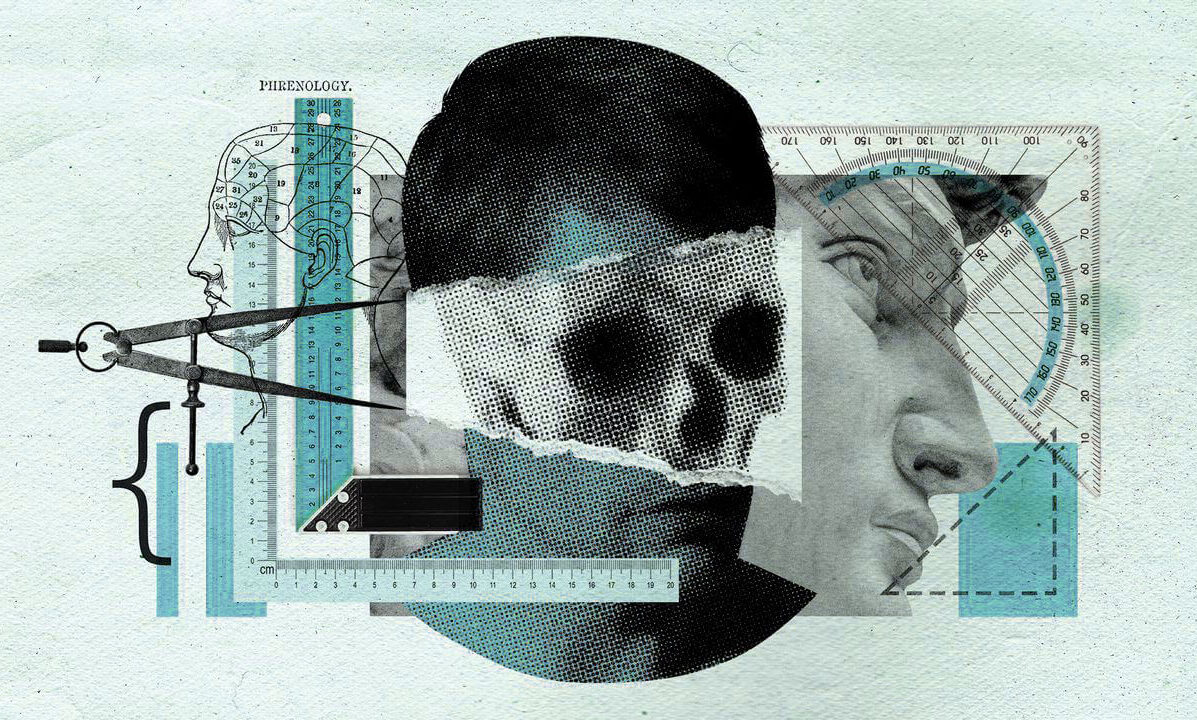
Smashing their faces with hammers to carve sharper cheekbones, injecting steroids and testosterone to grow their muscles, and smoking crystal meth to reduce their weight: these are some of the practices of a growing online subculture of men, known as “looksmaxxers.” This nihilistic community takes the most severe measures to enhance their physical appearance, with men transcending their biological destiny in the pursuit of unrealistic beauty standards.
Looksmaxxing, short for “maximizing one’s looks”, pushes self-improvement to its most extreme edge. In online forums and TikTok feeds, men document their quest for aesthetic “ascension,” the ultimate transformation of physical appearance. The looksmaxxing ideal is characterized by a wide and forward-grown maxilla—the upper jaw bone—which contributes to higher cheekbones and a sharper jawline. A positive canthal tilt is also sought, meaning the inner corner of one’s eye is lower than the outer corner, creating a lifted effect. Looksmaxxing forums contain precise ratios and degrees of facial features that map onto the artificially constructed perception of perfection.
The movement exists within the manosphere—a loose collection of male-focused communities that claim to address men’s hardships but often promote misogyny. While women have long been subjected to unrealistic beauty standards, a growing subset of men now face similar pressures, as the looksmaxxing community has venerated performance-enhancing drugs, cosmetic procedures, and untested research chemicals.
Braden Peters, a 20-year-old who goes by the name “Clavicular” (Clav), has pioneered the space with a large social media presence. Expelled from college for stashing testosterone in his dorm room, he now runs “The Clavicular System,” which is a supposedly data-driven framework that helps individuals supersede their genetic potential through looksmaxxing workshops, featuring a facial analytics dashboard, pharmaceutical skin protocols, and what he calls “structural training.”
In a YouTube interview with Jack Neel—host of a crime, business, and psychology podcast—Clav defined looksmaxxing as “the furthest extent that you could take self-improvement.” He also admitted to taking testosterone to grow his muscles, minoxidil and dutasteride to thicken hair, accutane to clear acne, and crystal meth as a stimulant to hollow out his cheeks, every day.
Clavicular has a following of over 700k on TikTok, influencing many to follow suit in his regimented routine of injecting peptides: research chemicals composed of amino acid chains that build protein. A male student from Southern Methodist University, who wished to be kept anonymous, remarked, “Social media is pushing this agenda of taking peptides. I know a couple of buddies who started taking these research chemicals, and it’s a little unsafe.”
In the YouTube interview, Clav claims his rationality justifies the risk. “If someone is hyper logical, doing the things that I’m doing, they can go up in looks-scale by 30-40%.” He frequently rates women on an internal scale: “Sub 3”, “Sub 5”, “Becky”, “Stacy”, “True Eve,” but has never asked women to rate him. This asymmetry is a reflection of the movement’s deeply rooted misogyny, where men feel entitled to objectify women and quantify their appearance.
In the video, he also claims, “I maximize all metrics of my life. I’ve just come to the conclusion, based on numbers, that looks are the most important metric, and it would be insane not to prioritize them.”
Maria Gendron, a Yale social psychologist, expressed her concern for the community: “Giving yourself peptides and trying to change your hormonal landscape is not something that people should be doing without support from medical providers.” Evidence suggests that some peptides have the potential to trigger cancer and severe systemic issues such as hormonal imbalances and heart palpitations.
She warned, “Creating ideals that are close to unattainable is not good for people’s self-worth, particularly when it’s leading to using yourself as a test subject for interventions that aren’t safety tested.”
In the YouTube interview, Clav admits he is aware of the damage that he has inflicted on himself. “It is very likely that some of my lifespan will be diminished with the things that I’m doing.” Nonetheless, “I’m not a huge longevity guy.”
Clinical psychologist Callie Mims, who has conducted research on adolescents with eating disorders at Yale School of Medicine, believes looksmaxxing has one fundamental problem: “The best version, it doesn’t have a ceiling. So looksmaxing is striving for a ceiling that doesn’t actually exist.” This crazed obsession with one’s appearance has no end, fueling a toxic culture where satisfaction is impossible and discontent is inevitable.
Dr. Mims sees parallels between looksmaxxing and longstanding beauty standards placed on women. “It’s actually really similar to the messaging that women have received about their looks since, not even the mid 1900s, but really the dawn of time. It’s this message that men are not good enough. It’s more than just self-improvement; it’s that you will never get there.”
She frequently treats patients with muscle dysmorphia—a form of body dysmorphic disorder characterized by obsessive concern with muscularity. “We’re seeing that they are engaging and really connecting with this looksmaxxing culture.” The appearance-optimizing community can exacerbate existing eating disorders and may contribute to the development of new ones by heightening body dissatisfaction and promoting a distorted self-perception.
Adam Faze, short-form video producer, reflected in an interview with The Politic: “It’s almost like we’re following in the worst footsteps of eating disorders that women have struggled with for a lot longer than we have.”
The allure of looksmaxxing is that it provides a tangible solution for men who feel insecure about their appearance. Dr. Mims observed, “The manosphere has come in and said, watch my series, and you can change your appearance like that. And so there’s this frustration of we’re receiving all of these messages that this should be something that we’re able to change.”
Although looksmaxing appears to supply an easy, accessible fix, the significant financial investment proves otherwise. Applicants to “The Clavicular System” must indicate how much they are willing to invest, with options ranging from $500 to over $5,000. Clavicular himself reportedly desires to get a $100,000 limb-lengthening surgery to grow from 6’2” to 6’6”. The movement preys on vulnerable youth, stripping their money and dignity, with potentially devastating consequences on their finances.
Ironically, financial insecurity may be fueling the very obsession with appearance. Dr. Gendron noted, “Some of the ideas surrounding valuing physical attractiveness may be because financial security, as a way to be attractive to a partner, is less attainable right now.” With a national decline in male college enrollment and a rise in gender employment equality, men increasingly feel their role as financial providers is being threatened. In response, the body becomes a new arena for competition.
Dr. Mims explained that many men are suffering from masculine discrepancy stress. “Men who feel insufficiently masculine can also cling to this idea that, well, if I push myself in the gym, if I push myself to look better, then I will be more manly, more masculine.”
These pressures are felt by transgender men, too. “Trans men with body image issues oftentimes feel this extra pressure to be more manly because of minority stress,” said Dr. Mims, who works with many trans men at her clinic.
The fragility of masculinity is captured by psychologist Jennifer Bosson in the theory of precarious manhood, suggesting that masculinity is “hard won and easily lost.” Looksmaxxing offers a way to reclaim it: chemically, surgically, obsessively.
Yet the movement is ridiculed with contradictions. Many participants claim their goal is romantic success, but the culture often discourages vulnerability or authentic connection. Yale undergraduate, Dexter Wells, noted that looksmaxxing “reinforces this idea that you’re not good enough. So you kind of shut yourself down from looking for anything to begin with, until you’ve reached this version of yourself that very few people do actually achieve.”
While it’s clear the community seeks to optimize its aesthetic appearance, the ultimate aim of such enhancement remains contested. Faze observed a paradox: “Men are really just trying to perform for other men. It’s interesting, because we’re having this entire conversation around how to make yourself more attractive to women without any women being part of this conversation.”
While most looksmaxxers chase hyper-muscular physiques—taking testosterone to enlarge their frame—mainstream male sex symbols like Timotheé Chalamet embody a slimmer aesthetic, revealing how unstable and contradictory these ideals truly are.
Dr. Mims explained that even though many people consider hyper-muscularity synonymous with looksmaxxing ideals, there is also the “lean ideal” of maintaining both muscle and trim. She highlighted how this embodies the unattainable essence of the movement: “the rise of these two competing ideals kind of fits in perfectly with the sense that they are very hard to achieve and, at times, at odds with one another.”
The community also carries darker ideological undercurrents. Eurocentric features are often upheld as the golden standard, and some forums echo social Darwinist language. Though looksmaxxing communities are visible online, they remain largely underground on college campuses, revealing their taboo nature. Numerous looksmaxxing students and influencers were contacted, but none agreed to interview with The Politic.
Even those who reject its extremes admit feeling its pull. “I’m kind of vain,” Wells admitted. He shared, “I don’t necessarily take things to the extreme of getting headgear to correct a recessed maxilla. But I probably stress out about how I look. I’ll try to maintain a pretty normal diet, because you can maintain better facial definition if you maintain a lower body fat percentage.”
Faze reflected on how the community is negatively affecting younger generations: “My 12-year-old cousins are only talking about who has aura and who’s mogging each other. And, one of them’s like, I have no aura because I have braces, and I’m chopped. These are crumbles of the conversation that are now starting to infect youth conversation.” As Generation Alpha continues to be inundated with looksmaxxing content during their formative years, what’s at stake is long-lasting mental health issues and flawed perceptions of self-worth.
Turning to healthier conversations about masculinity, Dr. Mims shared a solution centered on what she calls the “man box.” “Within the man box are all these pre-prescribed notions of traditional masculinity, what we think men should look or act like. Outside of that are all of the other things that men can be, which is just everything under the sun.” She explained how she helps individuals feel comfortable moving within and around the box without feeling demasculinized.
Looksmaxxing presents itself as radical self-optimization, a game with measurable inputs and outputs. But when self-worth becomes a metric to be maximized, the result may not be perfection. It may be permanent dissatisfaction. With every bone smashed by a hammer, looksmaxxing strays further away from self-enhancement and creeps closer to self-harm.