
Photo: REUTERS/Stringer
“In general, I’m against war—I’m just against death,” Cyrus Pahlavi told The Politic.
As the great-grandson of Ashraf Pahlavi, the twin sister of Iran’s last Shah, who ruled from 1941 to 1979, Pahlavi is no stranger to the turbulence of Iran’s current climate. He spoke of recent protests, widespread blackouts, and the steadily degrading sense of despair among Iranian civilians.
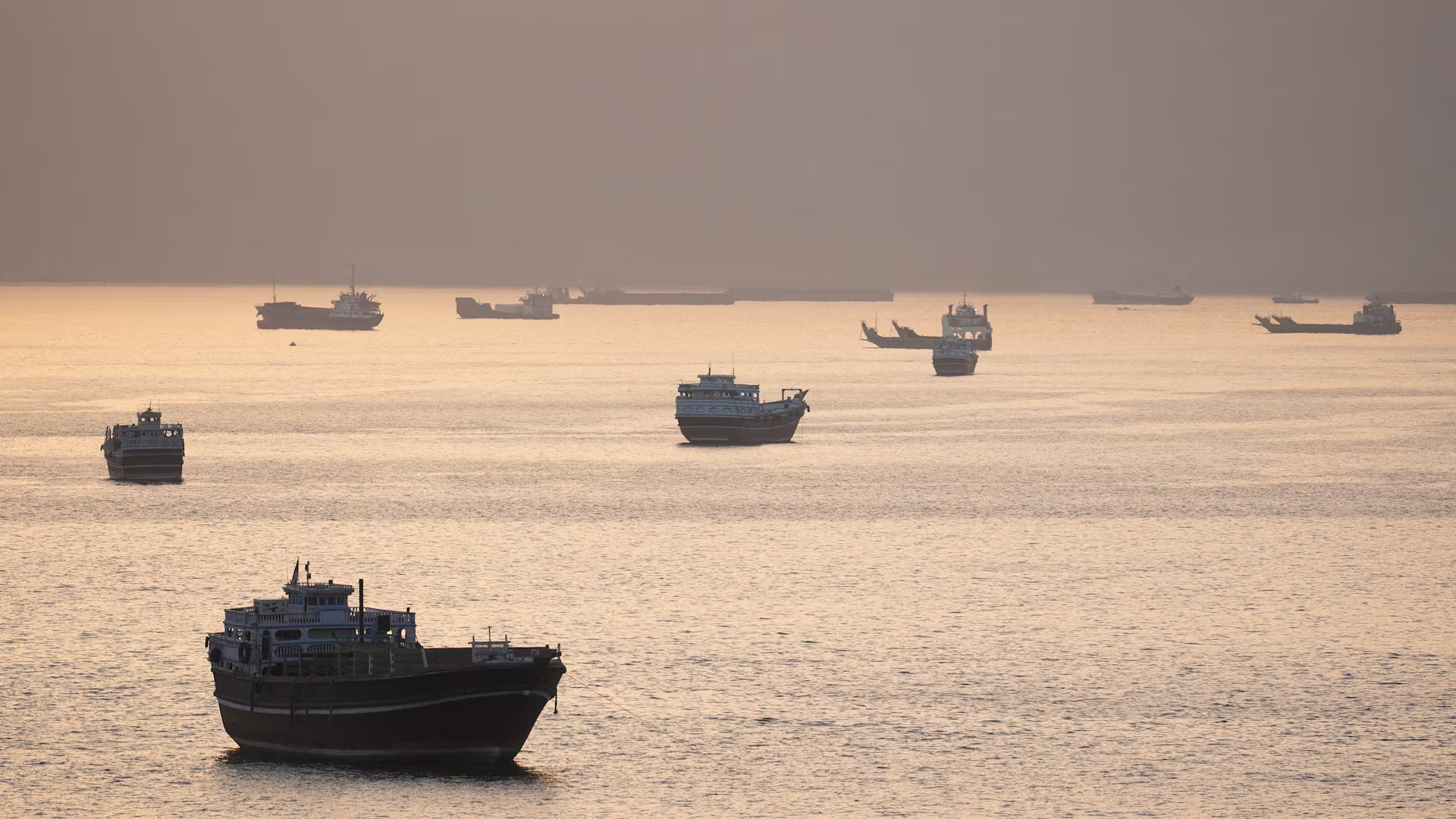
Yet despite this unrest, Pahlavi remained hopeful for a new era in Iran. That future, he argues, will depend on one channel: the Strait of Hormuz. The waterway is a powerful weapon of the Regime—critical for oil trade connecting the Persian Gulf and the Arabian Sea.
Beyond its regional scope, it serves as a vital artery of the world economy —approximately 25% of international seaborne oil trade and 19% of global liquefied natural gas (LNG) trade flows through it.
Measuring a meager 29 nautical miles wide at its narrowest point, the strait is the “world’s most important oil transit chokepoint” according to the U.S. Energy Information Administration.
Mark Nevitt, a law professor at Emory University, recounted memories traveling through the Strait of Hormuz as a junior naval officer: “I can recall being on the bridge of an aircraft carrier and looking at Iran—it’s really not far away.” This proximity makes the strait especially vulnerable to disruption by regional powers such as Iran. When so much of global trade depends on a single, narrow chokepoint, Tehran’s ability to exercise control over that passage becomes a strategic asset.
During the Pahlavi Dynasty, which ruled Iran from December 15, 1925, to February 11, 1979, Iran used the strait to encourage global trade. According to Pahlavi, “The goal for Iran before the 1979 Revolution was to be included in the global system by keeping the strait open.” This has changed since then, albeit not entirely overnight.
Over time, Tehran’s chokehold over the strait has strengthened. To Pahlavi, this reflected a shift in Iran’s strategic operation of the strait: instead of promoting free passage, Iran has shown its willingness to restrict access to the strait, exploiting the world economy’s ever growing dependence on the waterway.
After the collapse of the monarchy in 1979, the Strait of Hormuz became a critical battle ground of the new regime, the Islamic Republic of Iran as it fought to cement its position in the Gulf. The strait became a flashpoint during a phase of the Iran-Iraq War in the 1980s known as the Tanker War, which erupted after Iraq attacked Iranian tankers. “The war essentially spilled into the maritime environment,” Dr. Ian Ralby, a naval security expert, explained, marking the first time the strait had become a site of geopolitical tension.
Iraq began carrying out sporadic attacks on Iranian vessels, namely those carrying exports and military supplies. Despite lacking advanced military technology, Iran retaliated through attacks on Iraqi ships—often using ill-suited missiles designed for land targets. Although physical damage to ships was minor, Iran inflicted hundreds of thousands of casualties, disrupting passage through the strait.
While the Tanker War was predominantly a regional conflict, the United States became entangled in 1987, underscoring the strait’s transformation from a site of purely regional conflict. Iran’s attacks intensified—driven primarily by its procurement of powerful new missiles—and countries in the Gulf appealed to the U.S. to safeguard transit through the strait. Reliant to a large extent on oil from the Gulf, the U.S. obliged and began escorting vessels through the strait before Iran and Iraq agreed to a ceasefire in 1988.
Up until the U.S.-led Operation Epic Fury on February 28, 2026, the Tanker War was the only major episode to trigger American involvement in securing passage through the strait. And yet, even throughout the hostilities of the Tanker War, the strait remained open—suggesting that Iran then had little interest in complete closure despite threatening it.
A lot has changed in the strait since the Tanker War. Energy demands are growing, traffic through the strait has increased, and missile and drone technology have advanced. To Ralby, the strait is “More weaponized than it has ever been.” In fact, even at its most intense points, the Tanker War caused only a minor disruption to the strait, with a mere 25% reduction in shipping. Today, Iran possesses newfound capabilities to heavily and effectively disrupt the flow of traffic through the strait.
Iran’s military actions over recent years have shown a greater willingness to use the strait as economic leverage. This shift became clear in 2018, when, under the first Trump Administration, the U.S. left the Joint Comprehensive Plan of Action (JCPOA)—a framework designed to limit Iran’s nuclear program in return for easing sanctions—and reimposed sanctions, prompting Iran to target commercial shipping in the strait in retaliation. What emerged was “a sort of gray zone in maritime space,” Ralby explained, whereby Iran engaged in hybrid aggression, using tactics not typically associated with all-out war but hostile nevertheless.
This approach involved using inexpensive drones and mines to target ships that required far costlier countermeasures. As of April 2026—with an average of 80-130 ships passing through the strait each day—the U.S.’s ability to restore trade through naval escorts alone is impractical and fails to fully remove risk from small drones. According to Pahlavi, this has created a situation akin to a war of attrition, whereby Iran has been able to continue using mines and drones to target ships with little resistance.
“We can see the same situation with the Russia-Ukraine War. It has now been going on for four years, but they’re still firing at each other with drones because they’re so cheap to make,” Nevitt added.
For Pahlavi, Iran’s strategic advantage lies precisely in the cost asymmetry of this contest. “Iran could never conventionally rival the United States or Israel,” he said. As such, when the U.S. and Israel carried out Operation Epic Fury on February 28th, 2026, the effective closure of the strait was, according to Ralby, “entirely foreseeable.”
There are many parallels between the current tension around the strait and the 2022 Ukrainian energy crisis post-invasion, most prominently seen in supply chain disruptions. Ben McWilliams, a fellow of the Brussels Bruegel Institute working on European energy security stated, “The 2022 energy crisis and other energy shocks throughout history have consistently shown that, if you are integrated in this global energy trade, you are exposed to the global price.” He continued, “Even if you produce oil, consumers still face the global price.”
Although the two crises have affected global oil markets in similar ways, McWilliams believes the situation in Hormuz is more complicated. “Pipeline disruptions are far more damaging because entire systems are built around them,” he said. “For maritime, if you cannot get your ship from the Middle East, you get your ship from Africa or Asia or elsewhere.”
The crisis around the strait highlights an important difference between these two forms of transport: while pipelines are rigid and difficult to reroute, maritime shipping is more flexible—but still vulnerable to disruption.The greater flexibility afforded by shipping hides a key weakness: maritime trade lacks clear rules. When asked who is controlling passage of these vital shipping lanes, Nevitt admitted, “Really, no one. There’s no police force to legally secure the strait.”
Today, the structure of the global oil trade overwhelmingly favors shipping. Ralby argued, “There is a reason 90% of world trade is ship-based…you are looking at approximately 20,000 trucks for the same capacity as one ship.”
Pipelines are constrained by their fixed infrastructure. After Russia’s invasion of Ukraine in February 2022, pipeline gas flows between Russia and Europe gradually decreased, as the Kremlin cut gas supplies while European states moved to find more secure suppliers and reduce their dependence on Russia.
The international community adjusted away from Russian pipeline gas and towards LNG—half of which was supplied by the U.S. in 2023. As such, European leaders assumed that ships would be a more secure form of transportation than pipelines and would be impervious to further disruptions.
This has proved to be wrong.
“The reason Europe is still affected by disruptions to the strait,” McWilliams argued, “…is that now these Asian countries, which are no longer able to get energy cargos through the strait, are bidding up the price for energy cargos from the U.S., which would have previously gone to Europe.”
Furthermore, current tensions in the Middle East have illustrated that shipping, too, relies on extensive infrastructure that can be targeted, making the two crises more alike than meets the eye. Nevitt remarked, “It’s the oil and natural gas infrastructure around Hormuz that is really critical.” Iran has targeted energy infrastructure built around the strait—striking oil refineries and LNG facilities, including Qatar’s Ras Laffan Industrial City, which supplies 20% of the world’s LNG. Meanwhile, in March 2026, the U.S. and Israel threatened to seize Kharg Island, which processes the vast majority of Iranian ship-based oil exports.
Attacks targeting energy infrastructure have had reverberating effects and mirror the asymmetric attacks Iran has carried out on tankers through the strait. “One Iranian ballistic missile to a natural gas field and it takes five years to get back online…You can’t just switch them on and off,” McWilliams observed. This asymmetry, according to Pahlavi, “…could provoke Europe to start buying [oil] from places they wouldn’t usually buy from.”
Interestingly, one of the primary ways Gulf states have sought to bypass transit through the strait, and by extension ship-based oil trade, has been through the construction of pipelines, which have themselves been targeted by Iran and Iran-backed rebel groups.
Following the Tanker War of the Iran-Iraq War in the 1980s, Saudi Arabia began building the East-West pipeline due to fears over reduced transit through the strait. This might have solved the problem of dependence on Hormuz; however, solving one problem only created another. In fact, on April 8th, 2026, the Iranians struck the pipeline with drones, forcing a temporary closure. The attack followed previous strikes on Saudi pipelines launched by Iran-backed Houthi rebels.
Although Iran has claimed it would not attack its neighbors unless provoked, it has not acted accordingly. “Iran sometimes has good relations with Gulf states, but oftentimes not,” observed Pahlavi. There is no guarantee that any energy infrastructure surrounding the strait is safe.
Like Europe’s shift from pipeline to shipping after 2022 and the Gulf’s desire to shift from maritime to pipeline transport, either solution carries unique tradeoffs and risks. Qatar, one of Europe’s major exporters of LNG, halted production in March due to infrastructure attacks. Meanwhile, Saudi Arabia’s East-West pipeline—built as a direct result of threats to the strait—was struck on April 8, 2026.
With oil demand set to keep growing, the strait’s colossal importance is unlikely to disappear any time soon, and efforts to bypass it—such as pipelines—simply shift vulnerability, rather than eliminate it. For the time being, the strait will remain the waterway holding the world hostage.