

“It’s time for people to grow a spine,” says Ayaan Moledina, a junior in high school from Austin, Texas. “I think America has the potential to be the best country to live in, in the world. We’re not there yet. And I don’t think there are people working hard enough to get there.”
Moledina is currently the Federal Policy Director of Students Engaged in Advancing Texas, or SEAT. His passion for advocacy and political representation began during the pandemic, when public trust in leadership fractured. “I started to get involved because I knew that new voices were needed,” he explains. “Our stories and our experiences were not being represented in the conversations that affected us.”
Moledina felt the absence of political representation long before he knew to name it. “I didn’t see any South Asian people in those efforts or in those conversations,” he recalls. But representation, for Moledina, is about more than just optics—it is about intent. “It’s about going back to what the Founding Fathers envisioned, which is a country led by the people, for the people.”
During his time with SEAT, Moledina hosted youth suicide prevention round tables at the White House and, earlier this year, introduced three pieces of legislation in Congress about youth mental health. However, he has found that genuine representation often clashed with the performative culture of politics. “It’s rare to have a lawmaker who actually cares to sit down and have a conversation about my life without an agenda,” he says. “That’s what’s missing.”
While Moledina approached this issue through policy work and advocacy, Django Buenz took a different route. Buenz is a third-year undergraduate at Hofstra University majoring in political science. Since 2020, she has amassed 59,000 followers on TikTok and 22,000 followers on Instagram. Her platform is less about political allegiance and more about transparency. She explains, “I grew up in blue, blue Brooklyn. My mom has a poster of Obama in our living room. But once I learned that Democrats were also committing war crimes, I realized that the problem isn’t just one party. It’s the system itself.”
Once she started posting on TikTok, she was shocked at the popularity of her content. “I would have never guessed that I would’ve gotten that many followers,” she says, “but once I realized people were actually listening, I thought, ‘shit, I can do something with this.’” Her platform’s rise captures something deeper: Americans are hungry for honest representation in a system that rewards performance.
Nowhere is this clearer than in the success of New York City mayor-elect Zohran Mamdani. “Watching the mayoral debates felt like watching the failures of the old Democratic party next to what could be its future,” says Buenz. Mamdani’s influence has spread far beyond New York, with people across the country rallying behind him. Part of Mamdani’s appeal is his relatability: he is a proud immigrant who met his wife on Hinge and still rides the subway. His campaign serves as a case study in what it looks like for a modern Democrat to have an energized and excited voter base. But why? Is Mamdani just a special candidate, or is there a larger lesson for American politicians—Republican and Democrat alike—to learn?
For political strategist Kellan White, who has advised campaigns for Vice President Harris and Senator Bob Casey, among others, Mamdani’s success is both hopeful and cautionary. “My fear is that Democrats will learn the wrong lesson from this and try to find the next Obama, the next Mamdani. There isn’t one,” he says. “What we need is to find more authentic people to run who aren’t just politicians, who support policies that people actually understand and care about.”
There is a fine line between performative representation and authentic representation. For White, this is simple. “If you have to say it out loud, it’s going to backfire. Simple,” he says. This is what makes politicians like Mamdani and Obama so successful. They do not have to say the quiet part out loud. Their empathy is clear, and that resonates with voters. “That is the authenticity that helps us win campaigns, and it’s broadly missing on a national level,” says White. In his years of work across a wide range of campaigns, White suggests that voters value one thing above all: consistency. “It matters when you’re the same person in every room you go in.”
White points to a now-famous 1992 presidential debate between Bill Clinton, George H.W. Bush, and Ross Perot. During the debate, a woman asked the candidates how the economy directly affects them. Bush responded with policy. But it was Clinton’s response that stuck with the audience. Clinton told the woman he personally knows the people who lost jobs in her town, repeated her name, said “I feel your pain,” and sat down. “He does not mention any policy, but that woman certainly voted for Bill Clinton and probably volunteered on his campaign,” says White. It shows that, “at the end of the day, your ability to connect with people and your empathy is what matters most.”
Emma Bittner, the media manager at an advocacy nonprofit, goes a step further. Like Moledina, Bittner is from Austin and interacts regularly with local officials. In her line of work, she has found that. “Contacting officials feels inaccessible. I know I can do it because I’ve had to for work. But before that, I didn’t know I could just Google a phone number or an email and they would have to respond. I didn’t know you could just go to the Capitol because it’s a public space. It’s a conversation that’s not had enough.” For Bittner, the disconnect is not just emotional, but structural.
Krystal Milam, a former Capitol Hill staffer, adds that access used to be the heart of politics. “During his campaign, President Obama was literally going and sitting at people’s kitchen tables, eating sweet potato pie,” she recalls. “People felt they could reach him, and it gave him a better way to understand his voters. It’s a lost art.”

Photo credits to Reuters
This strategy of proximity—of politicians showing up and listening—is what makes politicians like Obama or Mamdani successful. This approach is what energizes voter bases and drives voter turnout—Trump’s decisive victory over Harris in 2024 starkly highlighted this longstanding issue within the Democratic Party.
The relationship between political representation and voter turnout becomes even more crucial in cities like Detroit, Milwaukee, and Philadelphia—cities with large minority populations in swing states that often experience low voter turnout. “These cities have low turnout because their minority communities have been neglected for generations,” says White. “You can’t just show up tomorrow and tell people to go vote, because they’re not wired that way.” Furthermore, White believes that “if you can solve the voter turnout problem in one city, you can solve it anywhere.”
As a campaign strategist in Pennsylvania, White is constantly focusing on voter turnout. “When Wilson Goode was the mayor of Philadelphia, voter turnout was roughly 83% when he won. But now, when Cheryl Parker won, it was only 38%. So we have to figure out how to get that up,” says White. “Once you get to federal elections, you’re going from 38% to roughly 65%, and that’s a steep hill to climb. But if you can get turnout in these off-years to 60% or even 70%, then all of a sudden Pennsylvania’s not a swing-state [right] anymore.”
Milam agrees. “We have to figure out how to win these states back. Ohio used to be a swing state, but it doesn’t swing [left] anymore. It boils down to leadership decisions by the Democrats,” she says. “We have people like Sherrod Brown losing their seats after holding them for 30 years. And voters are mad at the Democratic party,” says Milam. As for the Democrats, Milam believes that a large part of their failure in recent years is that, “Democrats don’t invest in the pipeline of the next generation the same way that Republicans do.”
The apparent lack of interest from the Democratic party has made young people feel a lack of representation. According to Moledina, “Young people are disengaging from politics. It’s understandable, because why would you want to engage with a system that doesn’t seem to care about you?” Moledina’s brother is one of them. “My brother didn’t vote in the 2024 election. He hates Trump, but he also felt like Kamala Harris didn’t care about him. And I know she cares, I’ve spoken with her. But it doesn’t come across,” he says.
Whether through visible representation or authenticity, politicians are constantly trying to cater to a broad range of voters. Specifically, the Democratic Party has tried to position itself as an ally to underrepresented and marginalized groups through identity politics, but as made clear by the 2024 election, this strategy is failing.
“The issue with identity politics is that the Democratic Party is trying to reach out to all these different groups and saying it supports them, but we still don’t see those groups rallying behind Democrats,” says Moledina. The reason is simple: follow the money. “Specifically for the Texas Democratic Party, do they put any funds into the communities they claim to support? Zilch, nada, nothing. And it’s the same on the national level.”
Yet interestingly, this strategy works for Republicans. As a successful businessman, there is a glaring distance between Trump and the average American. Despite this, he has mastered the art of relatability. According to The Guardian, Koch-backed, right-leaning Libre Initiative targeted Latino voters in swing-state North Carolina by offering grocery shoppers the cash that Democrats allegedly “stole” from them. The strategy was unorthodox—but effective. An Associated Press poll found that Trump received roughly 43% of the Latino vote nationwide, breaking the Republican record of 15% set by Bush. Republicans positioned themselves as the party that showed up for voters, and it paid off.
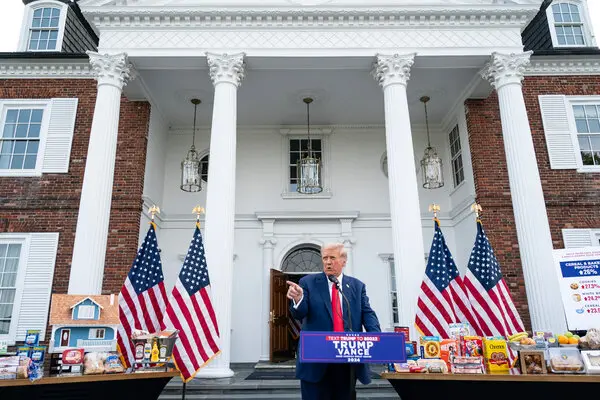
Photo credits to The New York Times
Trump’s own messaging works the same way. Trump’s tweets exemplify his strategy of connecting with the populace. On October 27, 2016, Trump tweeted, “To All Americans, I see you & I hear you. I am your voice.” On January 20, 2025, he tweeted, “AMERICA IS BACK. Every single day I will be fighting for you with every breath in my body…This will truly be the golden age of America.” That plain-spoken style extends beyond his tweets, into speeches at rallies and inaugural addresses, reinforcing a sense of mutual recognition and belonging among voters who feel alienated from political elites. This is the same strategy that Clinton used in that 1992 presidential debate. It is accessible, and it resonates with voters.
Authenticity obviously matters. But politicians also seem to misunderstand the importance of everyday affordability. As White explains, “the problem is that you have the economy as an academic term—which by every measure is doing well. Then you have what people feel. When they go to the barbershop, their dollar isn’t going as far as it used to.” Usually, the spokespeople that Democrats use to discuss come from elite backgrounds, explaining the economy in abstract, academic, and macroeconomic terms. They miss how money shapes everyday life: the cost of groceries, rent, childcare, and gas. When politicians speak in numbers rather than lived realities, the disconnect between them and their constituents only deepens. “Until we can close that gap and talk like real people, we’re in trouble.”
For many Americans, a sense of futility has become a defining feature of civic life. For many, it feels as though the system is working against them, further discouraging political involvement at every level—from simply voting to running for office. This is reflected in the frustrations of people like Moledina’s brother, who chose to disengage because of the apparent lack of engagement and care. His experiences reflect a much larger representation issue at hand in American politics. If the odds are stacked against representation at every level, it is only natural for people to withdraw.
Milam fears that “our current democratic systems can’t hold up like this.” Moledina is more optimistic. For him, America is not broken—it is simply unfinished. The challenge, then, is closing the gap between representation and reality. Authenticity creates politicians who genuinely care about representing the people who vote for them, leading to a political environment where voters want to be involved. “If America ever reaches its potential,” he says, “it’ll be because people at every level decide to care again.”