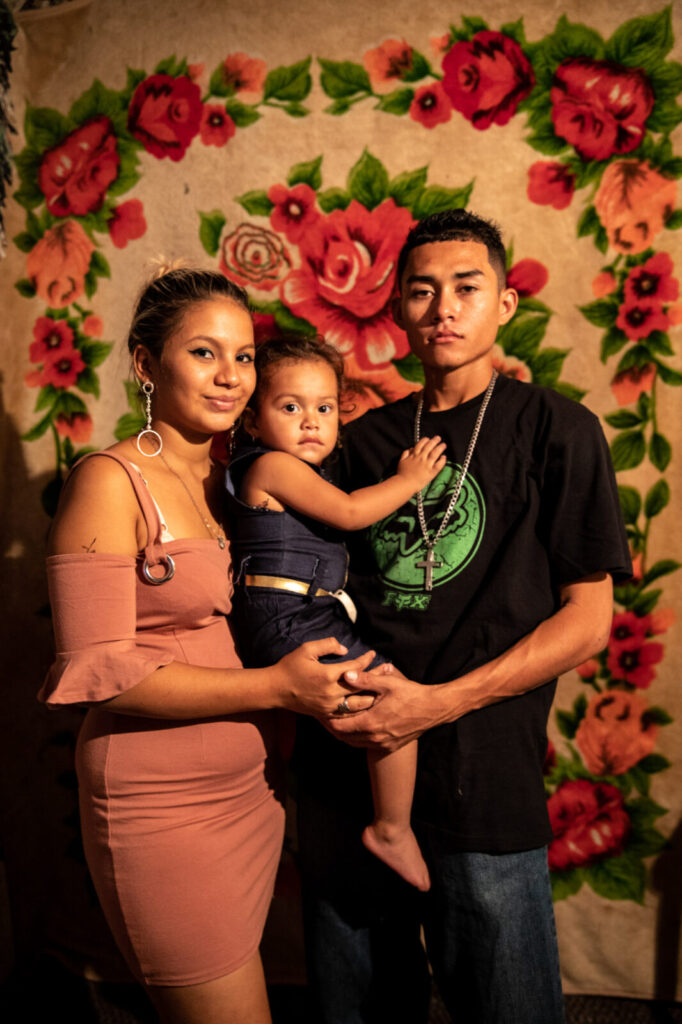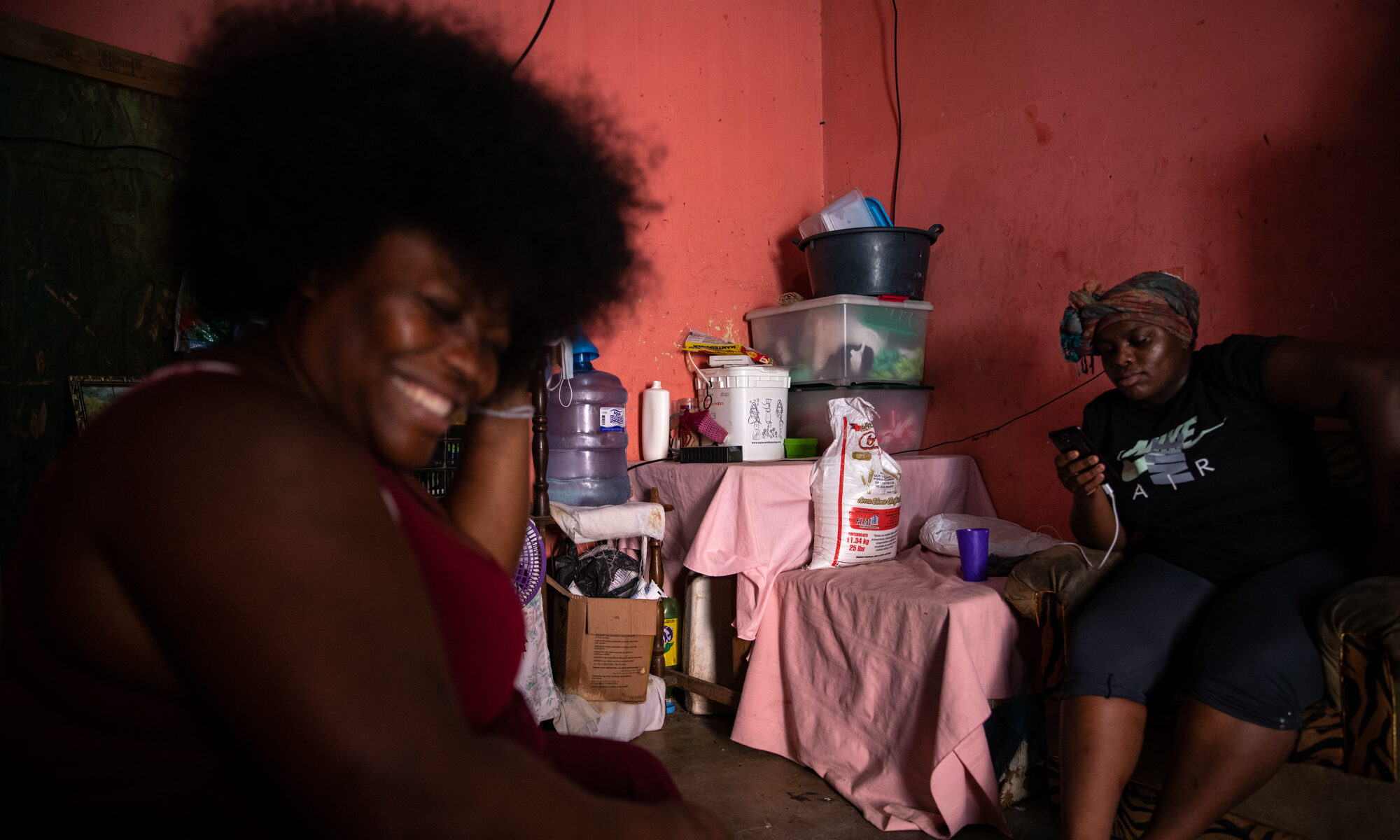
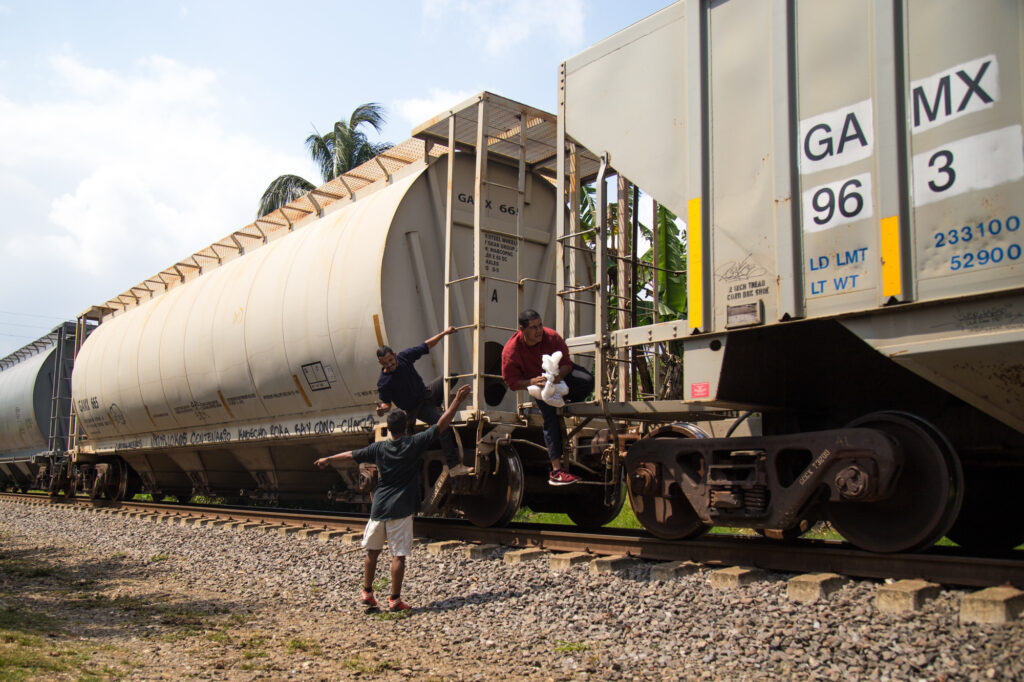
Tomas Ayuso’s images are jarring distillations of humanity. His pictures are reflections of intense violence, depicting machine guns, police, and bullet wound scars. Yet his photos also contain something unexpected: joy. A couple looking at memes together on the way to the US-Mexico border, a family laughing together as they eat, a little girl dancing with glee. The Honduran documentary photojournalist presents a fundamentally human portrayal of forced displacement and conflict in relation to the drug war in Latin America, one that reshapes the narrative of migration. Ayuso’s work has been featured in National Geographic, The New Yorker, The New York Times, and The Washington Post, among other publications. Currently, Ayuso is collecting Honduran stories for publication as part of a project called “The Right to Grow Old,” and continuing to report on the Palestinian diaspora in Latin America.
This interview has been edited lightly for clarity. All photos are courtesy of Tomas Ayuso.
When and why did you first decide to pick up the camera? What are some of the stories and photos that have stuck with you the most during your time reporting on forced displacement in Latin America?
Photojournalism was never the plan. I never considered myself a photographer, other than taking little flicks here and there with my phone. My plan was to work for something like the UN regarding conflict resolution, but I had to more or less abandon that dream and go back to Honduras. When I went back home, there was nothing I could do with the degree that I had, and I didn’t want to work in government, because the government is incredibly corrupt.
So, I was overeducated, and there wasn’t much that I could do. But I was driven to do something with what I had learned. So a friend of mine told me at some point, “Why don’t you just do the typical policy and white paper reports that you would have done for the UN, but make it more friendly for the general public?” I said to myself, “Why not?” So I started doing that, and I found that I was fortunate enough to gain the good graces of people who often are reluctant to be photographed. Ultimately, the reason why I made the decision to go from writing policy to being a journalist was that I did not like how Western media would depict Honduras in the crudest, most reductionist, and frankly racist terms. So I thought there needed to be a Honduran voice for the people.
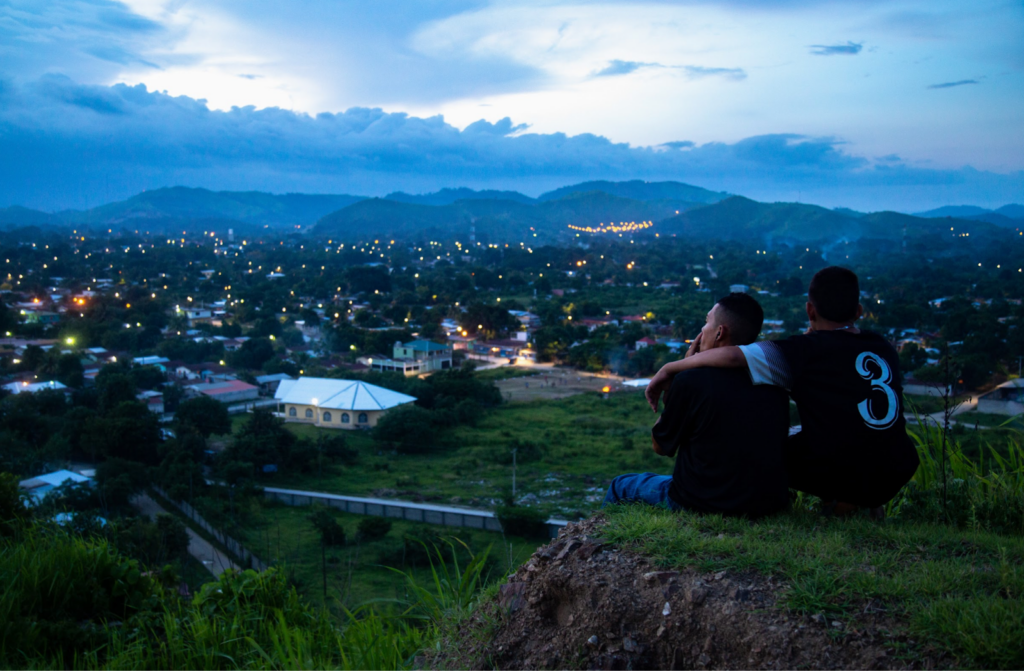
There’s a picture of two boys sitting on a hill. They’re both looking toward an informal neighborhood in San Pedro Sula. That picture really represents what Latin America is about for me. The color, for example, feels very ethereal, the lights barely look like street lights––they look more like a starscape fell on land. The line between reality and the surreal is barely there, and that relates to magical realism—the endless hope that comes with being Latin American. Everything’s rotting away, there’s corruption and there’s moral decay––but there is an unyielding hope that guides everything, which is what the picture reflects because the boys in that photo are being forced into displacement by armed groups. And they were sad, they were scared, they were everything. And as they were looking into the last scattered rays of sun after the sunset on the horizon, they were accepting their fate. They were saying, “I guess I’ll leave, but I will leave on my own terms, because I reject this society and the life that has been extended to me on account of being born where I was born.” And I’m happy to say that both of those boys are doing so well.
Walk me through how you took that picture. How do you capture photos while in the middle of an active conflict?
Ultimately, my method involves how I’m able to get close to the people, not only physically, but socially as well. Before I even took any pictures of the boys, I had spent a few days in that neighborhood living with them—no camera was taken out. I believe that if you’re going to share your story with me, you should know who I am, and you should trust me. I can’t pretend. I cannot write anything about these people if I don’t feel that they know that.
After two days, we all trusted each other and grew to become friends. One of the boys caught wind of the threat [of gang recruitment], so we went up to that hill, which was the only other safe space in the neighborhood besides their home, and in the middle of the exasperation of asking, “What do we do?”, we all sat down under the ledge where they are in the picture. I could feel the light changing. It was during hurricane season, so it had just rained, and there was a lot of blue. It was twilight hour, and it was very clear. I realized, damn, people should feel what I’m feeling right now. So I stood up, took five or four paces back and took that one picture all with the purpose of, “I want to convey exactly what is being felt right now.”
A photography mentor once told me that the difference between a writer and a photographer is that when it comes to documenting conflict, a writer can work from the hotel room, interviewing people here and there, and they can get close, very close, to a story. But a photographer has to be there. That’s the whole point of photography—to reduce the buffer between the viewer and the event itself. You have to be smart and not put yourself in unnecessary risk, but you also have to accept that in choosing to cover these kinetic moments, you could be hurt or worse. There has to be a degree of acceptance and caution. This is something I learned later, but some people never learn whether or not a picture is worth it.
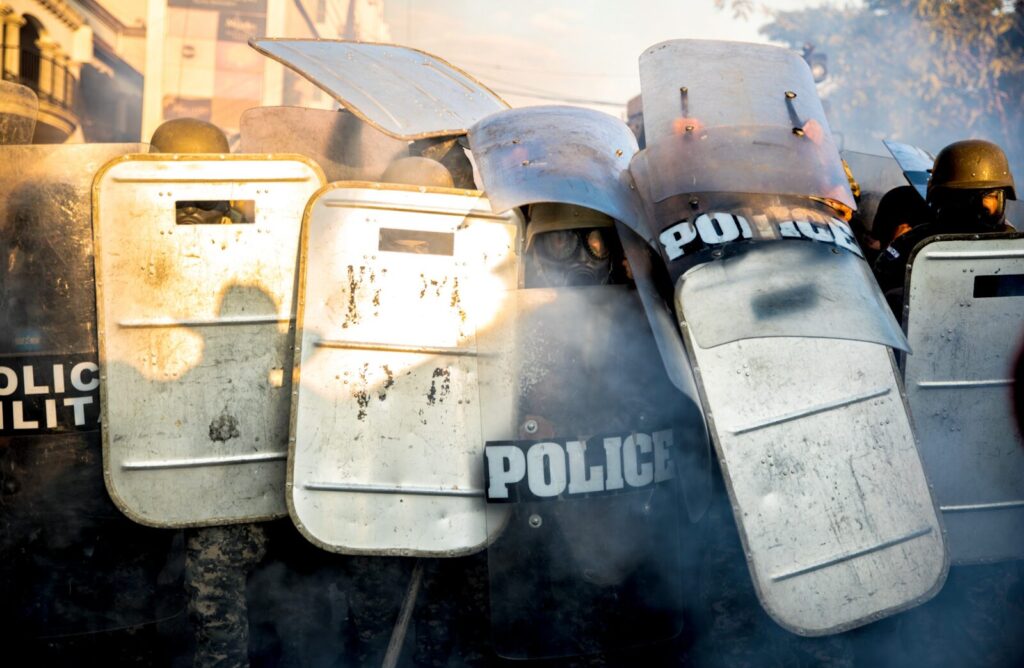
[For example,] the picture I took with the police officers and the shields was a moment in which Honduran democracy was being supplanted by an anti-democratic force. It was the first interruption of democracy in Honduras in decades. It was also important to capture that it was a move done in collusion with America, because the shields used by the police had been donated by the Obama administration. But other times, it’s just not worth it at all to be photographing some moment of violence, so there is a certain calculus that is done.
Your photos depict more than simply violence and despair. Can you discuss balancing capturing both the brutality of conflict and surprising moments of joy? What is it like showing these contrasting elements?
Latin America has so many different issues––extreme inequality, poverty, disease, war, conflict, or insecurity––it’s hard to live. Nothing is easy, everything is a challenge, everyone is mad, and there is just no light at the end of the tunnel. And, for whatever reason, those situations produce an excellent sense of humor. You just have to make light of how bad things are. Otherwise, you’ll lose your mind.
All over Latin America, people find ways to make light and laugh. Even though they don’t have a lot of food, they pull food together and share and enjoy it. Sometimes they don’t even make light of how bad the situation is; they just enjoy themselves, because what is the alternative? It’s to live permanently in misery, and they have plenty of that. So why not make the best of it?
Some people are shocked when I show them moments of joy of people who are in the process of being displaced. It’s like they can’t understand it—that joy is possible in that moment. Really, I think the opposite is more difficult to understand: the belief that people are incapable of finding time to smile, even when they are surrounded by misery. I believe that if you’re going to show how people live in these extreme circumstances, you can’t just show the misery or the sadness or whatever is making it bad.
For instance, like the picture of the two boys looking from the hill and facing gang recruitment, there were times in which his mom would make tortillas and beans, and recall moments in which he did something embarrassing when he was in first grade, and we all laughed. Or, I remember this girl brought her boyfriend to the house to meet the parents for the first time. These are moments of tenderness that everyone understands. So I don’t think I’d be doing my job if I just showed everyone being sad, because it’s not the truth. Even when you are in places where there is conflict and people live their lives in a limited way due to their circumstances, it’s important to remember that they’re still people. They still enjoy the whole spectrum of their emotional range.

Your work deals a lot with how people maintain their cultures in the face of forced displacement, particularly with the Palestinian diaspora in Latin America—how do you approach capturing that drive to hold on to a cultural identity?
The Palestinian diaspora is unique in more ways than this conversation could cover. My work follows several waves of Palestinian displacement: starting with those who left in the 1900s for Chile, those who fled after the Nakba and settled in Honduras from Bethlehem, and those who migrated in the 1960s and ‘70s to Brazil. Mostly, it was a large number of people from Hebron who relocated to Brazil.
So I’m focusing on those communities that have been living there for two to three generations. You know, being Muslim, speaking Arabic, having a different culture in a country with an overwhelming Christian majority, they decided to build different cultural centers, mosques, and schools. Now, they have built a replica of the Al Aqsa dome in the middle of Manaus, which is insane, because it’s in the middle of the Amazon. The whole purpose [of this work] is to show the presence of Palestinian people, because no one thinks about Palestinians in Latin America, but it is quite a large diaspora.
What do you think is something that is fundamentally misunderstood about migration? Where does the media fail in its coverage?
With migration and displacement, very few people do it because they want to do it. They do it because they’ve been left with no choice, and they want to live. They don’t want to abandon their parents; they don’t want their children to starve. Every person who was displaced has dreams, aspirations, and yearning. And oftentimes, when people talk about migration and the border, that’s just lost.
I don’t like to say that the media portrays them in a way that doesn’t humanize them, because by what right can the media strip them of their humanity, their peoplehood? But their uniqueness and individuality, and stories are lost, and they’re spoken about in bulk, and it doesn’t serve the public interest. They are shown as numbers. It’s hard to understand a number; you just don’t see them for what they are. If their state of hardship isn’t explained or shown, then it’s easier to just see these people as a problem that needs to be dealt with. That is a slippery slope that leads us to where we are today.
American and European media don’t really show how much suffering drugs incur. Sometimes drugs are shown as glamorous or without any consequences. In the 90s, for example, if you got a diamond from Liberia or Cote d’Ivoire, it was clear you were financing warlords. But drugs aren’t described that way. I understand that in the U.S., for example, drugs are talked about along with health issues, but that ignores all of the people who need to die in Latin America before that one person overdoses. The drug war results in bloodshed before it even gets to the people doing drugs.
How do you continue to work in the face of constant trauma and violence? Does it ever become too difficult, and if so, what keeps you going in those moments?
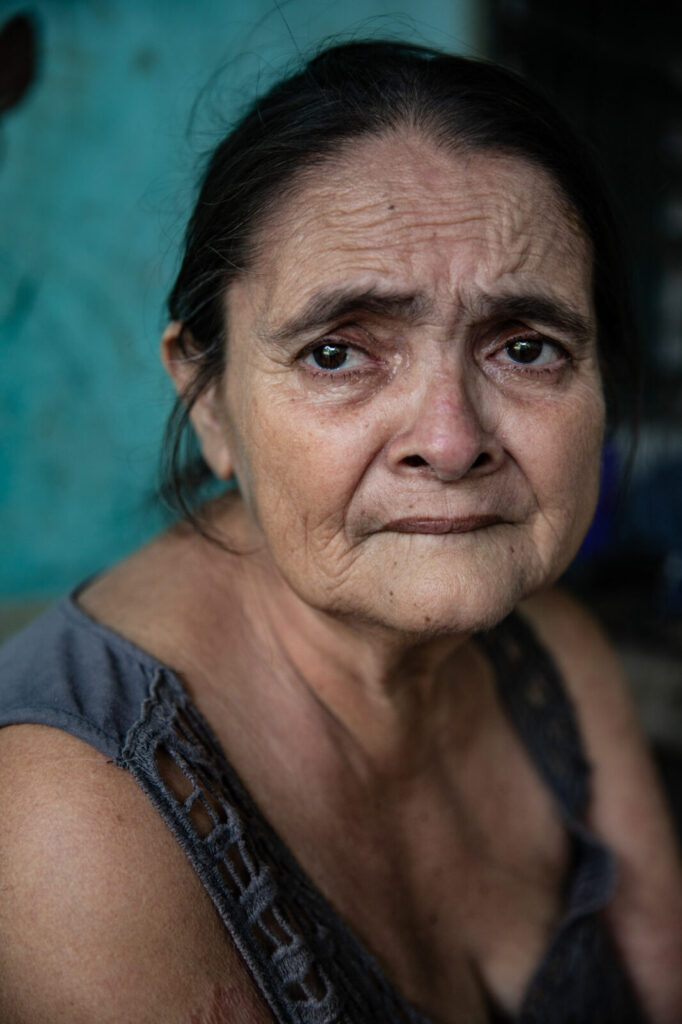
I firmly believe that the way things are in Honduras currently is unacceptable. A society that tolerates children who are starving to death and being brutally murdered has failed. It’s this abhorrence of injustice that I have that motivates me the most. I know I’m just one person, but if one person’s life can be improved as a result of the reporting I do, then that is a good thing. What I bet on is that this has a multiplying effect.
For example, I was posting stories about this single father who was making it to the U.S.-Mexico border to escape because his and his daughter’s lives were threatened. I followed this young father for several months and posted about him every so often on Instagram. I have fairly dedicated hecklers who would email or comment the most hateful nonsense. I’m not affected by it, but it really shows the depth of misinformed misanthropes that exist out there. I kept posting him, and there was one guy who kept commenting reductive things like, “He wants a handout,” or “He’s another parasite in the system.” I just ignored it and kept posting about the man––how he would play with his daughter, how he would do everything he could to get her food, how he would never let her sleep in any place that would be undignified for her, and so on. Then, I noticed that the heckler started liking the posts instead of hating on them. Then, one day, he messaged me and told me that he had to apologize––he had been wrong. Due to experiences in the past, he had become very hateful of immigrants of all kinds until he saw this story, and he realized that this was just a father who was looking after his daughter.
When he saw that, it all clicked with him, and he felt this horrible remorse and guilt. He apologized to me for being a racist, and he said that he will no longer do this, and I could tell that it was a big paradigm and spiritual shift for him, which was heartening. That’s why I keep doing it—because things like that happen, and comments like that have happened fairly frequently, both regarding Palestine and Latin America as a whole. So it is very gratifying, because most journalists don’t ever see the outcome of their reporting firsthand.

Today, what makes you pick up the camera?
I feel despair and rage all the time. It’s my fuel to fight against it. I know people who are being directly affected, and it’s infuriating, it’s maddening, but that’s why I do it. Why do I get close to the charging police officers to take the picture? Because it’s important to take that picture. Why do I do the work right now, especially at a time of crisis and tumult in the United States? Because it’s important to do it now. I know what happens to people, vulnerable people, when they’re deported. I know what happens when people are persecuted and show back up in the places they were fleeing from. I know what happens in some of these detention centers. The U.S. is just eating itself alive. And so many people, the people who are the most vulnerable, who have zero advocates, who have zero power, the people who are at the bottom of society, the undocumented, the people in the process of achieving asylum, are suffering. And journalism works in the service of justice, of the truth, and the truth is always going to be the truth, no matter if it’s good or bad or who says it. That’s what motivates me to keep going, the truth just has to be told.