
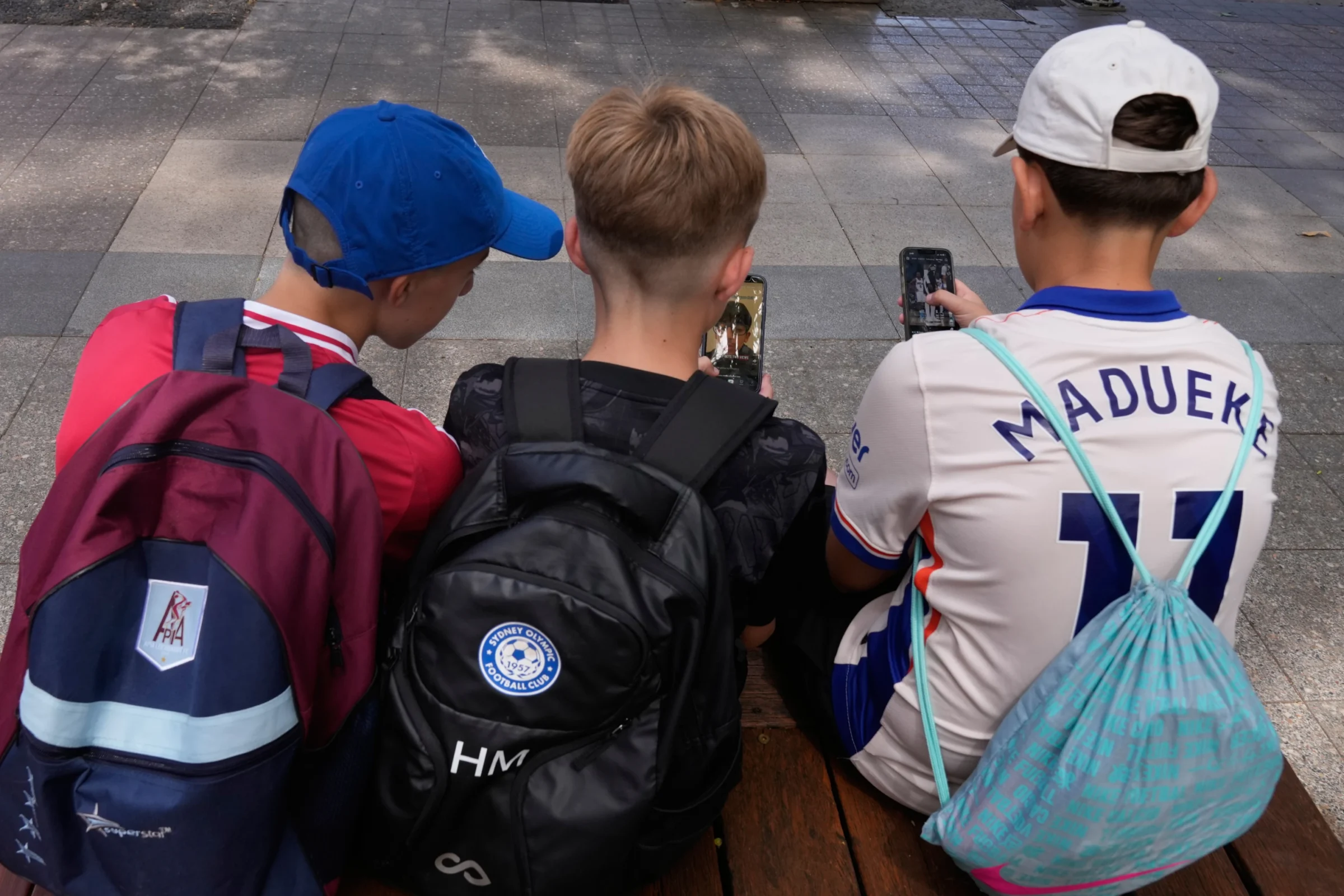
Photo: Hugo Winwood-Smith, right, Hardy Macpherson and Edan Abou, left, all 11-years-old, use their phones while sitting outside a school in Sydney, Monday, Dec.8, 2025. Rick Rycroft / AP Photo
On December 10th, 2025, Australia became the first country to implement a nationwide social media ban. At midnight, the Social Media Minimum Age Act came into effect, deactivating millions of accounts belonging to anyone under the age of 16. Zoe, a teenager from Brisbane, described the chaos that ensued the day the ban was passed: “We’d all heard about it, but nobody thought it was going to happen,” she said. “Everyone was shocked.”
The ban, which targets major platforms like Instagram, TikTok, Snapchat, and X, triggered the deactivation of an estimated 4.7 million accounts in its first few days. Many teenagers awoke to find themselves locked out of apps that were central to their social lives.
Lauren Ball, a parent and Professor of Community Health and Wellbeing at the University of Queensland, described the moment to The Politic. “[My daughter] was kicked off Snapchat immediately and was really upset,” Ball said. Her daughter had lost contact with friends she communicated with exclusively on the platform. “She panicked.”
As the first nation to implement such a sweeping, age-based restriction, Australia has become a global test case for digital paternalism. Understanding why Australia led the world on this issue—and why the policy might actually succeed—requires a closer look at the unique DNA of Australian culture and democracy.
Paternalism in Australia: a Misconception?
To an outside observer, a broad ban on social media might look like government overreach—individual freedom curtailed under the guise of protection. In Australia, however, the move was met with a 77% approval rating.
Steve Georgakis, a Professor at the University of Sydney, pointed to Australia’s colonial history to explain this overwhelming support. In 1788, Britain established its first settlement in Sydney as a penal colony. Over the following decades, more than 160,000 British convicts were transported to Australia. Even as free settlers arrived and the colonies later became an independent nation in 1901, British colonial influence endured. “For many Australians, following the British Empire is about following rules and regulations—it’s a central part of our society,” said Georgakis.
Professor Ball agreed that Australia’s British roots could help explain the unprecedented policy. She described an ingrained sense of “Englishness”—a cultural inclination toward social cohesion and rule-following—and argued that Australians often embrace the idea of “collectivism as a pathway to individualism.”
Unlike the libertarian bent of U.S. political debates, Australians are more inclined to view government intervention as a tool for the collective good. A 2025 poll found that 85% of Australians support government provision of social services such as healthcare and education. This ethos was most visible during the COVID-19 pandemic, a period Ball cites as a defining example of Australian compliance. Despite implementing some of the strictest lockdowns in the democratic world, including prolonged stay-at-home orders and internal border closures, Australia still boasted high compliance rates.
Australia’s collectivist ethos is also reflected in its political norms. Mandatory voting laws have produced exceptionally high participation rates, with turnout around 92%. Timothy Koskie, a Post-Doctoral Research Associate at the University of Sydney, argued that this produces a level of democratic legitimacy rarely seen elsewhere. Since every citizen is required to vote or otherwise pay a fine, lawmakers have a precise read on public opinion.
At the time the social media ban was implemented, public support for the measure was quite high. If the government had failed to address youth social media addiction, Koskie explained, “then they would have [upset] about 77% of people. There was a big push from the bottom up.” Consequently, what may first appear as dogmatic legislation seems closer to a grassroots mandate born from strong national consensus.
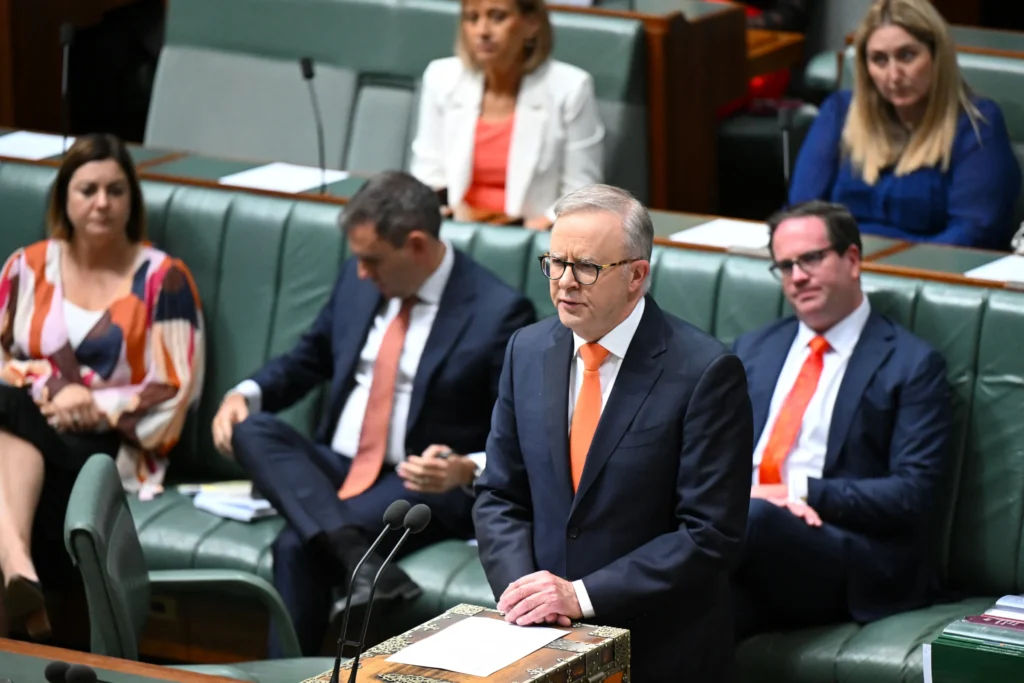
Photo: Australian Parliament, Lukas Coch / AAP Image via REUTERS
The Scientific and Moral Case
The ban also arose in response to an escalating mental health crisis among Australian youth. Koskie told The Politic that the 2024 parliamentary inquiry on social media received over 200 submissions. Many of those submissions, Koskie said, contained painful accounts from parents whose children had died by suicide, driven by cyberbullying and eating disorders.
The anecdotal evidence is largely supported by emerging longitudinal data. Dr. Bader Chaarani, a neuroscientist at the University of Vermont, is involved in the Adolescent Brain Cognitive Development (ABCD) Study, which is tracking mental health outcomes for 12,000 children over 10 years. “We’re seeing that social media use from ages nine to 18 is causing higher depression symptoms,” Chaarani told The Politic. While he noted that moderate use—less than an hour—shows little harm, the majority of teens are logged in for two hours or more per day, falling victim to the platforms’ addictive design.
The danger of social media seems to lie in its addictive architecture. Stefan Harrer, an AI expert and global head of data and computational science at Sanofi, argued this is one of the most “sinister” aspects of modern technology.
“Kids are on the phone at 2 a.m. because there’s texting going on or [they] have to be on a posting streak. These addictive elements are deliberately built into many social media applications, and that is despicable,” said Harrer. Capturing attention drives engagement and profits, putting Big Tech’s bottom line at odds with the well-being of its youngest users.
Professor Ball told The Politic that algorithms often create feedback loops that show users increasingly extreme content based on their interests and engagement patterns. “For a young person, if they see extreme things online and it’s at odds with their day-to-day life, it brings a sense of normality. Whether it’s body shape, drug use, sexual in nature, or violence, it gives a sense that this is normal. That’s the issue—that’s why we have poor mental health outcomes,” said Ball.
Potential Pitfalls
Critics of the social media ban argue that the policy creates a new set of legal and ethical problems. “The key constitutional issue in Australia is that the country does not have a Bill of Rights, but there is an implied freedom of political communication,” said Terry Flew, Professor of Digital Communication and Culture at the University of Sydney. “Legal questions will arise regarding whether this implied freedom extends to social media use, particularly for those under 16.” This concern has materialized through the Digital Freedom Project, a youth-led group supported by libertarian MP John Ruddick that is preparing to challenge the government in the Australian High Court.
Privacy advocates have also raised concerns about the bill, given that it requires social media companies to gather data on users to verify their age. “To address these issues, the Australian Privacy Commissioner has been asked to collaborate with the Office of the E-Safety Commissioner,” Flew told The Politic.
At the heart of the debate is a practical concern: can the ban actually be enforced? The law puts the onus on Big Tech platforms, which face fines of up to $32 million for failing to take “reasonable steps” to verify ages. But accurate age verification has proven difficult; many teenagers simply changed their birthdays in settings or used VPNs to appear as though they were logged in from the U.S. or Europe.
In an effort to enforce the social media ban, some platforms have turned to facial recognition software. However, its accuracy has proven limited. “Some of the age verification technologies rely on physical characteristics that are not ubiquitous among 13, 14, and 15-year-olds. There are [teenagers] that can appear to be much older,” Koskie explained. Professor Ball was disappointed to see that on Instagram, her daughter was simply met with a pop-up asking if she was over 16. She clicked “OK” and kept scrolling.
Such inconsistent enforcement has divided peer groups between those whose accounts were deleted and those who successfully found ways to keep their profiles. “[My daughter] was disappointed because she was looking forward to her friends collectively finding new ways to connect together and hang out without their phones. About half of her friends were kicked off some platforms, and half of them weren’t kicked off,” Ball explained.
A Cultural Shift
Despite these technical shortcomings, many parents see the law as a vital step forward. The ban has shifted the burden of accountability away from households and onto the platforms themselves. Ball told The Politic the ban has reframed conversations about social media with her children: “It’s not us robbing you of this activity—it’s now the law. It’s the tech companies who need to take more responsibility.”
While enforcement remains flawed, the legislation still has the potential to drive real cultural and social change. Online safety educator Paris McNeil told The Politic she thinks enforceability is the wrong metric to judge the bill. “The better questions to ask are: is this legislation actually meeting its intended objectives? Are we protecting more kids from harm?” said McNeil. “Are they connecting more in person? That’s the real measure for me as to whether this social media ban will be effective. Not every account needs to be deactivated for that to happen. We just have to get a majority of kids offline hanging out in person, and then I think it will be a win.”
There are signs that the law is already reshaping social norms. “It is now not socially acceptable to say that [prolonged] recreational social media use is a good thing,” Ball said. For some teenagers, the prospect of a shared consensus on social media use is appealing. “I feel like if it was the standard…then everyone can grow up seeing their friends in person and having a real connection before just talking online,” said Lucy, a 14-year-old from Brisbane.
The Big Tech Perspective
For Big Tech companies, taking steps to protect children is often a matter of business pragmatism rather than principle. Ramya Vairavan, a parent and former Meta manager living in Australia, told The Politic that Meta has developed tools like Messenger Kids, which incorporate parental controls such as contact approval, activity monitoring, and usage limits. However, she noted that these measures are often motivated by public relations and legal incentives rather than concern for public health.
Without strong legislative measures—such as the threat of hefty fines—corporations are unlikely to prioritize the mental health of minors over profits. The social media ban may help push platforms to invest more seriously in these protections. “I think that breaking the law is an effective incentive. These companies don’t want to be in the news for breaking the law, especially when it comes to such a sensitive regulation,” Vairavan said.
Indeed, cultural change might be the key to holding tech companies accountable for protecting youth health and safety. “Culture drives what businesses care about. And if businesses don’t believe that the culture is generally upset about these things, they’re not going to invest as many resources into it,” said Vairavan.
Unintended Consequences
While the ban intends to safeguard all Australian youth, Professor Jioji Ravulo, Chair of Social Work and Policy Studies at the University of Sydney, warns of unintended consequences for marginalized communities.
“A lot of young people in the Pacific Islander diaspora in Australia connect with their countries and cultures of origin through social media,” said Ravulo. “That might be through looking at content created by relatives in the islands themselves, or accessing information about activities and events happening in the islands.” Platforms like TikTok, Instagram, and Snapchat thus serve as vital digital tethers to families and cultures abroad, allowing marginalized youth to connect with their culture and access communities that may not exist where they live.
The ban may ultimately trade one harm for another. Dr. Rowena Forsyth, a health sociologist at the University of Sydney, pointed out that digital literacy skills must be developed over time. “How are they going to know how to spot problematic accounts and avoid engaging with potential predators? They’re not going to suddenly gain all those skills overnight,” she explained. By removing access to these platforms rather than investing in digital literacy, the policy risks leaving all children ill-equipped to handle the digital world once they turn 16.
Vairavan, a parent living in Australia, shared her concerns with The Politic: “When I look at my children, I think, ‘How do I want to prepare you for life? Is it to shield you from everything that could potentially be bad, or is it to empower you with the knowledge and the tools to be able to make the right decisions?’”
Setting Global Precedent
Such unprecedented social media legislation has transformed Australia into a global pioneer, sparking an international debate and establishing a regulatory model that is now inspiring governments around the world. “France has followed Australia’s lead by passing a law that sets minimum age restrictions for social media users under 15. Denmark, Norway, and Italy are considering similar measures, while Greece and the UK are also engaged in strong discussions about whether to adopt the Australian model,” Flew told The Politic.
Pressure is also mounting on Big Tech in the U.S. In April 2026, Meta lost a landmark negligence trial in Los Angeles, where a court found the company responsible for designing features that are intentionally addictive to children. The jury awarded $6 million in damages to the family of a teenager, finding that Meta’s algorithms actively amplified content related to self-harm and body dysmorphia. Meta disagreed with the decision and has confirmed it will appeal. Still, the verdict may be a sign that even in a country like the U.S., where regulatory intervention faces fierce resistance, the tide may be turning.
Whatever the lawyers and politicians ultimately decide, Zoe—the teenager from Brisbane—has already arrived at her own conclusion. “I definitely want to go back to the days of having to call your friends and not being able to communicate 24/7,” she said. “I feel like it would just be a better way of living without knowing what’s happening every second of the day.” For a generation that has never known a smartphone-free world, Zoe’s vision of a more present childhood might be the most radical proposal of all.