
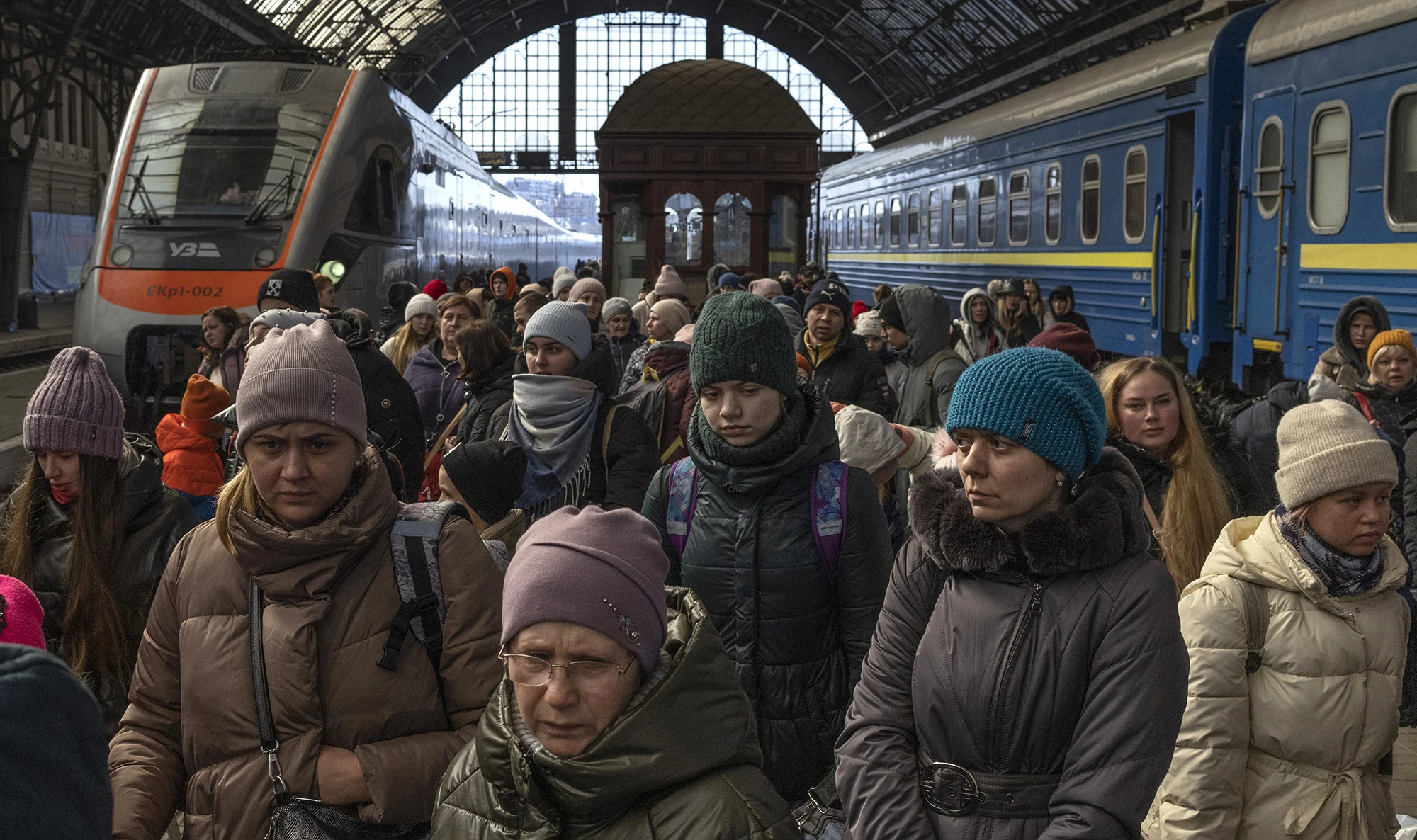
Photo: Passengers depart from the railway station in Lviv, Ukraine, after disembarking trains from the eastern part of the country on March 11, 2022. Published in CNN; Dan Kitwood / Getty Images.
From Kharkiv to Europe: New Geographies of Survival
On February 27th, 2022, 15-year-old Anna (The Politic agreed to use a pseudonym for her safety) reached the Ukrainian-Hungarian border. She had been traveling for 48 hours, squeezed in between 14 other refugees in the four-person carriage of an evacuation train. She was leaving Kharkiv, her home that was just 30 miles from the Russian border, as the occupiers edged closer. Anna was alone with her 18-year-old older sister. Their parents were frontline doctors who were unable to leave the country, so they sent the children away in hopes of safety. Anna and her sister did not know where they were going; they only knew what they were running away from, an invasion mercilessly headed for their home.
On February 24th, 2022, Russia launched a full-scale invasion of Ukraine that would, within days, cause the largest refugee crisis in Europe since the Second World War. As of 2026, over nine million Ukrainians have been displaced, including over six million who have fled abroad. Cities across the continent—Warsaw, Berlin, Prague, Vienna—have become a new home for people who had, until that morning, never imagined becoming refugees. In many of those cities, there were preexisting Ukrainian communities—an established diaspora shaped by decades of integration.
In cities like Paris and Budapest, wartime refugees encountered institutions, associations, and religious organizations established by earlier waves of Ukrainian migrants, some dating back three decades or even a century. What followed was a new interaction between earlier and later waves of arrival: instead of simply expanding existing communities, the refugees who arrived in 2022 began transforming them into multifunctional communities, no longer limited to cultural preservation but actively engaged in refugee support, integration, and political life.
A Century of Migration: Two Communities, Two Histories
The first wave of Ukrainian migration began in the early 20th century. Ukrainian intellectuals, labor migrants, and political exiles started leaving their homeland, fleeing Russian imperial rule. At that time, most of the eastern and central Ukrainian lands were under the control of the Russian Empire, which throughout the 19th century pursued policies aimed at suppressing Ukrainian language and culture, including the Valuev Circular and the Ems Ukaz. For many, departure was not only an escape from political control but from a system that increasingly denied the legitimacy of a Ukrainian identity and sought to assimilate its people into a broader imperial culture.
In France, in 1908, students from Galicia and Ukrainian political émigrés who had left the Russian Empire founded the first Ukrainian organization, Le Cercle des Ukrainiens à Paris. The next wave of migration followed from the 1920s to the 1930s, with those fleeing after the Ukrainian Revolution of 1917-1921. During the collapse of the Russian Empire in 1917, Ukrainians established the Ukrainian People’s Republic, an independent state that was seeking international recognition. However, the statehood was short-lived, as Ukraine became a battleground for competing armies, including the Bolshevik invasion. The failure of long-lasting independence led to Soviet rule in the east and the partition of the western territories between Poland, Romania, and Czechoslovakia.
The Ukrainian community in France stabilized during the Cold War, as Soviet border controls made new immigration nearly impossible.
In Hungary, the story was shaped less by migration than by imperial geography. Large parts of western Ukraine—Galicia and Transcarpathia—had been part of the Austro-Hungarian Empire, with Transcarpathia administered directly under the Hungarian crown. After the empire’s collapse in 1918, these populations became separated by new state boundaries. Ukraine’s presence in Hungary remained limited for most of the 20th century, and during the socialist period, migration from Soviet Ukraine was heavily restricted.
The collapse of the Soviet Union in 1991 opened new possibilities for Ukrainian migration across Europe, as borders that had been sealed for decades now opened. Many left Ukraine in search of better economic opportunities. In Paris, the Ukrainian post-Soviet arrivals contributed to both the city’s long-established Ukrainian institutions and the creation of new ones. In 1997, both pre-existing and newly established Ukrainian organizations in France created the Representative Committee of the Ukrainian Community, with the aim of uniting the cultural and social life of Ukrainians. The committee led and centralized a network of organizations: The Union of Ukrainians in France, The Association of Frenchmen of Ukrainian Origin, and The Association of Ukrainian Women in France.
In Budapest, migration from western Ukraine brought a new, more visible Ukrainian presence. Though still small in number, the immigrants laid the groundwork for a population that could organize and preserve its language and culture.
The new and old Ukrainian immigrants grew into a formally recognized minority. “There are 13 indigenous national minorities in Hungary, whose rights are guaranteed both by the Fundamental Law and by the Act on the Rights of National Minorities,” as Liliana Grexa, the Ukrainian minority’s representative in the Hungarian Parliament, describes. Grexa mentions that National minorities in Hungary—including the Ukrainians—“enjoy extensive rights: they can establish national schools, use their national symbols, pray in their native language, set up self-governing bodies at local, regional, and national levels, and, since 2014, have also had parliamentary representation.”
By the early 2000s, both Paris and Budapest had Ukrainian communities capable of sustaining cultural, educational, and social life. They were stable, settled, and largely self-contained. The diaspora did not need to expand. It did not need to fight for its survival. However, it all changed in a single morning.

Photo: The Ukrainian and French flags fly together outside the cathedral in Taras Shevchenko Square, Kolomyia, Ukraine. Taken by Vladyslav Yatskiv.
February 24, 2022.
Father Andriy Morkvas, a priest of the Ukrainian Greek Catholic Church (UGCC), has been serving in France since the beginning of 2012. He began his pastoral work for the Ukrainian diaspora in Lyon, where, under his leadership, his cathedral became the center of the Ukrainian community: he spearheaded the Saturday School for Ukrainian children and led efforts to restore the site. He was later appointed Head of the Liturgy Commission of the Eparchy of the Volodymyr Le Grand Cathedral in Paris, the biggest UGCC community in France.
“People used to come and go,” Father Andriy recalled. Migration was often temporary; people came to earn money and then returned to Ukraine. The community did not expand with many new arrivals.
It all changed on the morning of February 24th, 2022.
The women arrived first. Then, the elderly and children, many of them separated from fathers who had stayed behind to fight. People came with almost nothing: some with suitcases packed in a rush, others with only what they could carry. They arrived at train stations and border crossings, often in the middle of the night, and organizations like Father Andriy’s were there to meet them. Describing the rapid change in diaspora life, father Andriy noticed that “the churches and cultural offices were transformed into support networks.”
As Ukrainian law prohibits most men between 18 and 60 from leaving the country, thousands of families like Anna’s were separated across borders. Those who arrived in cities like Paris and Budapest were caught between the hope that the war would end quickly and the fear that it would not. Many did not initially see themselves as emigrants or members of a diaspora, but rather as Ukrainians temporarily abroad, expecting to eventually return home. This perspective did not place them in opposition to established communities; instead, it introduced a different understanding of displacement: one that coexisted with, and gradually became integrated into, the longer-term experiences of Ukrainians already living in these cities.
According to the United Nations High Commissioner for Refugees (UNHCR), by the end of 2022, approximately 5.7 million Ukrainian refugees were recorded globally, the vast majority of them in Europe. By the end of 2022, France had welcomed approximately 120,000 Ukrainian refugees, according to UNHCR and government data. This represented a dramatic increase compared to the pre-war Ukrainian population in France, which had been estimated at only a few tens of thousands. Hungary, as a country bordering Ukraine, received over 1.5 million arrivals by the end of 2022. Although many continued onward, around 45,000 Ukrainians were registered for temporary protection in Hungary, highlighting its role as both a transit and a host country.
Viktória Bernáth, the head of the Lesya Ukrainka Ukrainian School, recalled the period after February 24th as a profound transformation in her organization’s work. “In 2022, a humanitarian aid hub opened here. People were gathering near the train stations, meeting refugees and trying to respond to urgent needs.” There was an immediate need for translators. Members of the local Ukrainian community, in addition to addressing other urgent needs, stationed themselves at train hubs to interpret and assist new arrivals. As Bernáth emphasizes, many refugees arrived in a state of shock, making communication itself difficult: some were so overwhelmed that they were unable to process or respond, even in Ukrainian or Russian.
The sudden arrival of thousands of Ukrainians reshaped the daily life of these communities. In Budapest, Jevgenija Jedlicska serves as the president of the National Self-Government of Ukrainians in Hungary. “After the invasion, our work shifted to providing shelter, coordinating medical assistance, and enrolling children in schools,” she said. The organizations that had once served primarily long-established Hungarian citizens of Ukrainian descent now had to accommodate newcomers who were temporarily without legal status, housing, or access to social services.
Jedlicska mentioned that her organization “represents the population of Hungary with Ukrainian heritage who have been living here for a long time,” noting the legal and political realities of the community’s self-governance structure.
Liliana Grexa, a Parliament Representative, said: “Only those Ukrainians who are Hungarian citizens and have previously registered on the national minority electoral roll are entitled to vote for representatives of the national minority, local government bodies, and the parliamentary representative.” Similarly, only a Hungarian citizen may serve as a representative of the national self-government or as a member of parliament. Ukrainian refugees, however, are still welcomed in all their events.“They are entitled to education and religious instruction in their native language, as well as to participate in any activities related to the Ukrainian community. It gives new impetus to the development of Ukrainian national life.”
In Paris, Father Andriy noted that the Volodymyr Le Grand Cathedral became both a spiritual refuge and a practical support center. The Ukrainian Saturday School, which runs every Saturday, quickly expanded to accommodate the influx of children from newly arrived families. Whereas earlier migrants since the 1990s often arrived temporarily as working migrants, earning money and then returning home, today many families stay longer, actively enrolling their children in schools and helping them learn French. The church also became a space for new associations and initiatives, such as “Save Lives Together,” which aimed to help children with serious diseases, and many others, serving the needs of the frontline, broadening its reach beyond liturgy and cultural events. “The Ukrainian voice is being heard more than ever,” Father Andriy observed.
The church also plays an important role in the Budapest community. As Liliana Grexa noted, “A significant achievement in the sphere of spiritual life in our native language is that the Ukrainian Greek Catholic community has been granted the status of a personal parish in Budapest.” The UGCC plays an important role across the continent and beyond. The liturgy itself became a meeting point. In the same pews, women who had lived in Paris or Budapest for twenty years sat beside women who had left Kharkiv or Mariupol weeks earlier. The prayers were the same. The language was the same. And even though the grief was not the same, it was shared, and that mattered. This is what the church could offer that no government program could: a common space of solidarity. The church provided recognition, in that one’s Ukrainian-ness, one’s grief, and one’s specific history were recognized and honored.

Photo: Inside the Saint Volodymr Cathedral, Paris, France. Taken by Vladyslav Yatskiv.
Uncertain Futures: Return, Permanence, and Diaspora Expansion
Ukraine will face an immense challenge in the years ahead: rebuilding not only its cities and infrastructure but also its population. The return of millions of citizens will depend on security, economic opportunity, and the state’s ability to reestablish stability.
For many who have spent years abroad, return may mean another form of displacement—leaving behind the lives they have tried to rebuild abroad.
For the refugees, the question of the future remains unresolved. Some continue to hope for a return, seeing their displacement as temporary. Others build new lives: find work, send children to school, learn new languages.
Looking ahead, Ukrainian diaspora leaders express their hope to become more visible not only at the national level in their countries but also in Ukraine, building stronger connections to the homeland.
“We are very happy to see our communities expanding and becoming more visible,” Viktoria Bernath, the head of the “Nova Hvylia” and Head of the Lesya Ukrainka Ukrainian School, said. “But what is the cost?”
Bernath emphasized that, as the community expands, they expect more Ukrainian-Hungarian bilingual schools to open, and they are currently working hard to make that happen. “From September 2026, another school, attended by around 350 children, predominantly Ukrainian refugees, will come under the auspices of the State Self-Government of the Ukrainian National Minority,” noted Liliana Grexa, Parliament representative of the Ukrainian national minority of Hungary.
“The Ukrainian community in Paris has only started gaining its momentum, and Ukrainians are now more visible in France and Paris itself,” Father Andriy notes.
Yet these changes would not be possible without the tragedy that continues unfolding in Ukraine. New refugees arrive as Russia continues its offensive campaigns. The future remains uncertain, as numerous rounds of negotiations to end the war have failed.
On Saturday mornings, the courtyard of the Ukrainian Cathedral of Saint Volodymyr in Paris fills with voices in both Ukrainian and French. Inside the cathedral complex, the activities extend beyond the liturgy itself: volunteers move between rooms, families gather for classes and community events. Life, in all its complexity, goes on.

Photo: French street artist Seth Globepainter painted a little girl in Paris three days after the war began, symbolizing the Ukrainian people’s courage and determination to face the Russian invasion. Donna Haden / Graffiti Street