
The Politic is thrilled to announce its winners and honorable mentions! Congratulations to all those named below!
TOP THREE WINNERS (click on their names to view their articles)
HONORABLE MENTIONS (NO ORDER)
- Elliott David
- Gavin Reddy
- Leyth Sharaf
- Elina Jadhav
- Aadya Jain
- Martín Ramirez Páchon
- Jack Tuomi
- Hoang Anh Tuan
- Medhavika Rai
- Andrew Larsen
Congratulations to all those who participated. Our editorial team was amazed by the quality of submissions. We particularly congratulate those named as quarterfinalists, semifinalists, honorable mentions, and winners above! As a reminder, all scoring and determinations are final and not subject to appeal.
Any questions regarding the High School Competition should be directed to competition.yale.politic@gmail.com.
We are thrilled to announce The Politic’s first-ever high school competition. The Politic High School Essay Competition is a summer writing competition organized by The Politic, Yale University’s premier undergraduate journal of politics and culture. The Politic invites high school students to engage in original, community-rooted investigative journalism, developing the research and writing skills central to responsible democratic participation. We can’t wait to read your work!
Please find below the official rules and terms of participation. By registering, all participants acknowledge that they have read, understood, and agreed to the outlined terms in full.
The Yale Politic is published by Yale College students, and Yale University is not responsible for its contents nor the competition. To learn more about The Politic and read some of our previous works, click here.
Dates and Deadlines
| DATE | DETAILS |
| June 21, 2026 | Early Registration Opens |
| July 8, 2026, at 11:59 PM EST | Early Registration Closes Regular Registration Opens |
| August 14, 2026 at 11:59 PM EST | Regular Registration Closes |
| August 21, 2026 at 11:59 PM EST | Essay Submission Deadline |
| September 11, 2026 by 8:00 PM EST | Winners Announced |
Registration Instructions
There are two steps to complete registration:
- The registration fee ($30 for regular registration) must be paid via our Stripe platform. The amount owed on Stripe corresponds to the stage of registration we are in.
- Within 48 hours of paying via Stripe, we will send you a private email with the link to the registration and submission forms.
- You must complete the registration form prior to August 14, 2026, to be considered registered.
- You must complete the registration form prior to submitting the submission form.
- Refunds will only be processed before you submit the registration form.
- The essay can only be submitted via the submission form emailed to you.
Competition Details
Eligibility
Who May Enter
The Competition is open to current high school students in grades 9–12 (or international equivalents) who are enrolled in an accredited secondary school at the time of submission. Both domestic and internationally based students are eligible to participate (ages 14-19).
Age and Parental Consent
All participants under the age of 18 by the submission deadline (08/21/2026) must obtain parental or guardian consent on the registration form. Parental consent is required to award the prize to any participant and will be confirmed via a signed consent form provided at the time of registration. The Competition organizers reserve the right to request proof of age, school enrollment, or identity at any stage of The Competition. Submissions from participants for whom parental consent has not been obtained will not be considered registered.
One Entry Per Participant
Each participant may submit only one entry, submitted in their own name. Group or collaborative submissions are not accepted.
Competition Format and Structure
Overview
The Competition runs in a single-round, open-submission format, that is structured around a single national submission window. Winners will be selected by a panel of judges made up of The Politic’s editorial team, which can be found in the Masthead on The Politic’s website.
Essay Category
This Competition features one essay category: Investigative Journalism. Competitive submissions will adhere to the investigative journalism format as defined in the “Submission Requirements” section.
Topic Requirement: Local Community Issue
All submissions must investigate a specific, real issue affecting the student’s local community. “Local community” is defined as the student’s town, city, county, school district, immediate surrounding region, or country.
Examples of eligible topics include, but are not limited to:
- Local public opinion surrounding a recent election
- Environmental issues affecting a specific neighborhood or municipality
- The impact of government cuts on public services within a community
- School district funding, policy, or equity concerns
- Redistricting battles in state and local governments in the United States
- Business closures and their economic ripple effects
- And more
Registration Fees and Financial Aid
Registration Fee
There is a registration fee (in USD) to participate in The Competition. The fee for Early Bird registration is $20, and is available from June 15th to July 8th. The Regular registration fee is $30, and opens from July 9th and closes on August 14th. Upon paying the registration fee, participants will be emailed the registration form to the email address they provided no later than 48 hours after their purchase. All participants must fill out the registration form prior to submitting their essay.
The registration fee must be paid via Stripe here. You will receive a receipt of payment via email. Refunds will only be issued before submission of the registration form. Once the registration form is submitted, no refunds will be processed.
The Politic is committed to ensuring that cost is not a barrier to participation. Students are encouraged to explore the following options if the fee presents a financial challenge.
School Funding
If your school offers funding for academic competitions, we encourage you to reach out to a teacher, advisor, or school administrator to explore whether they are able to support your registration fee. If helpful, The Politic is happy to provide a brief letter confirming the legitimacy and educational value of this competition for use in that request. To request a letter, please contact us at competition.yale.politic@gmail.com.
Financial Aid
If the registration fee poses a financial barrier, please do not hesitate to contact us. We are willing to work with students in need to discuss financial aid options on a case-by-case basis. To initiate a request, please email us at competition.yale.politic@gmail.com with a subject line of “Financial Aid Request” and include a brief statement of need.
Liability
Entry fees, if applicable, are non-refundable. The Politic reserves the right to modify or cancel The Competition at any time, with notice provided via https://thepolitic.org/high-school-competition.
Submission Requirements
Word Count
Submissions must be between 800 and 1,200 words in length, excluding the title, byline and footnotes. Submissions falling outside this range will be automatically disqualified.
Format
Submissions must be in Microsoft Word (.docx), typeset in Times New Roman, size 12, with 1.5-line spacing and 1-inch margins on all sides. The top of the first page must include the student’s full name, school name, grade, city, state, and country and the title of the piece.
File Naming
Files must be named according to the following convention: LastName_FirstName (e.g., Smith_Jane). Submissions not adhering to the naming convention may be disqualified.
Final Submissions
Final submissions are due no later than August 21st, 2026, at 11:59 PM EST. Upon payment, participants will be emailed a submission form to the email address provided no later than 48 hours after purchasing. Final submissions should only be uploaded to that form. This form should not be shared to non-paying participants. Before submitting, please ensure your file is correctly named and formatted. You must submit the submission form under the same participant name used when registering.
Citations
All factual claims, statistics, and sourced information must be hyperlinked. A Works Cited or Sources section must appear at the end of the document and will not be counted toward the word limit. The essay should adhere closely to The Politic’s Style Guide, which can be found here.
Submissions must draw from a minimum of three distinct sources, at least one of which must be a primary source, such as an interview with a named individual, a government record, or a public meeting transcript. Wikipedia, anonymous sources, and undated web pages are not acceptable as primary sources and may be used for background reference only.
Our Standards for Investigative Journalism
What Is Investigative Journalism?
Investigative journalism involves the systematic, in-depth examination of a specific issue of public concern, typically one that involves wrongdoing, inequality, or a matter that institutions or individuals have not adequately addressed. It is distinguished from general reporting by its reliance on original research, document analysis, and primary source interviews.
Required Elements
All submissions must demonstrate the following:
- A clear central question or investigative thesis that the essay seeks to answer or prove.
- Evidence of original research: at least one interview, public record review, or firsthand observation conducted by the student.
- Presentation of multiple perspectives, including those of affected community members and, where applicable, institutional representatives.
- A factual, objective tone. Submissions should not read as op-eds or personal essays.
- A conclusion that synthesizes findings and communicates their significance to the community.
It may be helpful for students to read published articles for reference and style guidance, available on The Politic’s website: https://thepolitic.org/
What Is Not Acceptable
Submissions that function as opinion or personal essays, rely entirely on secondary sources, or present only one side of an issue are unlikely to be judged competitively. Such submissions do not meet the investigative journalism standards outlined above.
AI Policy
Position Statement
The Politic is committed to ensuring that all submitted work reflects the authentic intellectual effort of the participating student. The use of artificial intelligence writing tools is strictly regulated.
Prohibited Uses of AI
The following uses of AI are prohibited and constitute grounds for immediate disqualification:
- Using AI to generate, draft, or substantially rewrite any portion of the submitted essay
- Using AI to paraphrase or summarize source material that is then incorporated into the submission
- Using AI to generate citations, interviews, or fabricated source material
- Using AI tools to construct the essay’s structure, argument, or thesis on the student’s behalf
Permitted Uses of AI
The following limited uses of AI are permitted:
- Grammar and spell-checking tools (e.g., Grammarly in its basic mode)
- Using AI to help understand a complex concept or term for background research purposes, provided the student independently verifies and cites the information from primary sources
Disclosure & Detection
The Politic reserves the right to request a brief written explanation of any submitted work if AI use is suspected.
Judging, Evaluation, and Integrity
Judging Panel
Submissions will be evaluated by a panel made up of members of The Politic’s editorial board. All judges will review submissions anonymously (without knowledge of the submitting student’s identity).
Judging is at the discretion of the panel. Strong article submissions will not need to have a fixed format, but the panel would love to see essays with strong primary sourcing, originality of research, journalistic style and voice, and adherence to guidelines outlined above.
Decisions
All judging decisions are final and not subject to appeal. The Politic reserves the right to withhold prizes if no submissions meet the minimum quality threshold.
Disqualification and Integrity
Participants may be disqualified for any of the following:
- Plagiarism: submitting work that is not their own, whether from another student, a published source, or an AI tool
- Fabrication: inventing quotes, statistics, events, or sources
- Misrepresentation: providing false information on the registration form
- Violation of the AI Policy (Section 5)
- Harassment or inappropriate conduct directed at judges, organizers, or other participants
The Politic’s Managing Board retains the right to disqualify participants based on these parameters. If you are disqualified, the judges will provide you with the reason. Disqualified participants forfeit all prizes and recognition. The Politic may notify the participant’s school administration in cases of academic dishonesty.
Prizes and Recognition
Awards
First, second, and third-place winners will be notified. We will also notify the other top 10 students as having received honorable mentions. No ranking beyond the top three winners will be provided. Following notification, an announcement will be made on The Politic social media platforms and on the website. Those awarded will be considered for publication—see Section 7.2.
Publication
By submitting, participants grant The Politic the right to publish winning and honorable mention submissions, with attribution, on The Politic website (https://thepolitic.org/) and in print. Participants who do not wish their work to be published must notify organizers in writing before the essay submission deadline; this preference will not affect judging in any way.
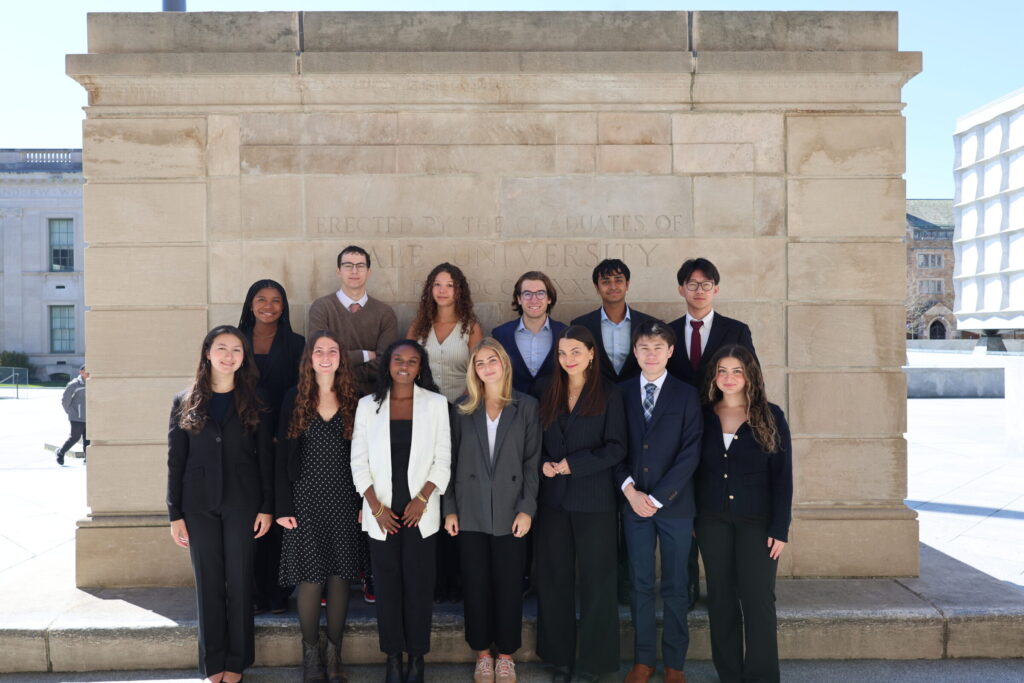
The Politic‘s 2026-2027 Managing and Operations Boards.
The Yale Politic is a registered 501(c)(3) organization run by Yale University students in New Haven, Connecticut.