
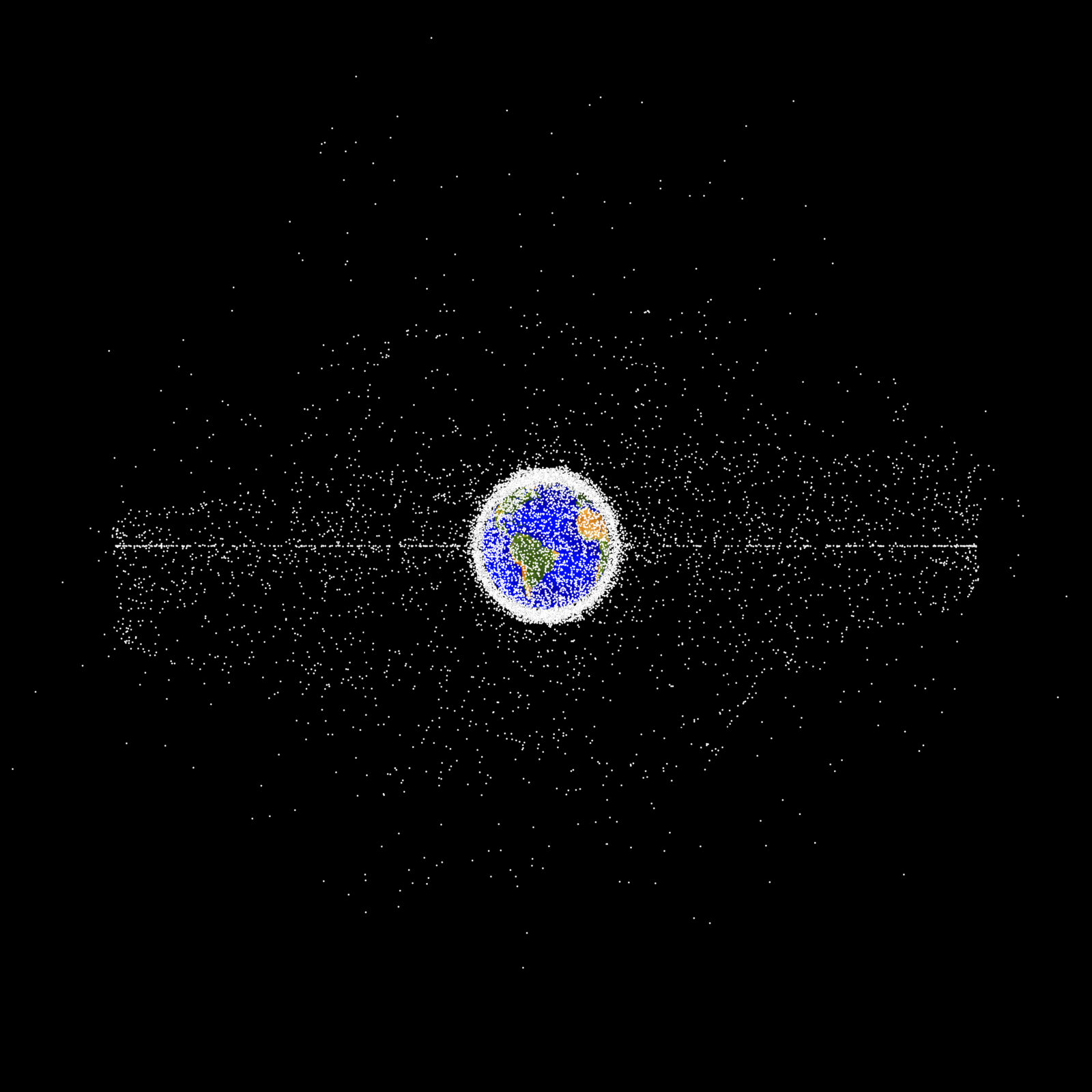
Photo Illustration courtesy of the National Aeronautics and Space Administration Orbital Debris Program Office
Swaths of human trash fill an estimated 500,000 landfills and inundate waterways worldwide. Yet human pollution extends even beyond the frontiers traversed by man.
Today, man-made litter has transcended the confines of our planet and gone into orbit, creating a unique debris problem that threatens missions beyond Earth’s atmosphere.
Is Space Debris a Crisis?
As of January 2026, researchers have estimated that there are over 140 million pieces of debris in space: defunct satellites, spent rocket bodies, tiny paint flakes, and bolts.
The majority of debris is concentrated in Low Earth Orbit (LEO), the region between 100 and 1,240 miles above Earth, which is home to the International Space Station and the vast majority of commercial satellites used for navigation and imaging.
Although most of these fragments are too small to detect, they travel with enough energy to obliterate almost any of the 14,200 functioning satellites in space.
Upon impact, each high-speed collision exponentially increases the amount of debris, increasing the likelihood of subsequent collisions and the risk of a domino effect of destruction. This runaway process, known as the Kessler Syndrome, could rapidly destroy swaths of existing commercial spacecraft in LEO, rendering the orbital band unusable in the future.
Recent estimates put global annual losses from space debris collisions at over 107 million USD. With the number of active satellites orbiting Earth projected to surge by the early 2030s, some experts fear an increase in the risk of costly crashes among satellites that power global telecommunications and navigation.
“[We] reached a point of critical [object] density decades ago,” Dr. Darren McKnight, Senior Technical Fellow at LeoLabs and member of the International Academy of Astronautics’ Space Debris Committee, said. “People miss that critical density is not when you’re going to get an imminent collision. It’s when, sometime in the future, you’ll get a collision, and another collision, and they’ll be self-perpetuating.”
Others suggest that an extreme Kessler Syndrome state is unlikely to advance at an uncontrollable rate.
“The problem [with] the Kessler Syndrome is that it can have a very long timescale, and it can take tens of years to a century to really develop,” Dr. Aaron Boley, Professor of Physics and Astronomy at the University of British Columbia and Co-director of The Outer Space Institute, said. “In the upper areas [of orbit], it’s not drastically affecting operations right now.”
Even though experts debate the extent to which the Kessler Syndrome poses an imminent existential threat to space operations, most agree that long-term remediation efforts, including the active removal of existing debris, are necessary.
“We’re not going to see a cascade for decades from now,” said Dr. Boley. “With that said, there’s a lot of leftover rocket bodies, and really big dead satellites that have been abandoned in orbit, and they’re not going to come down on their own anytime soon… So remediation is important.”
Strategies to Mitigate Space Debris Damage
So far, most solutions to the space debris problem physically dodge the issue. International Space Station operators use small propulsion thrusters installed on spacecraft to perform several collision‑avoidance maneuvers each year.
As the amount of debris piles up, however, two broad mitigation strategies have emerged to prevent a potential cascade. The first is stopgap measures aimed at minimizing launch-related waste to prevent new debris from forming. For example, operators increasingly utilize reusable boosters when launching payloads to reduce the number of spent stages left in LEO or add shielding to improve resilience to micro‑impacts.
The second strategy is to remove existing debris and defunct bodies that pose the greatest risk. Japanese operators have pioneered the use of a cleanup spacecraft that captures free-floating debris with nets, harpoons, or robotic arms, returning to Earth once they have cleared a portion of LEO.
“Remediation efforts are starting to pick up speed. But that doesn’t mean they are done [or] have had any benefit yet,” said Dr. McKnight. “Even if debris doesn’t make orbit uninhabitable, it’ll significantly add to the cost [to constantly maneuver around debris] for operational spacecraft.”
Policy Solutions and Where They Currently Fall Short
Concerns about mass satellite destruction and widespread debris have prompted policy debates over where culpability falls for remediation and cleanup in orbit. The incentive for actors to actively remove space debris has been mired by two international policy issues.
The first is that the persistence of the debris crisis, at its core, reflects a collective action problem in which both governments and private space corporations face strong financial incentives to delay mitigation. This is because the benefits of debris reduction are only realized over many decades. The long-term benefit of space sustainability is further tempered by the costs of active debris removal, which can amount to billions of dollars. Without collective investment, these costs would have to be incurred by states or firms individually.
“When it comes to things already in space, [operators] generally agree that things shouldn’t be up there for more than 25 years, and if anything is not functioning, it should be brought down,” said Dr. McKnight. “But there’s a trade-off there. Nobody wants to spend the extra money to bring things down faster.”
While space agencies like NASA advocate for remediation strategies, they acknowledge the high up-front costs of debris removal. These hefty expenditures are difficult to justify, especially given frequent reelection cycles and the low salience of space debris removal among voting constituents. In fact, the Trump administration has already threatened to cut funding to NASA in favor of more electorally appealing spending priorities.
Moreover, geopolitical pressures to secure market share or strategic advantage in space encourage countries to prioritize the rapid deployment of satellites, even if doing so might increase orbital congestion. Without binding international cooperation or cost-sharing frameworks, each actor’s self-interest risks a cosmic “tragedy of the commons,” in which debris continues to accumulate despite threatening the long-term viability of space operations in LEO.
The second issue comes in the form of legal ownership constraints. Under Article VIII of the United Nations Outer Space Treaty of 1967, the 118 state signatories retain sovereignty over any object launched from their territory, even if inoperative or launched by private corporations. There is no legal mechanism by which a state can be unilaterally removed from ownership, nor is there a streamlined process by which a state can transfer rights over a spacecraft to another party. Active debris removal operations thus risk violating the “perpetual ownership” other countries have over their spacecraft, making large-scale cleanup akin to trespassing.
Furthermore, the United Nations Outer Space Liability Convention holds states absolutely liable for any damages caused during active debris removal efforts, such as accidentally damaging another country’s satellite. These dangers, combined with the upfront cost of active debris removal (ADR), further discourage space operators from undertaking cleanup attempts.
Recognizing these shortcomings and the growing threat of space debris, several international agencies and jurists have proposed changes to international space frameworks. One proposed remedy is to replicate the structures of international climate agreements, such as the Paris Agreement, by having states set goals to reduce debris in LEO. However, such structures rely on the “name and shame” approach instead of legal penalties or sanctions, raising concerns over whether states will be held accountable for failing to meet international goals.
“To put outer space into context, we’re dealing with an area outside of a state’s national territory,” Chris Johnson, Adjunct Professor of Law at Georgetown Law and Space Law Advisor for the Secure World Foundation, said.
The current governing body, the United Nations Committee on the Peaceful Uses of Outer Space (UN COPUOS), adopted the Space Debris Mitigation Guidelines in 2007. These guidelines internationally recommend debris-minimizing improvements to launch procedures. Similarly, in 2023, the European Space Agency announced its Zero Debris Charter under which 14 countries, including New Zealand and the UK, committed to ADR efforts to reverse critical density in orbit by 2030.
38 countries have begun to incorporate these recommendations into national laws and licensing criteria. The United States Federal Aviation Administration (FAA) requires operators to dispose of defunct spacecraft within five to 25 years before they are allowed to launch new objects. The Senate also introduced the 2024 Orbital Sustainability (ORBITS) Act to actively fund commercial space corporations to complete ADR operations.
However, as of March 2026, the ORBITS Act has yet to be passed, let alone ratified into law. Orbital debris regulations also vary widely across countries, with emerging spacefaring leaders like India and China lacking such legal standards due to the high costs of implementation.
“You have commercial operators globally who want to be safe, but they may not be getting the support from their governments to do so,” Dr. McKnight stated.
The White House recently proposed a 54 million USD cut to the Office of Space Commerce, which could threaten its ability to track crucial space traffic data through its Traffic Coordination System for Space. At the same time, major commercial operators like SpaceX are actively investing to remove thousands of collision-prone satellites in LEO.
“If you talk one-on-one with space companies, they’re responsible,” said Dr. McKnight. “But when you look at what [countries are] pushing at a government level, they don’t care as much about [debris] concerns.”
Another proposal is to emulate international maritime laws that prevent pollution, such as Article 192 of the United Nations Convention the Law of the Sea (UNCLOS). States that violate these laws would be fined or legally sanctioned, suffering harsher penalties than under alternative “name and shame” structures.
“We also have other areas outside of national state territory, [like] the high seas, for which there are bodies like the UNCLOS and the International Tribunal for the Law of the Sea (ITLOS), that regulate the high seas and adjudicate disputes,” space law expert Chris Johnson said.
Regardless, concrete plans for binding space agreements are far from maturity. As existing guidelines, such as those of UN COPUOS, are non‑binding, space law experts like Mr. Johnson are skeptical of the effectiveness of agreements that rely on adoption by numerous individual nations. Similarly, the development of alternative binding agreements may be hindered by state-specific incentives.
“The development of a binding international body is desirable, but I don’t think it is feasible or is going to happen anytime soon,” Mr. Johnson said. “The Americans, the Russians, [and] the Chinese are not going to create an international organization that tells them what they can and cannot do in space. It’s not going to happen for political, geopolitical, geographical, and historical reasons.”
“So, would it be desirable in certain academic senses? Yes. Is it likely to happen? No,” he added.
Toward a More Comprehensive Solution
Ultimately, the exponential growth in state-specific satellite investments and the threat of space debris endanger the future viability of our shared orbital commons. The challenge is not only to slow the accumulation of debris but also to fundamentally rethink how space is governed as a shared resource across countries.
As long as the responsibility falls on individual countries and international regulations are non-binding, mitigation efforts will remain imperfect. Perhaps that is because there is no international institution that adjudicates space law, as ITLOS adjudicates maritime law.
“Space debris doesn’t have a governing body,” Mr. Johnson said. “[No single] government is on the hook for that, but this is the playing field.”
Without stronger international coordination, the very competitive forces driving groundbreaking innovation risk accelerating the degradation of the new frontier where it happens.