
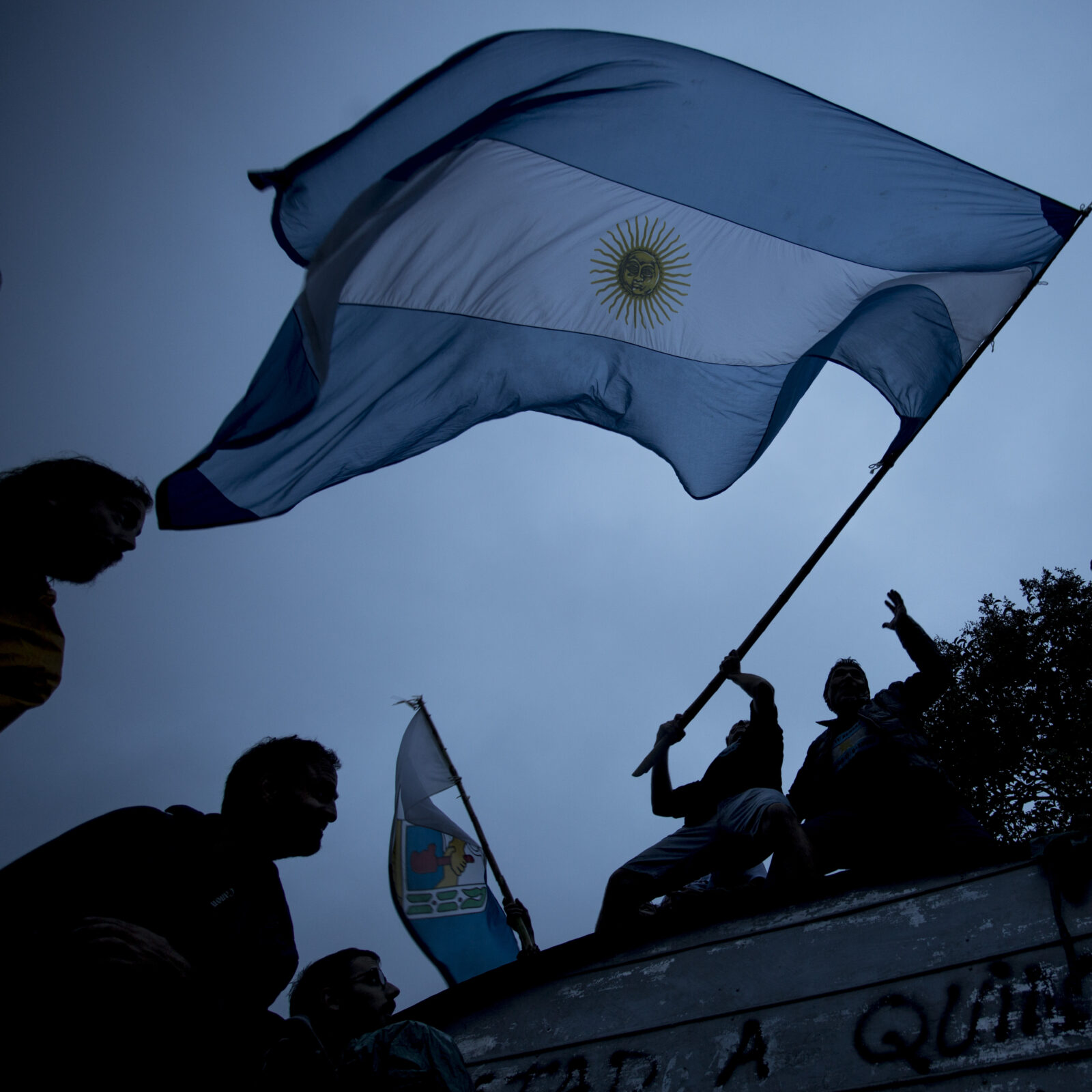
Photo: Martin Zabala
Luciana Abecasis, an Argentine mother of two children, lives in the small city of Reconquista. For her, Javier Milei’s presidency reflects a shift from what she calls an “artificial economy,” an economy with heavy government intervention, to what she sees as a more honest one—a capitalist economy. Among Argentines, many share this perception.
From 2001 to 2023, much of Argentina’s economy was sustained by the government’s financial assistance, which kept everyday costs low for much of the population; however, these subsidies strained state finances. Milei, through his campaign, emphasized reducing subsidies that primarily benefit lower-income populations. He kept his word. At the beginning of Milei’s presidential term, he laid off about 58,000 state workers and reduced the energy subsidy from 1.5% of government spending to 0.8%.
For some, Milei’s economic agenda was too aggressive. A proportion of low and lower-middle-class individuals struggle to keep up with the rising cost of living and the rapid withdrawal of state support. For instance, nine out of ten Argentine households are in debt, and many have defaulted on a loan. Previously, many Argentines paid only about five percent of the real cost of electricity; recent measures have raised this figure to nearly half.
Even though these economic policies were designed with good intentions, the average Argentine has struggled to adapt to the increasingly costly economic environment. Argentina’s poverty rate rose to almost 53% in the first six months of Milei’s presidency—the highest level in two decades.
Argentina’s economic policy since the early 2000s has been extremely cyclical, fluctuating between market-oriented and state-interventionist administrations. However, a strong preference for state intervention has remained deeply embedded in the country’s social fabric.
For decades, the dominant political movement in Argentina has been Peronism. Historian Daniel James, emeritus professor at Indiana University, characterizes the movement as one that transforms everyday experiences of Argentina’s popular classes into political ideology. It defends the working class by focusing on social justice and state intervention.
By the early 2010s, the Peronist model began to lose momentum. Under this left-leaning leadership style, Argentina’s economy was on the verge of collapse. Inflation rose from around 10% in 2012 to nearly 24% by 2014, economic growth slowed to near stagnation, reaching around 0.5% in 2014, and the peso experienced a sharp devaluation of about 20%. Citizens had a growing desire for a different government.
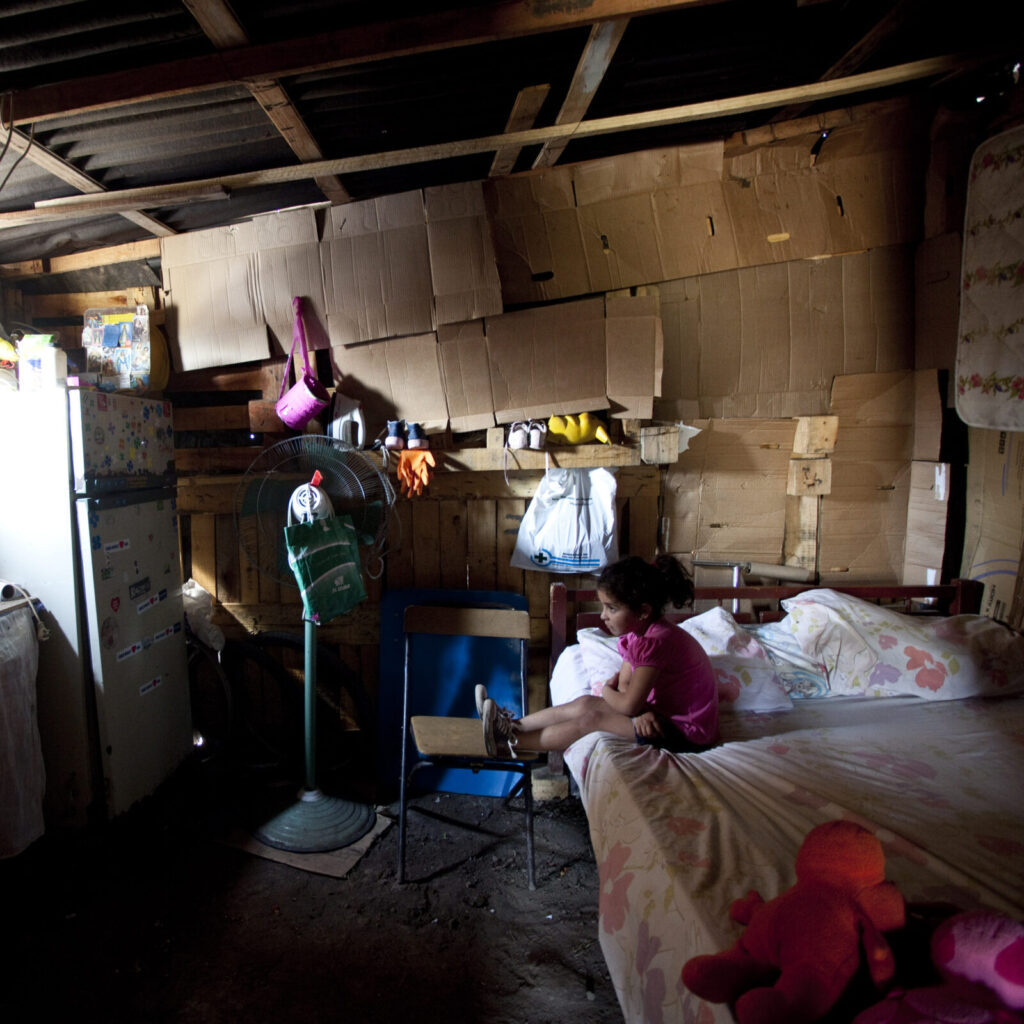
Little girl, Source: Martin Zabala
Former President of Argentina Mauricio Macri, who governed from 2015 to 2019, reflected these frustrations. He positioned himself as a right-leaning business-friendly candidate who vowed to improve the country’s reputation among investors, boost economic growth, and repair Argentina’s weakened political relationships with other countries.
However, initial supporters of President Macri, like Abecasis, acknowledged that “although he had good intentions, his projects failed.” Macri’s supporters were left disappointed by his administration, as the change he promised never materialized. As a result, many right-leaning voters returned to the familiar alternative: Peronism.
Under the administration of Alberto Fernández from 2019 to 2023, Peronism returned to power. President Fernández promised to implement policies that put money in citizens’ pockets. Notably, a price control program known as Precio Cuidados regulated the cost of over 1,000 essential goods in an effort to protect consumers from inflation. However, these efforts towards economic stability were short-lived. The pandemic marked a critical turning point as initial unity around strict public health measures and lockdown policies gave way to growing division. After nearly four months of consecutive lockdowns, Argentine society became divided amid growing demands to relax quarantine measures. Simultaneously, trust in the government declined in response to rising inflation and a prolonged lockdown that only allowed citizens to leave their homes to buy essential goods.
Abecasis elaborated on the severity of the situation, recounting how during the pandemic, her children “went almost two years without classes.” “In big cities people could send their kids to private schools, but in smaller towns like mine education is entirely public.”
Living in Reconquista, a small city 800 kilometers away from Buenos Aires, her experience reflects that of many Argentine citizens.
The pandemic isolated Argentines, not only through social distancing, but also by separating them from their own government. The economic consequences of COVID-19 intensified years of frustration and further amplified demands for change.
For some, the crisis justified greater state intervention to protect citizens, while for others, it exposed the failures of government control and the need for a market-oriented system.
These differing frustrations are longstanding and are known in Argentine politics as “la grieta.”
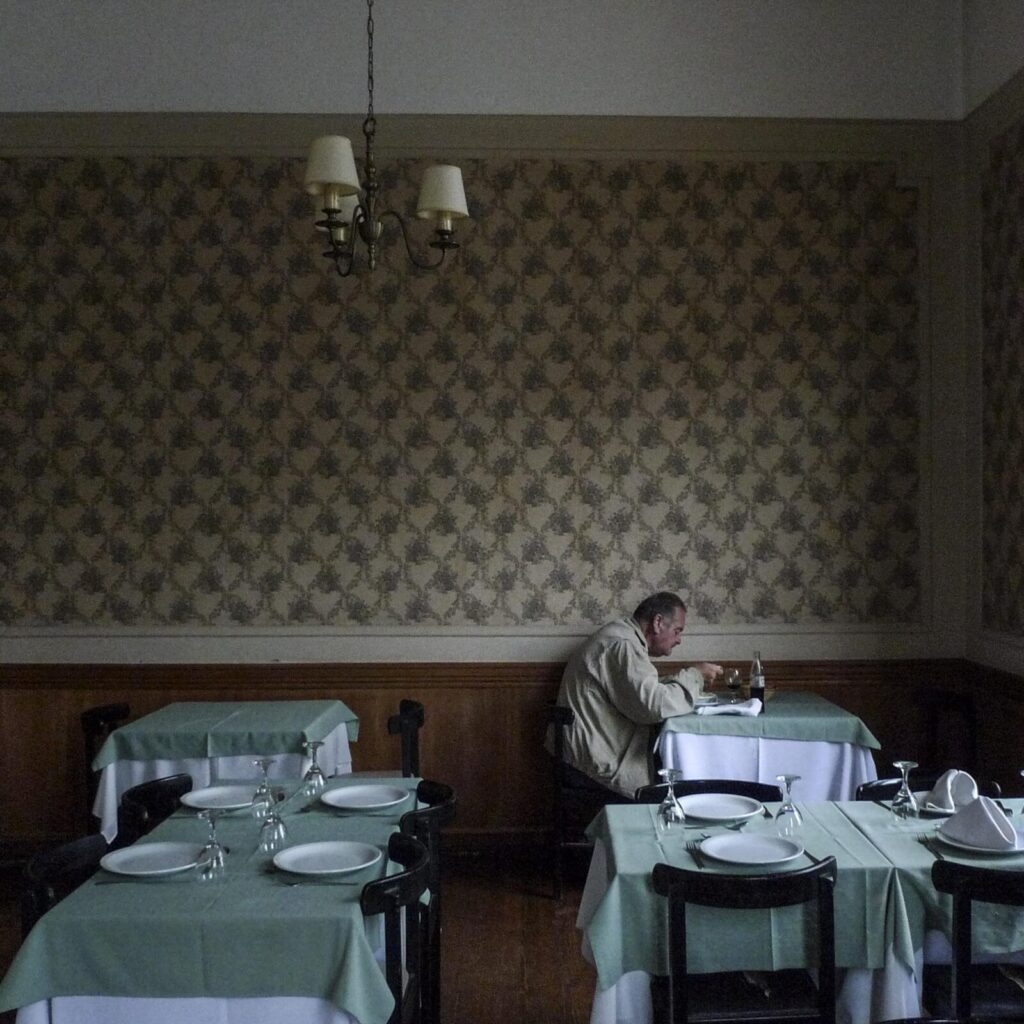
Man Eating, Source: Martin Zabala
La grieta refers to the division between left and right-wing political factions in Argentina, so pervasive that it exists not only between political parties, but also within them. For instance, the Justicialists, Argentina’s main Peronist movement, have long been characterized by internal divisions. One of the most influential aspects within Peronism is Kirchnerism—a more left-leaning populist current. During Fernández’s presidency, Peronism operated as a coalition heavily influenced by Kirchnerist leadership.
As a result, Fernández’s alignment with Kirchnerism intensified ideological divisions, reinforcing perception among right-wing citizens that the government was moving further left. This contributed to a deepening of la grieta during the pandemic.
Although the rise of Kirchnerism contributed to this polarization, corruption was the driving force. Former President Fernández was charged with “abuse of authority” and violating a public official’s duties for allegedly extending the COVID-19 lockdown between 2020 and 2021 for political gain.
At the same time, many Argentines experienced what they perceived as a breakdown in public services during the pandemic. Abecasis recounts that in her community, Reconquista, nearly 90% of patients who were intubated with COVID-19 died. She attributes these outcomes to an overwhelmed public healthcare system, unable to respond effectively to the pandemic due to years of government mismanagement.
Not only was Argentina mourning the loss of its loved ones, but it also experienced a severe economic downturn. The inflation rate soared past 100% for the first time since the hyperinflation of the ’90s. Citizens couldn’t keep up with the cost of living. The price of meat alone rose by almost 20% within a single month.
Rapid inflation meant many Argentines were earning only enough to survive. Every penny spent was directed towards necessities. The dramatic decrease in purchasing power greatly affected the economy. With around 50% of employment in the informal sector, declining disposable income left informal workers with almost no earnings.
The pandemic’s consequences left society deeply unsatisfied. Argentine political scientist and Professor at Universidad Torcuato Di Tella, Juan Negri, explained in an interview with The Politic, “Today, Peronism has become associated with chaos; whenever it looks like they might win, country risk rises, the dollar spikes, and markets become unstable.” In turn, financial markets reacted with increased uncertainty and reduced confidence in the country’s economic stability. Trust in the government was completely lost, and citizens, more than ever before, desired stability.
Milei understood this evolving social environment. As Negri elaborated, Milei knew that, “as a minority government without parliamentary support, he needed to rely on public opinion.”
Abecasis, like many Argentines, quickly found Milei’s policies and rhetoric appealing. She recounted how “with Milei, he made us realize that there were things that actually could be done” about Argentina’s declining situation.
Milei’s campaign centered on his plan to end Argentina’s decay. He wanted to create a new Argentina, fundamentally different from the previous left-wing administration. He envisioned a country built instead on free-market principles and liberal values.
Milei’s radical capitalist reforms particularly resonated with Argentine youth. The young population’s support for Milei was so strong that almost 70% of young voters backed him in the November 2023 election. Abecasis stated,“What surprised me is how Milei connected with young people through social media, such as TikTok.” She added, “He explains economics very clearly,”—a strategy that has helped turn support for him into the norm among young voters.
Although Milei received widespread support from younger audiences, older generations were unaware of this appeal at first. Abecasis recounts how her daughter one day said that Milei is going to win, and she simply responded, “Cata, you’re crazy.”
When Milei did actually win, his victory surpassed expectations. Milei’s party, La Libertad Avanza, won nearly 41% of the vote in Argentina’s recent legislative elections, marking one of the first times a party has won a midterm election since 2017.
Widespread support can be explained by the sense of order and stability that Milei’s new government gave the country. Negri stated, “The government had positive results to show…there was a perception that the future would be better.”
In his first year in office, Milei delivered on his promises of security and economic stability. Crime and murder rates fell by more than 50%. Inflation slowed from a monthly rate of 25.5% to 2.7%. Argentina achieved a financial surplus of 0.3% of GDP for the first time since 2006.
Not only did Milei prove himself through meaningful results, but he also used his image strategically, positioning himself as an anti-establishment outsider. He reinforced this persona through provocative rhetoric and symbolic gestures, such as his “chainsaw” proposal to cut government spending. Abecasis emphasized how she “was surprised by how well known he was, Trump supported him, which was unthinkable for an Argentine president before.” His reputation only further consolidated initial support in his government.
On paper, the results were clear. However, in society, the situation was much more complex.
While Argentina’s economy is improving, it has not translated into the stability many anticipated. Luna Miguens, director of the Land, Housing, and Economic Justice Program at the Center for Legal and Social Studies (CELS), attributed the lack of social stability to Milei’s economic model that generates activity without creating stable, formal employment. In an interview with The Politic, she explained that in key sectors, policies implemented “do not create high-quality formal jobs” even if “they do generate some economic activity.”
As a result, much of the workforce is forced to rely on informal labor, where income is irregular and unprotected. Miguens further explained that even traditionally stable groups are affected, as “the lower middle class and informal workers [are] merging into a single highly vulnerable group.”
Milei’s economic policies, even though direct, are harsh. For instance, he reduced public spending by 30%, eliminating departments such as Education, Social Development, and Health, to achieve a budgetary surplus and promote a market-driven economy. These cuts have disproportionately affected lower-income and rural populations who rely heavily on public services. In many regions, especially outside major cities, public institutions are often the primary provider of these services. As a result, reductions in funding and staffing have translated into fewer available resources and reduced access to essential services, placing increasing strain on public health and education systems.
Despite perceptions as a champion of change, Milei’s presidency actively reinforces la grieta through his policies and governing style. His reduction of government involvement in the economy has been welcomed by supporters as necessary reform, while critics see it as taking away essential support systems. Abecasis and Miguens’ views on Milei’s economic policies illustrate this divide.
While Abecasis acknowledges that Milei’s policies can be aggressive, she emphasized how they have shown results so far. She argued,“now salaries are real,” reflecting a shift away from wages distorted by inflation and government intervention.“So, people only hire what they truly need.” She sees this as evidence of a more efficient, even if more restrictive, economy.
Furthermore, Abecasis alluded to the previous government’s corruption, explaining how “many people don’t want change because the system has benefitted them.” Under Milei, however, Argentina’s Corruption Perception index stood at 36 out of 100, its lowest level since 2019.
Miguens offers a far more critical perspective, arguing that Milei’s reforms have come at the expense of social stability. She highlighted how weakened essential support has been notable, noting that “the role the State used to play at least fulfilled those functions to some extent. Today, it no longer does, or it does so in a very limited way.”
Rather than increasing efficiency, she believes these economic policies have created a growing economic strain for households, particularly the lower and middle classes.
This strain is reflected in survey data from La Cocina de los Cuidados, a CELS-led initiative focused on households with caregiving responsibilities, where 42% of respondents said their economic situation worsened over the past year, while 16% stated it had remained equally difficult. Notably, 56% reported having to reduce food consumption due to resource constraints.
Ultimately, such direct contrast in viewpoints reveals that la grieta is no longer confined to a purely political divide; it is now a reflection of two competing realities in Argentina. Perceptions of Milei’s leadership are not only shaped by ideology, but by materially different lived experiences. As these competing realities continue, public opinion has become increasingly volatile.
At present, Milei has faced some backlash. His administration recently experienced a decline of about 5% in support, and criticism of his government has intensified in recent weeks. This may be partly explained by a decline in negative sentiment toward the previous administration of Alberto Fernández, as public attention shifts towards Milei’s own performance.
Negri elaborated how society “can’t spend four years blaming the previous government, at some point, society will start holding the current administration accountable.” Milei’s campaign was built on public opinion, so it is only natural for the party to experience some decrease in its overall support. This shift is also occurring now because the initial period of public patience is fading; people are bearing the costs of Milei’s economic reforms in everyday life.
The shift in public opinion reflects the broader uncertainty in the country concerning Milei’s reforms. Argentina’s long-term success remains conditional on Milei’s ability to deliver concrete economic improvements while also accounting for the social costs borne by society as a whole. Negri suggested, “These drastic changes must generate well-being for most of the population relatively quickly or the dynamic changes.”
The shift in public opinion reflects an uncertain future for Argentina under Milei’s rule. For some, his reforms have provided hope for a desire for economic stability; for others, he signals the erosion of essential social protections. As the consequences of his policies unfold, the question is no longer whether la grieta will persist, but what version of Argentina will prevail.
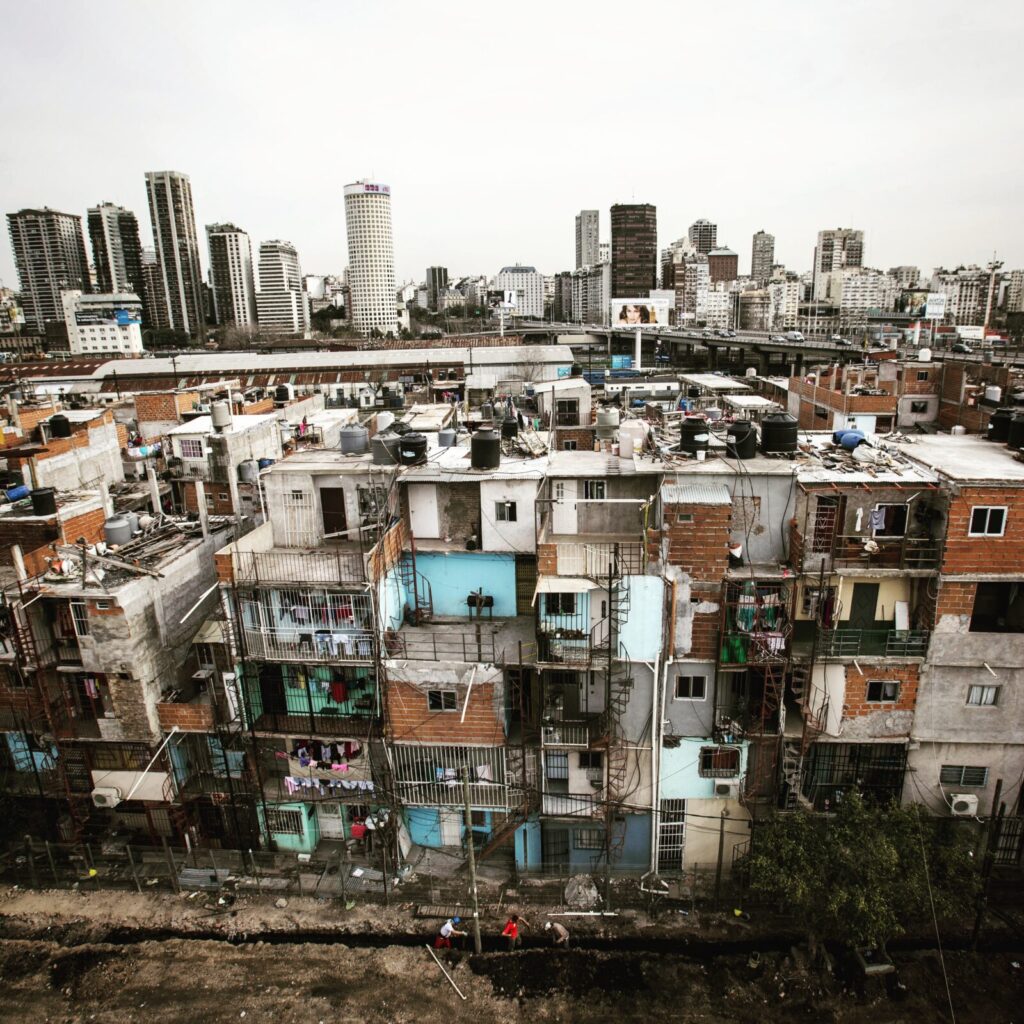
City Contrast, Source: Martin Zabala