
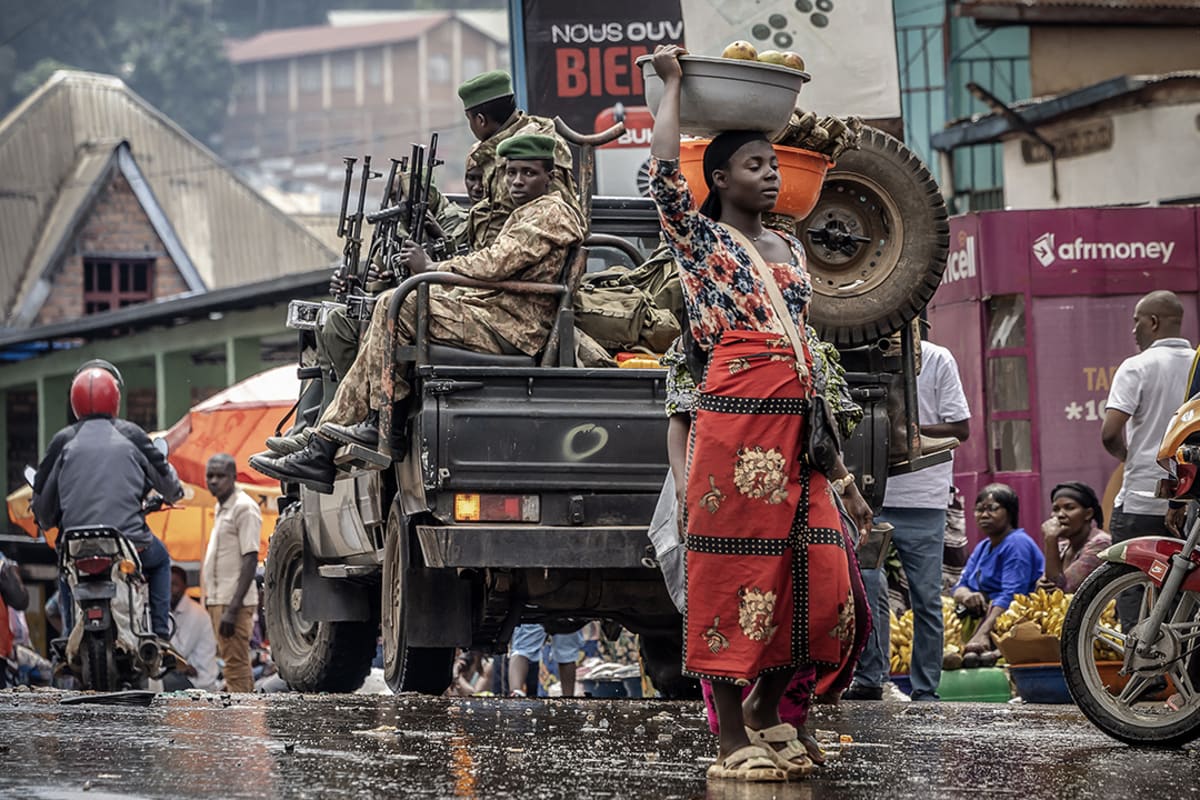
Members of the M23 armed group sit on a pickup truck during a patrol as women carrying fruits walk past a market, following the takeover of the city by the M23 movement in Bukavu on February 18, 2025. Source: Luis Tato/AFP via Getty Images
You can blame King Leopold or Belgium or Capitalism or whatever satisfies your conscience: the Democratic Republic of the Congo (DRC) cannot operate as a cohesive political unit. For three decades, armed rebellion has been a way of life in the Congo’s eastern provinces, with state control barely extending beyond the capital Kinshasa. Since 2021, the Rwandan-backed rebel group M23 has captured vast swathes of territory, including the two largest cities in the east, Goma and Bukavu. Western journalists, such as former Reuters correspondent Michela Wrong, have criticized the rebellion’s foreign backing as a breach of Congo’s sovereignty, framing the group as the primary driver of instability. This thinking feeds into the same cycle of delusion that has produced one failed peace treaty after another. Attempting to tie the Congo back together from the capital is not the solution: it is time to rethink political construction in the region.
Governance Without Control
The current internationally recognized government in Kinshasa operates as a commercial cartel. Its legitimacy is derived almost exclusively from mineral extraction rents and a wooden placard at the United Nations. President Félix Tshisekedi won the presidency in 2018 by striking a deal with outgoing dictator Joseph Kabila, co-opting the motley crew of former warlords and power brokers that have long run the Congolese political system. Corruption is rampant: mining and airline revenues flow to family members and cronies from Tshisekedi’s home Kasai province while political opponents are sidelined. By 2023, Tshisekedi was on the verge of losing re-election due to rampant human rights abuses and corruption. However, M23’s resurgence has flipped the script, allowing Tshisekedi to paint his regime as a victim of aggression and thus redirect criticism of domestic governance failures to one of the Congo’s eastern neighbors, Rwanda.
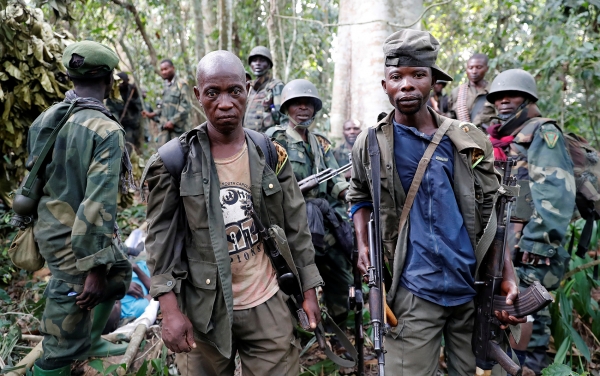
Congolese armed forces (FARDC) after dismantling ADF rebel camp in North Kivu on 18 February 2018. Source: Goran Tomasevic/Reuters
The reality is that the success of the M23 rebellion reflects more domestic incompetence than foreign meddling. Despite possessing a budget of nearly one billion dollars—five times that of Rwanda—and a standing army of over 130,000 soldiers, the Forces armees de la republique democratique du Congo (FARDC) has largely capitulated to a much smaller M23 force of 10,000. Furthermore, the FARDC enjoys significant external support, including tens of thousands of local militiamen known as Wazalendo, more than 10,000 Burundian soldiers, 1,000 Southern African Development Community (SADC) soldiers, 300 Romanian mercenaries, and dozens of Belgian, French, and American trainers and drone specialists. The odds are clearly stacked in the Congolese government’s favor—how, then, has it managed to lose the war?
During the Cold War, Congolese dictator Mobutu Sese Seko told his soldiers, “You have guns; you don’t need a salary.” This governance mindset characterized Mobutu’s rule from 1965 to 1996, entrenching a culture in the FARDC that prized loyalty and self-sufficiency over competence and experience. As a result, the FARDC operates less as an army and more as a network of bandits on their own land, extracting revenue from Congolese citizens and selling guns to the rebels it is supposed to fight. When M23 advanced toward Goma and Bukavu in February 2025, the demoralized FARDC fled faster than the rebels could advance, clashing with its own allies in a complete rout.
Front lines have stabilized since, but only because U.S. diplomatic pressure rolled back M23 offensives on Walikale and Uvira, two remaining FARDC-held cities in the east. Indeed, the fact that U.S. support seems to be the only effective military instrument in Tshisekedi’s arsenal might explain his decision to pawn off billions of dollars in mining deals to Trump in exchange for increased security cooperation. At the operational level, DRC-US cooperation has taken a controversial turn: in recent months, the FARDC has begun enlisting the services of Vectus Global—an American private military company run by former Blackwater founder Erik Prince—for indiscriminate bombing campaigns on M23 territory.
However, the FARDC remains incapable of defeating M23 on the ground. A massive FARDC offensive in February 2026 made negligible territorial gains despite Vectus-operated drones killing M23’s spokesperson in a targeted airstrike. Even recent gains made by FARDC near Uvira and in Lubero district reflect more political negotiation than military action. If M23 is to be pushed out of its captured territories, it will not be because of the Congolese army.
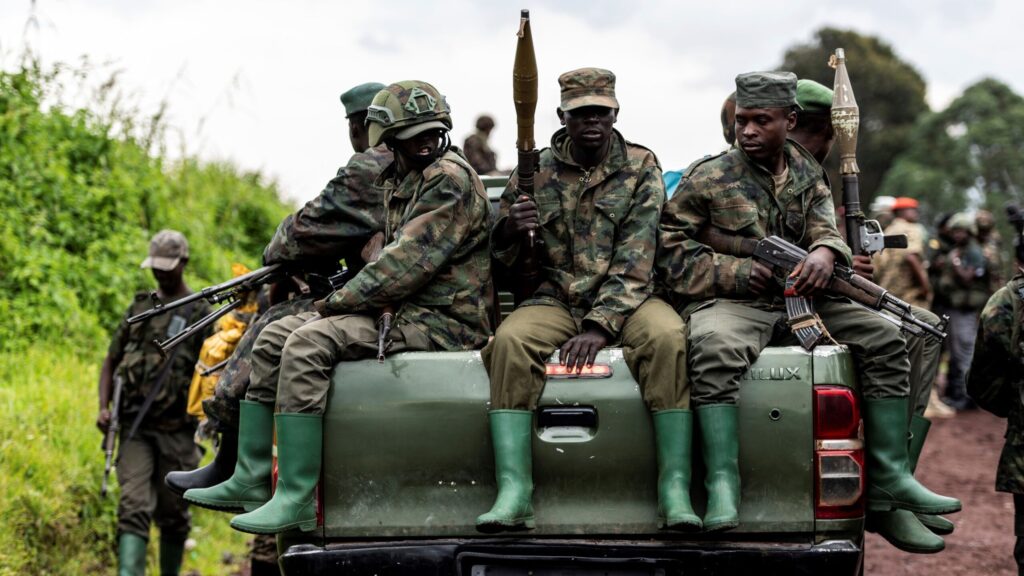
M23 rebels withdraw from their positions in the town of Kibumba, Democratic Republic of Congo, Dec. 23, 2022. Source: Moses Sawasawa/AP Photo
A negotiated end to this conflict is unlikely to meaningfully resolve security concerns. The current regime faces a commitment problem, as it cannot credibly pledge to share power with a disarmed M23. Historical precedent reinforces this skepticism—M23 is named after the March 23, 2009 peace agreement, whose terms Tshisekedi’s predecessor Joseph Kabila failed to implement. Even if M23 were neutralized, the eastern Congo is no paradise—more than 85% of the seven million displaced persons in the region were forced to leave in years while M23 was inactive.
Neighboring Ituri province has been embroiled in a jihadist-infiltrated civil war for decades. Most of the Wazalendo militias fighting M23 on the ground consist of distinct rebel groups only loosely aligned with the government. The instability that has ravaged the country cannot be credibly pinned on M23. At some point, the international community must recognize that M23, and by extension Rwanda, is merely a scapegoat to Kinshasa’s inability to rule.
M23’s Parallel Administration
Unlike Kinshasa, M23 has built well-maintained civilian leadership structures in North and South Kivu provinces. District and local-level offices oversee virtually all administrative tasks, from issuing travel documents to implementing mass vaccination campaigns. M23 has reformed the education sector, built a parallel justice system, and even conducted civil service exams for new magistrates. The rebellion is even cracking down on corruption within its own ranks, replacing family members of leaders accused of embezzlement—something Tshisekedi has notoriously failed to do. The primary shortcoming of M23’s quasi-state is its financial system, which has been held hostage by the internationally recognized Kinshasa government for over a year. As M23 attempts to remedy the situation with its own heavily tax-funded system, ordinary citizens have endured the brunt of Kinshasa’s political ransom.
Despite the positive development led by M23, its nation-building has come at no shortage of coercion. Humanitarian organizations have released countless reports of threatening, beating, and imprisonment of dissidents. Efforts to stabilize society are heavily abrasive and come at a high human cost. Reduced crime is not linked to poverty alleviation but rather to civilian fear of reprisal from M23 patrols. Arguably, the most concerning overreach is M23’s strict control over media outlets, which makes independent journalism nearly impossible to access. While M23 may be engaged in an extensive state-building project, it is a project imposed involuntarily on the people of the eastern DRC.
Ultimately, this debate should come down to one question: can M23 or the Congolese government better govern its territory?
Human rights abuses have become a major source of concern. M23’s offensives have certainly increased violence in North and South Kivu. The group forcibly conscripts people, weaponizes sexual violence, and summarily executes suspected enemies.
However, this destructive behavior is not unique to M23. The FARDC and Wazalendo have committed equally catastrophic war crimes while facing much less public scrutiny. For example, the FARDC and Vectus have recently escalated drone strikes targeting densely populated areas in Goma and South Kivu. The international community has been overwhelmingly silent on the matter, a result of Western media outlets’ tendency to highlight spikes in violence associated with M23 offensives and underreport more regular abuses by Congolese government forces. There is also an instinct to misattribute government violence to M23: news headlines wrongly blamed M23 for prison escapes and looting in Goma and Bukavu, which occurred in the days before M23 soldiers infiltrated those cities.
Alongside framing M23 as the primary contributor to the humanitarian crisis in the region, critics commonly point to the M23’s economically exploitative behavior. The rebel group operates many coltan and gold mines in its territory, most notably the Rubaya mine, which supplies 15% of the world’s coltan. The Congolese government has rightly pointed out that M23 openly steals profits from the mine to fund the war effort. Notably, this is also exactly what Tshisekedi hopes to do by offering Rubaya to investors in February 2026 as part of the minerals-for-security deal with the U.S. government. Whether framed as blood minerals or Rwandan-backed looting of Congolese resources, the difference between M23 and the Congolese government’s control of these mines is negligible.
Gold presents a similar issue: both Rwanda and neighboring Uganda smuggle billions of dollars worth of the mineral every year. Yet the dividends that do end up in Kinshasa’s coffers rarely translate into local investment. Ultimately, the double standard of judging “illegitimate” exploitation should be dropped. The question of who steals from the Congo matters far less than who governs it.
On the other hand, security appears much stronger in M23-controlled areas. For the first time in three decades, citizens can walk outside at night in Goma. Banditry, heavily linked with the mesh of nonstate armed groups vying for control in the region, has been drastically reduced as M23 cracks down on opposing militias. Despite their hatred of the Rwandan-backed militia, many residents in the countryside would prefer that M23 stay in charge. As Foreign Policy’s Krista Karch and Merveille Kavira Luneghe put it, “M23 has brought a form of stability that hasn’t existed in decades.”
The gap widens when considering actual development outcomes: M23’s parallel administration has been far more efficient and productive than the Kinshasa government in nearly every dimension. All of M23’s aforementioned achievements stand in stark contrast to the Congolese government’s history of neglect, not just in the Kivus, but the country as a whole. The fact that a cash-strapped M23 accomplished more in a year than Tshisekedi could in at least four means that M23 has unequivocally brought better development outcomes to the region than the Kinshasa regime.
A key challenge to M23’s statebuilding project lies in historical legacies. M23 is a rebel movement led by Congolese Tutsis, the same ethnic group as Rwanda’s post-genocide leaders. Since the Rwandan genocide and subsequent Congo Wars, Tutsis have been at the center of intercommunal violence in the region, and civilians in the eastern DRC have suffered the most. Through a combination of massacres, retaliatory massacres, and decades of state propaganda, anti-Rwandan and anti-Tutsi sentiment in the eastern DRC is dangerously explosive. When M23 took control, many were surprised that the rebel group did not continue to kill and pillage like their predecessors. These historical grievances cannot be ignored. But, like their neighboring country, Rwanda, inter-communal reconciliation and development are both possible. Since successive Congolese regimes have shown little interest in either, why not give M23 a chance?
The Case for an M23 State
M23 has built a more legitimate governance system in the eastern DRC than its internationally recognized counterpart. To translate this system into a state requires immense pragmatism in abandoning continent-wide notions of sovereignty. However, an M23 state is a viable solution to resolving the root causes of conflict in the eastern DRC.
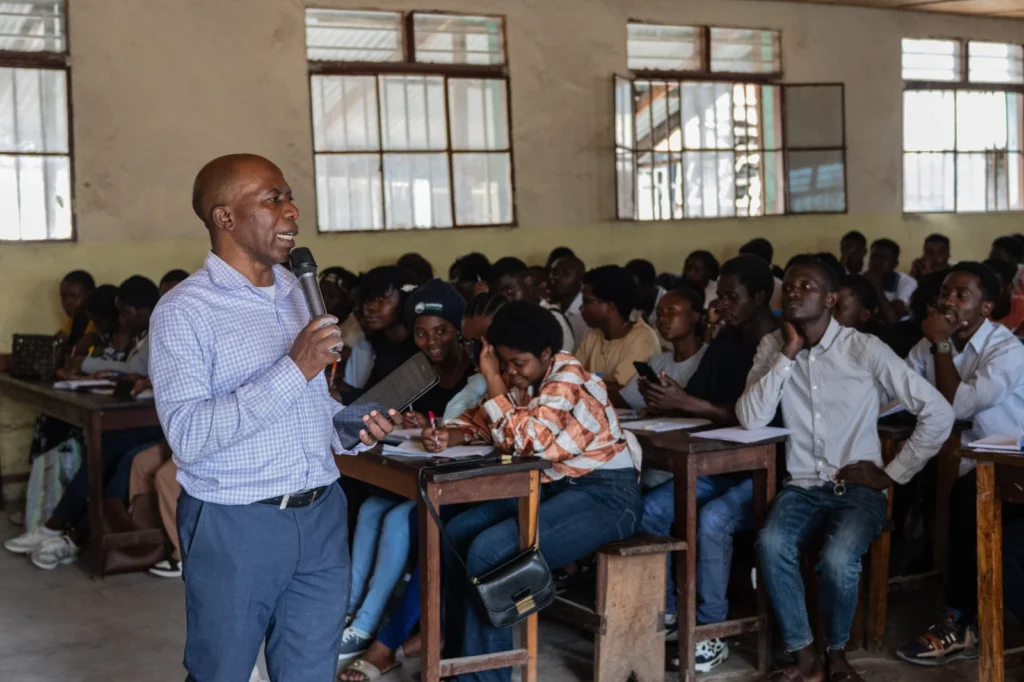
Deo Bengeya lectures students on economics in Goma, Democratic Republic of the Congo, Friday, Jan. 23, 2026, a year after M23 took control of the city. Source: Moses Sawasawa/AP Photo
First, M23 rule alleviates Rwanda’s regional security concerns. For thirty years, Rwandan intervention in the DRC—and the resulting violence—has been driven by a desire to neutralize armed groups tied to the Rwandan genocide. Successive Congolese regimes have allied themselves with these genocidaires rather than eliminate them; a Congolese Tutsi-run M23 has the necessary will and capability to finally resolve this issue.
Second, M23’s rule marks an inflection from the cycle of insecurity that has plagued the eastern DRC for decades. While obviously not perfect, M23 has stabilized its territory and laid the groundwork for actual local governance. Rwanda’s post-genocide growth illustrates that development can at least placate generational trauma and allow a younger generation to move beyond violence.
The primary stakeholder opposed to an M23 state is the current Congolese regime. International perception has been dominated by a sovereignty-first lens that both highlights and misrepresents the challenges to M23 governance. But in a fair comparison between M23 and Kinshasa, there are few elements in which Kinshasa wins.
***
There is no silver bullet to conflict in the eastern DRC. Individual actor incentives, complex networks of extraction, and decades of extreme violence suggest that real peace is likely distant. M23 is incredibly flawed and seen by many domestic and international observers as an illegitimate foreign actor. But it is likewise folly to assume that the regime in Kinshasa can be a solution. The current Congolese regime is held in place solely because outside powers have declared it legitimate. Furthermore, Western media has failed to reveal the exploitative intentions driving these countries’ support forward. Rwandan puppet or not, M23 has brought security and development to a region the likes of which have never been seen before. Effective governance in the DRC may not be best pursued head-on, but rather in bite-sized pieces.