
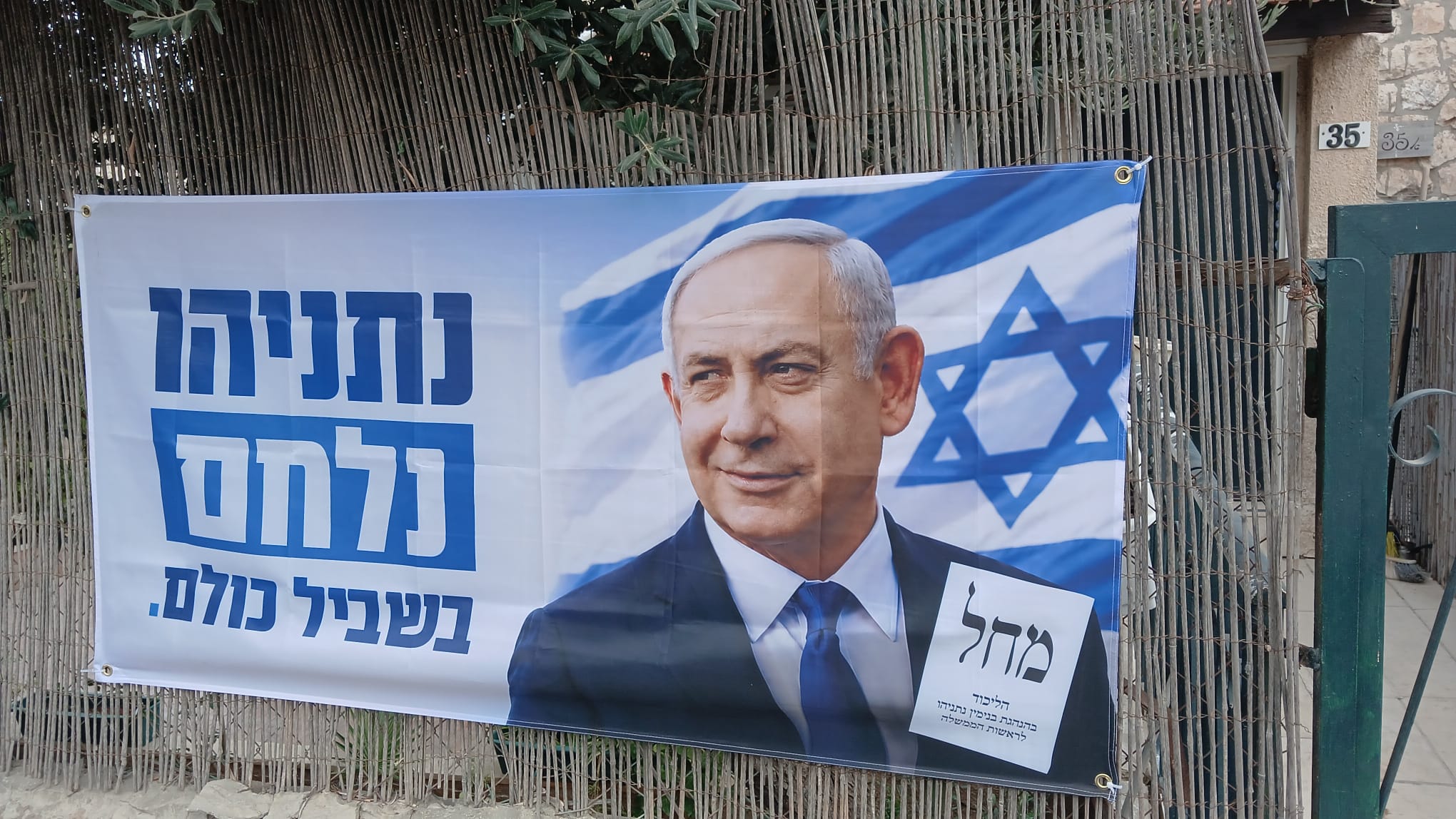
Photo Credit: Yael Yavin. Translation: “Netanyahu will fight for all of us.”
On October 27, Israel will vote to elect a new government for the first time since the 2023 October 7 massacre.
“If the opposition doesn’t win this time, I don’t think that Israel will remain a liberal democracy,” said Harvard Professor Chuck Freilich, former Deputy National Security Advisor to the State of Israel.
On the other hand, many who do not support the opposition fear that it will not be able to form a government strong enough to lead Israel and protect its citizens during a time of war. In particular, they worry that any opposition coalition that is formed will be too fractured to hold together and that the government will collapse at a crucial moment.
Long-standing debates have come to the forefront of national conversations, from judicial reforms and prime ministerial term limits to the role of Arab political parties and Haredi military exemptions. Combined with the legacy of October 7 and the ongoing wars, they have made this election feel pivotal to many voters.
“Most of the people in Israel consider these elections as really crucial and really important,” said Dr. Ido Dolev, Research Assistant at the Viterbi Family Center for Public Opinion and Policy Research at the Israel Democracy Institute (IDI), which runs the majority of Israel’s public opinion polls. “It’s more important, the elections, than it seems outside the country.”
Security Concerns
Security is among Israelis’ primary concerns when voting. October 7 and the ongoing wars dominate the national conversation and will significantly shape voting preferences.
“Israelis have been thrown down the Maslow hierarchy of human needs and are focused on personal and collective security,” said Professor Amichai Magen, Senior Research Scholar at the Center on Democracy, Development and the Rule of Law (CDDRL) at Stanford and the founding director of the center’s Jan Koum Israel Studies Program. Speaking of the candidates for the Prime Minister position, he said that “The cardinal question Israelis are asking themselves is ‘Who do I trust more to keep my family safe? Bibi, Eizenkot, Lieberman, or Bennett?’”
Netanyahu’s stance on security and decades of experience have long factored into Israeli citizens’ support for Netanyahu, even prior to the current conflict.
“For me, the most important thing is security,” said Mr. Salman, an Israeli who now lives in California. “I want to see which candidate’s agenda… would protect Israel the best.”
Mr. Salman does not wholeheartedly endorse Netanyahu and believes that he should be held accountable for the security breach that allowed the October 7 massacre to take place, though he contends that Netanyahu is most qualified to keep Israelis safe and guide Israel through this period.
“He has to have blame for October 7,” said Mr. Salman.
Since its founding in 1988, Hamas has repeatedly and publicly announced its intent to destroy the state of Israel and annihilate its people. Prior to October 7, 2023, most Israelis had faith that IDF intelligence and the government were handling Israel’s security situation. The massacre’s devastation shook Israeli citizens’ faith in their leadership’s ability to perform their most fundamental task, protecting the Israeli people.
According to investigations by The Atlantic reporter Vivian Salama, both Abbas Kamel, then-Egyptian intelligence chief, and Mohamed bin Zayed, President of the UAE, warned the Israeli government. IDF soldiers stationed along the border also reported signs of unusual Hamas activity. However, Netanyahu denies having had access to information before the attack. As of November 2025, his government is investigating the accusations about its security handling.
For Mr. Salman, Netanyahu maneuvered Israel through the past few years of crisis: “I am personally not a big fan of Bibi, but you cannot basically shut your eyes to what he did,” in terms of providing strong leadership throughout the period.
Nonetheless, around 87% of Israelis want to see Netanyahu take accountability for the October 7 security failure, and 72.5% want him to resign as a result.
Public trust and security concerns, however, are not limited to Netanyahu’s coalition alone. Many Israelis worry that the opposition leaders are not strong enough to lead Israel and protect it. “The left wing does not have enough mandates to build a government,” said Mr. Salman. “The only way they can do it is with the Israeli Arabs. If we had to do any military attack with a left-wing government, the Arabs are going to go against it…. And the government is going to fall.”

Source credit: Yael Yavin. Translation: “Ben Gvir for Minister of Defense. Gottlieb for Minister of Justice.”
Ongoing Judicial Reforms
In addition to being the first election since October 7, this is also the first election since the protests over Netanyahu’s judicial reforms began.
Israel is a parliamentary democracy whose 120-seat Knesset is elected by proportional representation. To form a government, parties must build a coalition holding a majority of seats, which then backs a prime minister. Because the government is drawn from and depends on the Knesset majority, and there is no second chamber or separately elected executive to check it, the judiciary is effectively the only independent check on the Knesset’s power. Coalitions are also fragile: if enough members defect mid-term, the government can collapse and trigger new elections. That happened repeatedly between 2019 and 2022, when Israelis voted five times in under four years.
Some Israelis worry that the fact that Israel does not have a written constitution and relies on a framework of Basic Laws leaves the government open to corruption. The fact that the fundamental structure of the government—for instance, the powers of the judiciary—are not firmly fixed and can be changed with a simple majority may allow his coalition to consolidate power in their branch of government.
Since 2019, Netanyahu and his coalition have led efforts to pass judicial reforms, amending the Basic Laws. These would effectively limit the judicial branch and shift power to the ruling coalition by removing the only “checks” on coalition authority. According to Netanyahu and other right-wing leaders, the Supreme Court has become elitist and overstepped its role, and these reforms are necessary to prevent further corruption.
The battle between Israel’s parliament and the Supreme Court over how much the judicial branch can limit the power of Netanyahu’s coalition peaked between March 2023 and October 2023, with no resolution. It remains ongoing.
Israel’s government passed the Incapacitation Law in March of 2023, creating stricter criteria for impeaching the prime minister. Soon after, the Supreme Court issued a strategic ruling that said these standards could not be implemented until after the next Knesset was established. In July 2023, the government abolished the “Reasonable Standard,” which protected a facet of the Supreme Court’s veto power. In 2024, the Supreme Court struck down this law.
In 2025, the government successfully passed a law that will replace independent representatives from the Israeli Bar Association on the Judicial Selection Committee with political appointees. The courts and opposition parties are still contesting the law.
“What Netanyahu calls judicial overhaul, I call a judicial wrecking ball,” said Professor Freilich.
The reforms enacted, along with Netanyahu’s outline of future overhauls, resulted in months of nationwide protests and unrest. From January 2023 until October 7, hundreds of thousands of Israelis took to the streets to protest what many saw as a violation of democratic principles and a threat to Israel’s status as a liberal democracy.
“We’ve seen playbooks of democracies that fall, and we see what this government is bringing us,” said Dr. Tali Reiner Brodetzki, a leader in the pro-democracy movement for Israel in the United States and former Director of Community Outreach and Development of the AID Coalition. And part of it is built because of this case against Netanyahu, and he’s trying to avoid the ruling and trying to get away with his crimes and corruption. Basically, he’s trying to build himself up as a dictator.”
In 2019, Netanyahu was indicted on corruption charges. Some of his critics argue that he has used his position as Prime Minister to prolong the trial and avoid prison.
“For Bibi it’s make or break, because if he doesn’t become Prime Minister then he won’t have the ability to potentially influence the outcome of his trial, which he’s been able to delay through a thousand small manipulations as prime minister,” said Professor Freilich. “So the trial will accelerate, and he’ll probably find himself in jail in a few years.”
Though October 7 catalyzed the unity of Israelis across the political spectrum, that unity was short-lived.
“For 3-4 months after October 7, Israelis came together in grief and civic rallying,” Professor Magen said. “But the unity was short-lived. Israelis are as toxically polarized today, arguably more so, than they were on October 6. That polarization has been ‘nurtured’ by politicians who view division, hatred, and fear as a winning formula. It ‘rallies the base’ at the cost of national fragmentation.”
Netanyahu’s Coalition
Netanyahu’s current coalition includes his own party, the Likud, the Shas, Otzma Yehudit, the Religious Zionist Party, United Torah Judaism, Amcha Yisrael, and New Hope. Despite all being right-wing, these parties vary in religious ideology, from secular to ultra-Orthodox.
In addition to security concerns, the economy is a top priority for many voters. According to a monthly public opinion poll released by the Israeli Democracy Institute in September, the economy ranks equally with, or even slightly above, security among Israelis’ major political concerns heading into the elections.
While Netanyahu’s coalition has advocated for free-market capitalism and a hefty defense budget, the opposition platform emphasizes reducing war debt and integrating the Haredi and Israeli-Arab populations into the broader society, citing economic concerns.
The opposition is led by Gadi Eisenkot, the leader of the Yashar! party, Naphtali Bennett, prime minister in 2021-2022, and Avigdor Liberman, the leader of the Yisrael Beiteinu party. While each is expected to put forth an independent bid for Prime Minister after the elections, they are currently allied against Netanyahu, having signed a deal on September 26. Since then, division has emerged between Liberman and Eisenkot.
Netanyahu and the opposition align on Iran and their plans regarding a Palestinian state.
“On Iran there’s no real difference in any event between the opposition and Bibi,” said Professor Freilich.
Whichever side wins the election, Professor Freilich says that there will be a “holding pattern on the overall Palestine issue” since “both sides are so consumed by their domestic policies, no one is capable of making major compromises at this point.”
Professor Freilich explained that the fear of a second October 7th factors into the government’s reluctance to reenter negotiations. The Israeli outpost in Gaza is “something of a buffer between Israel and Hamas, whose army is just waiting for the opportunity to launch the next massacre,” he said.
Ultra-Orthodox Military Exemptions
A significant difference between Netanyahu’s coalition and the opposition parties is their stance on the Haredi issue. The role of the Haredim in Israeli society has been one of the most controversial issues in Israeli politics for some time.
The Haredi (ultra-Orthodox) parties are aligned with Netanyahu’s coalition, though there are tensions over the extent to which their demands will be met. Netanyahu previously announced he would address their concerns of maintaining their exemption from the nationwide military draft. He would also maintain their yearly subsidies and benefits, amounting to about 37.5 billion shekels ($12.1 billion) yearly.
Ending Haredi draft exemptions and cutting funding are key parts of the opposition platform.
“Everything has to do with these basic issues: integrating this population into society; it is the same with the Israeli Arabs, they also have to be more integrated than they are today,” said Dr. Eylon Yavin, a professor at the Hebrew University in Jerusalem.
For Professor Yavin, Haredi integration is more urgent because the problem is more severe; Israeli Arabs play crucial roles in many industries and do not receive governmental financial support the same way the Haredim do.
“If they are not integrated into society, I don’t know how the country will survive,” said Professor Yavin.
Making up a little over 14% of Israel’s total population, they live in independent communities guided by religious principles and maintain separation from secular society. Many do not believe that a Jewish state should exist until the coming of the Messiah. Current law exempts them from military service, and has since the founding of the state. Disputes over whether or not they should be forced to enlist have dominated Israeli political conversation for years.
The war has brought the debate to the forefront of public attention. Before October 7, Israelis who had already completed their mandatory military service after high school were required to serve as reservists for an average of only 18 days per year. They now spend between 55 and 60 days per year on average, leaving their families and jobs for extended active military service.
“Since the war broke out in October 2023, soldiers and reservists are all the time in the army,” said Professor Yavin. “Over the last three years, there are families where the father, and sometimes also the mother, are for months and months in the miluim [reserves]. Part of it is reasonable because we have wars going on, but part of it is that the ultra-religious are not giving a hand to the situation, and the government did not deal with this in a good way, in a way that would make these reservist soldiers have fewer tasks to do throughout these three years.”
Some Israelis, including Mr. Mor Manor and Mr. Salman, both Israeli citizens interviewed for this article, feel that this issue is being raised for election purposes and is not as critical as others believe.
“I think that this agenda is being brought up as a tool,” said Mr. Salman. “Neither the left nor the right wants the Haredim to be in the army. Obviously we need some of them. But a left government before had a chance to do it, and they didn’t do it because they didn’t really want it. Now, in order for the left wing to attack the right, they need to bring the Haredim. So I think it’s basically just an issue that’s just politics.”
While the IDI’s most recent poll shows that 72% of Jewish Israelis want the Haredim to be drafted, some who do not share this view have expressed concerns that the Israeli Defense Forces (IDF) has insufficient accommodations for ultra-Orthodox Jews. Among other things, ultra-Orthodox Jews require stricter Kosher standards for their meals and cannot serve in the same units as women.
“If you want to bring them into the army, you have to set up; they have special needs in a way,” said Mr. Salman. “So right now the military does not have the resources, if, let’s say, 10,000 Haredim want to join the army today.”
Electoral uncertainty and integrity
The election results are impossible to predict. According to recent polls, neither the current coalition, led by Netanyahu, nor the opposition has enough votes to form a government. Israelis fear that the results will be inconclusive and there will be months of election after election.
“There is a real possibility that Israeli politics has reached levels of fragmentation, instability, and toxic polarization that make establishing and maintaining a representative and stable government extremely difficult,” Professor Amichai Magen stated. “Too many parties refuse to sit with too many antagonistic parties; too many political figures refuse to compromise and are prepared to risk round after round of elections simply in order to deny their opponents.”
Beyond the uncertain outcome of the upcoming elections, voters are concerned about election tampering and whether the losing party will accept the results. Members of the current coalition collect ballots, raising the possibility of election interference. According to a recent IDI poll, 72% of Jewish Israelis and 58.5% of Arab Israelis believe Israel’s elections face a threat to their integrity.
Israeli citizens living outside Israel are also concerned about the election. At least 53,000 Israeli citizens from the U.S. are traveling to Israel to vote in the upcoming election, since Israel does not permit mail-in ballots. This is partly thanks to initiatives such as the AID Coalition and Fly&Vote. Netanyahu’s party, the Likud, initially attempted to block these organizations, but after a hearing before the Central Elections Committee Chairman and Supreme Court Justice Noam Sohlberg earlier this month, they withdrew their petition by mutual agreement.
U.S.-Israel Relations
The election results will ripple internationally and will be key to determining the future of U.S.-Israel relations.
“If Bibi wins, you see a continuation of the hard-line policy, potentially the annexation of the West Bank, a rapidly deteriorating relationship with the United States, and Israel’s relationship with the countries in the region won’t get any better either,” said Professor Freilich.
“Paradoxically, the U.S.-Israel strategic relationship has never been as strong as it is today; Israel participated almost as a 100 percent equal partner against Iran,” he said. “At the same time, the relationship has never been worse” in terms of public opinion.
If the opposition wins, by contrast, Israel’s relationship with the U.S. and the Arab countries around it will, according to Professor Freilich, “improve markedly.”
He believes that repairing the U.S.-Israel relationship and dealing with the Iran threat, including its proxies, Hamas and Hezbollah, are Israel’s biggest security priorities. Many in Israel fear that the country may not be able to rely on U.S. support the way it has been in the past.
“We just fought a war together with the United States, and that war failed,” he said. “I don’t think the U.S. is going to agree to a war a second time. Israel’s going to have to resolve this on its own.”
Whatever government emerges after these elections must address and grapple with the continuing conflict with Iran.
“It has to do everything it possibly can, because Iran going nuclear is an existential threat to Israel,” Professor Freilich said. “At the moment they are close to being able to cross the nuclear threshold.”
On October 18, 2026, President Trump officially endorsed Netanyahu for Prime Minister. He posted on Truth Social, “Together, we’ll finish the job,” referring to America’s and Israel’s partnership in the campaign against Iran.
Israel’s Future
Despite the tense political atmosphere, many Israelis hope Israel can begin a new path after these elections.
“Israel desperately needs a whole series of reforms,” Professor Magen told The Politic. These would include reforming the education system, integrating the Haredim and Arabs into mainstream Israeli society, and “the passage and implementation of comprehensive constitutional reforms that would ensure a liberal, Jewish and Democratic State in the spirit of Israel’s Declaration of Independence.”
Israelis who have spent most of their lives in a state of war hope for peace.“The truth is that we just want to live in peace,” said Dr. Ronen, an Israeli voter. “We have to defend ourselves, and we have to be lethal in order to defend ourselves, sadly, but the truth is that we only want to live in peace.”
The road ahead is long; nonetheless, voters can begin this journey at the ballot box.
“Hopefully we can have a new government that will work for the people, and not work for themselves,” said Dr. Brodetzki. “I hope this election will make history.”