
Historically, African states have had to exercise their agency practically, which sometimes came in the form of “colluding with the colonizer to get the best possible outcome, whether for themselves or for their people”, Yale Professor of South African History Daniel Maganizer told The Politic.
Since the beginning of the transatlantic slave trade in the fifteenth century, African states have long played an instrumental–yet constrained–role in global history and economic exchange. As Magaziner puts it, whether pre-colonial, colonial, or post-colonial, African states are in a “structurally weak position” within the world, a reality that was produced through centuries of global extortion, colonialism, and unequal politics that continue to shape the continent’s governance.
Today, Africa’s global role cannot be understood through current developments alone. Rather, it reflects how states strategize within their constraints – balancing opportunity and dependency in the pursuit of development, ultimately practicing agency. As Maganizer explains, it is“something that exists in the abstract and within the context of what’s possible”.
Western headlines cast China’s infrastructure investment in Africa as a predatory global threat. The Belt and Road initiative is treated with suspicion of “debt traps,” militarization, and democratic erosion. In China, however, the narrative is one of “win-win” partnerships, non-interventionist foreign policy, and necessary financing for infrastructure development in some of the world’s most desperate economies.
On the global stage, political and economic power are no longer separate–rather, they intersect, and their convergence continues to play out in Africa today. Global superpowers such as the United States and China have long shaped Africa’s trajectory, yet the continent’s future will be defined by the strategic choices African nations make in engaging with both powers.
American Engagement – On the Surface
For decades, the United States has engaged with the African continent and emphasized developmental partnerships in sectors such as institutional reform, public health, and humanitarian assistance. Through large-scale initiatives such as the President’s Emergency Plan for AIDS Relief (PEPFAR), the President’s Malaria Initiative, Feed the Future, Prosper Africa, and Power Africa, the U.S has continued to play a central role in expanding assistance across the continent.
U.S involvement on the African continent is beyond significant. Overseas Development Assistance (ODA) to Africa reached 59.7 billion, with the U.S contributing to 26 percent of aid flowing into the continent. U.S.-funded programs in Africa are a long-standing tale of external dependence — it has become deeply embedded into the everyday lives of citizens and administrators, establishing the U.S as an extremely influential partner to Africa.
The Realities of American Aid
Looking beyond the framework of development and humanitarian support offers a more comprehensive view of the strings attached to U.S foreign interference; regime incentives and long-term diplomacy. During the Cold War era, the U.S has shaped Africa in institutional ways, particularly through government reforms, humanitarian aid, and country development programs. For instance, in the Democratic Republic of Congo, the U.S intervened in domestic politics and used CIA forces in a 1961 coup to remove the incumbent prime minister, Patrice Lumumba, and replace him with the coup leader Mobutu Sese Seko, who ruled the country for more than three decades, from 1965 to 1997.
Under his rule, Mobutu consolidated power through corrupt elections that denied citizens a choice, followed nepotistic models, and siphoned about 60% of the public budget; it is even estimated that Mobutu embezzled funds of about 5 billion dollars. With continued U.S support, Seko was able to maintain his corrupt regime, causing political destruction and economic downfall to the Democratic Republic of Congo.
Beyond incentivizing regime politics, another phenomenon is that U.S. policy and assistance have become so embedded in everyday life that reliance on external aid has become an institutional foundation for countries, leaving governments constrained and survival in the hands of the donor, dependent on external sources.
African dependency has only become more evident with recent cuts and changes from the Trump administration. Recent policy shifts aimed at reducing developmental assistance could push many Africans into extreme poverty. Data from 2025 shows that even a small percentage of reduction in aid could push 5.7 million people into extreme poverty. In such a scenario, the economy of sub-Saharan Africa is expected to drop 4.6 billion in value.
Simply put, U.S. aid in Africa operates as a lifeline for governments. While U.S programs have supported and substantiated efforts towards public health, food security, and economic development, it leaves governments with their hands tied when those same efforts are scrutinized and politicized in U.S domestic affairs.
As Philip Akrofi Atitianti, researcher at Africa China Centre for Research and Policy, explained to The Politic, “U.S.–Africa relationships are quite volatile, or are more susceptible to change”. Oftentimes, foreign policy and decision-making on various types of assistance and funding are shaped by shifting political leadership. He continued, “For the US, we almost don’t know what to expect based on the government in power,” highlighting the uncertainty that comes with dependence on the U.S. African governments that need funding to protect public health, food security, and education programs enter a vulnerable position.
Chinese Engagement – Opportunity and Appeal
China’s engagement across the continent is often characterized as a “ no strings attached” development model. Unlike other Western aid frameworks that emphasized involvement in institutions and domestic politics, China has taken a different approach: a state-to-state negotiation model that primarily focuses on infrastructure development and economic opportunity. For African governments, this is seen as an agreeable approach, promising progress, except for certain conditions.
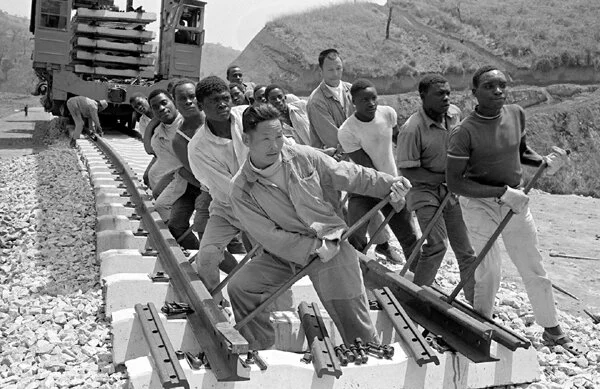
In the Cold War Era, China cultivated a legacy of South-South solidarity. Outlined explicitly in the 1955 Bandung Conference, China’s approach of “peaceful coexistence” gave rise to African nations’ most foundational infrastructure developments. Projects such as the TAZARA Railway, which broke landlocked Zambia’s economic dependence on white-minority-ruled southern regimes and fostered African liberation, serve as enduring symbols of China-Africa friendship. As Paul Nantulya, a research associate at the Africa Center for Strategic Studies, told The Politic, the railways marked “the beginning of the Belt and Road program, because it was China’s largest economic project and most ambitious economic project in the world at the time”.
Across much of the continent, infrastructure has become one of the most visible markers for development, and in recent decades, China has financed and delivered these outcomes. In the climate change sector alone, China has invested over $33 billion between 2020 and 2024 towards clean energy efforts in Africa, expanding power generation capacity to over thirty African countries. In countries such as Mozambique, Kenya, and South Africa, Chinese firms have become major finance suppliers of renewable energy technology as governments continue to pursue greener and climate-friendly policies.
Infrastructure projects have continued to reshape daily lives with railway systems – shortening commuter times, expanding electricity service, and connecting communities. In Ethiopia, the $475 million Addis Ababa Light Rail transports thousands of commuters through the Ethiopian capital daily, bypassing the gridlocks of excessive traffic in the region. Additionally, the Grand Ethiopian Renaissance Dam is a $4.8 billion project that is expected to double Ethiopia’s electricity generation, providing power to 65 million citizens who currently lack access. Equivalently, those transformations have also taken place in Angola, with the rehabilitated Benguela Railway, moving minerals to trade ports more efficiently than the colonial-era lines they replaced.
For many Africans, the stakes are immediate rather than geopolitical. Their central concern is not abstract great-power competition, but tangible improvements in daily life—reliable electricity, transportation, job opportunities, and sustained investment. As Sylvia Sinkari, senior research fellow at the Africa-China Centre for Policy and Development, told The Politic, citizens “do not see people coming in to develop them as Chinese or American or British. They just see people coming into their communities to develop.”
Sinkari characterized Chinese – African dynamics as “symbiotic”, noting that while African nations diversify their economies, China gains access to new markets, raw materials, and positive long term economic partnerships. The relationship between the two is mutually beneficial, with similar goals of developmental priorities rather than political conditionalities.
The Debt Trap Diplomacy
One of the most persistent critiques surrounding China’s role in Africa is the risks of debt dependency, political leverage, and uneven developmental procedures. As African states navigate a new territory of globalization and consider economic partners, they are looking for transparency, truths and overall consistency. While Chinese-funded infrastructure projects have accelerated development in the region, they also shine a light on the historical patterns of foreign dependency and the warning signs of project development failures.
Often described as “debt-trap diplomacy,” critics argue that China extends large loans to developing countries to increase dependency, incentivize decision-making, and claim political influence. However, the relationship between the nations is often more complex than portrayed. African debt or dependency issues did not solely originate from Chinese lending; however, Chinese loans now operate in existence with structural fragilities still raising concerns about leverage and vulnerability of states. Yale Professor Benedito Machava explained to The Politic, “it’s not clear who is really benefiting—who is pushing the agenda.”
Analysts and policymakers point out imminent warning signs of political leverage as African countries increasingly show diplomatic alignment with China on the global stage. A clear example of this was during the United Nations Human Rights Council (UNHRC) debate cycles in 2020 and 2022, where China was being questioned on human rights violations in Tibet, Hong Kong, and Xinjiang.
The UNHRC’s 43rd Session in 2020 saw two joint statements revealing growing international division: 27 Western countries criticized China over controversial national security laws in Hong Kong, while 53 countries took the side of China, including 25 African countries.
This was consistent in the 51st session in 2022, when leading Western countries proposed a motion to debate on China’s treatment of Uyghur muslims in Xinjiang. However, this motion was denied, with a significant portion of African states voting against it.
Debt sustainability remains a central topic of concern on the African continent, with case studies revealing the fiscal fragility of ambitious infrastructure projects. In Ethiopia, Chinese funding has brought about important developments such as hydroelectric dams and roads; however, the country continues to face a debt burden. The International Monetary Fund has identified Ethiopia’s debt as unsustainable, with loans worth about 5.4 billion. Kenya shows a consistent pattern with the 3.6 billion Mombasa-Nairobi Standard Gauge Railway (SGR). While it has significantly improved transport across the country, it has struggled to generate revenue, which combats these costs.
Chinese development and funding in Africa present a complex reality that combats any notions of a simplistic narrative. As Professor Maganizer notes, current China-African relations “represent an iteration of long-standing practice.” In today’s interconnected global system, China-Africa relations are a result of a historical continuity where African states are balancing opportunity and constraint.
African Agency
Looking beyond the narratives of dependency, loans, and domination, a different story emerges—one of African sovereignty and agency in the modern world.
In Ghana, an evolving climate partnership continues to develop with China, following commitments made at the 2024 Forum on China-Africa Cooperation (FOCAC). Issifu Seidu, Ghana’s Minister of State for Climate Change and Sustainability, has said that “Ghana stands ready to work with China and all partners to ensure that our shared journey is one of resilience, prosperity, and sustainability.” Such a statement is not a reflection of passive dependence, but rather a strategic partnership between economic partners.
African states have also begun major developments to monitor and track foreign partnerships through the expanded use of the African Peer Review Mechanism (APRM). Similarly, the African Union Commission (AUC) continues to develop partnerships with Chinese counterparts to ensure commitments and partnership agreements made under the FOCAC Summit in 2024 are being followed through, garnering major successes. China has pledged to restructure debts and develop financial models such as green bonds and blended finance, which better suit both sides of the partnership. The infrastructure sector has also seen some successes with Chinese cooperation, with expanding support for countries like Nigeria, Ethiopia, and Senegal.
At the forefront of Chinese engagement, African states continue to vouch and vie for their long-term concerns and cooperation with Chinese officials. While important improvements have been made in the partnerships going forward, there are issues of transparency and inefficiencies that only underscore a long-standing history of Africa and its external relationships. The ongoing challenge is how to balance this opportunity with limited constraints.
Maganizer notes that “agency is the range of options available to an actor in any given moment…and it is defined as much by its limitations.” Today, African states are balancing this narrative as they explore
relationships with both China and the U.S., keeping their people at the forefront of their decisions while also continuing to develop and operate in global constraints.
Final Conclusions
Between the competing global superpowers, African nations are neither passive background actors nor are they simply tools of dependency. Rather, the continent is an agent within itself, navigating a new world with historical constraints, external extortion, but ultimately a growing opportunity. While China has partnered and helped develop some of the greatest advancements to African infrastructure, there still remains a conversation of emerging historical patterns as debates over debt and influence continue to emerge. The U.S. still continues to shape the continent through its foreign aid despite its various reductions and frequent inconsistencies in the past year.
All in all, Africa’s role in the global world cannot continue to be reduced to a mineland and determinant of global power. African nations have shown resistance and growth as a response to their histories, continuing to evolve in a world that has long limited them. They are ready to continue defining their place in the world, asserting their own priorities and their people’s interests.