
This piece was written by a contributing Tsinghua student for The Future of U.S.–China Relations, a joint special issue by The Yale Politic and Tsinghua Youth Voice.
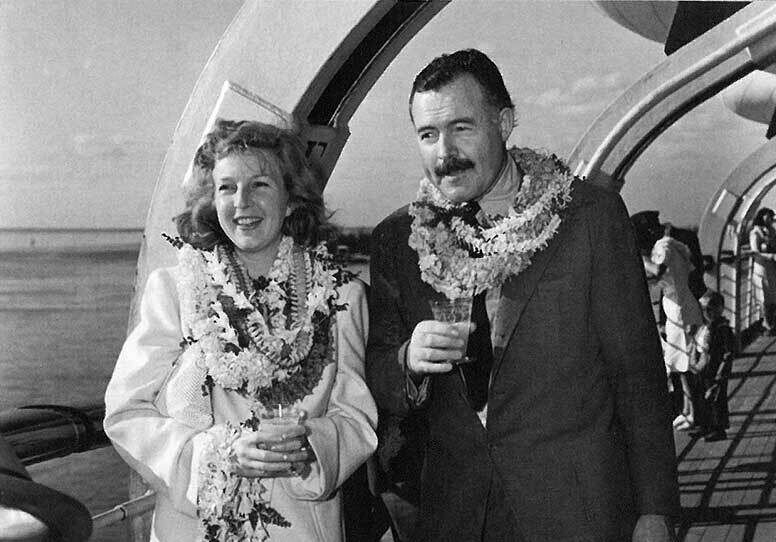
In the early months of 1941, Martha Gellhorn, a war correspondent, was gathering material in China for Collier’s, an American weekly. Ernest Hemingway, a world-famous writer and also her newly married husband, was wheedled into going where he had no wish to go. They stayed in Chongqing, which had become China’s temporary wartime capital after the government fled eastward from Nanjing during Japan’s invasion, for several weeks. It was seen as gray, shapeless, and muddy, a collection of drab cement buildings and poverty shacks.
In her memoir, Gellhorn describes the Nationalist soldiers as barefoot and starving “orphanage children,” contrasting them with the “embalmed” Chiang Kai-shek who ruled what she called “a hell of expendable slaves.” Conversely, she found Zhou Enlai to be a winner and the “one really good man” they had met, marking a sharp distinction between the charismatic Communist leader and the perceived decay of the Republican regime.
Months later, the couple were summoned to Washington, D.C. to answer questions about China. They went surlily and recounted to desk intelligence officers what they had seen during their stay in Chongqing and whom they had encountered. On this basis, they predicted that people under such conditions would welcome radical change and that the Communists were likely to take over after the war. As usual, they were called “Cassandras,” figures whose accurate predictions are ignored, and “branded fellow travellers,” those regarded as sympathetic to communist causes.
What happened to the Hemingways was not unique. In U.S.–China people-to-people exchanges, what was seen and how firmly it was grounded were quietly ignored. Instead, what it was taken to represent and whom it was thought to benefit became the battlefield for both sides. Once a person, a project, or even a shared memory is recognized as leaning closer to one side politically, trust and goodwill on the other side can fade quickly. It is like walking a tightrope, where a slight shift in balance can be read as taking sides. This is the either/or trap.
***
Hemingway also shared his observations in six China dispatches serialized in PM, a liberal-leaning New York daily. Two of these reports, titled “China’s Air Needs” and “Chinese Build Air Field,” warned of Japan’s dominance in the air and argued that aircraft alone would not strengthen China without trained pilots and viable airfields.
At the same time, Claire Lee Chennault, an American adviser bolstering China’s air defenses against Japan, was lobbying to recruit experienced pilots in the United States in hopes of organizing a volunteer air unit to fight the Japanese along the Yunnan–Burma Road, a critical overland supply line skirting Japanese blockade. This force became known as the American Volunteer Group and later the Flying Tigers. Their American-made warplanes, painted with the gaping, tooth-filled mouth of a shark, produced a vivid image that has taken on lasting symbolic meaning in Chinese memory.
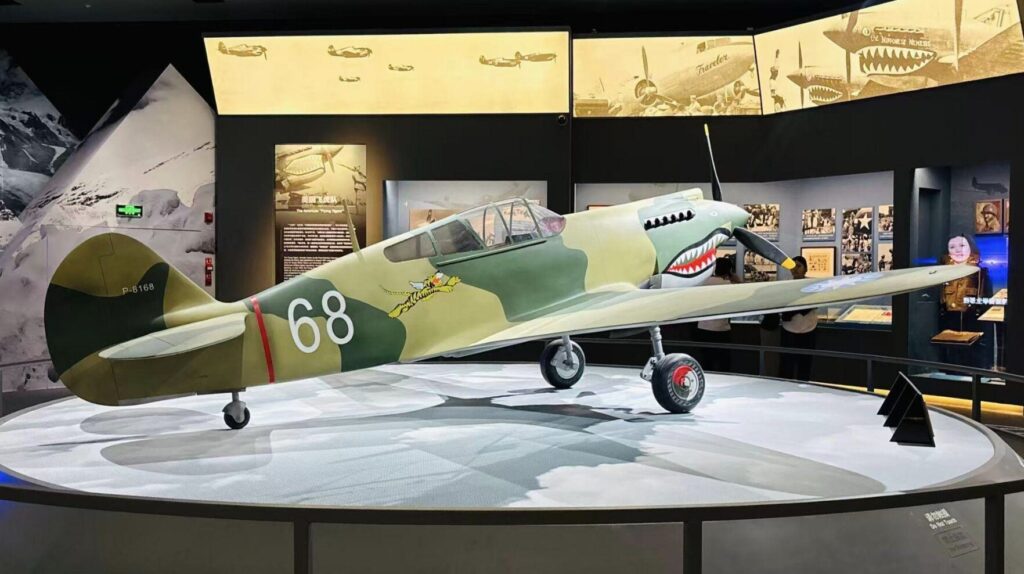
Such a scale model of a Flying Tigers fighter was displayed in the “International Friends and China’s War of Resistance” exhibition at the National Museum of China, as part of China’s commemoration of the 80th anniversary of the victory in the Chinese People’s War of Resistance against Japanese Aggression and the World Anti-Fascist War in 2025. Increasingly, Chinese people have come to remember China–U.S. friendship through this shared memory. It reminds people that the United States and China were once allies and fought against Japanese aggression together, especially in the present context, when bilateral ties are tense. Many interpersonal exchange activities organized by the Chinese side, both semi-official and school-based, are related to this shared memory.
However, while the Flying Tigers symbolize friendship on one side, on the other they have increasingly come to be perceived as an official and political symbol, one that is gradually forgotten and sidelined.
Daniel Wang, a Chinese master’s student in international affairs at Tsinghua University who helped prepare activities related to the Flying Tigers, spoke to The Politic about his experience.
“I contacted a number of American scholars who study China, but only a few responded, and overall engagement was limited. Beyond academia, public awareness of the shared history of the Flying Tigers in the United States also remains relatively low. At present, most participants in related activities are witnesses and descendants,” Wang told The Politic.
Furthermore, as a student involved in China–U.S. youth exchanges, Wang told The Politic, “I was once advised that it might not be ideal to raise this topic with American students and scholars, since many Americans are not very familiar with it unless they specialize in China or history. Moreover, the topic can easily come across to them as an official event rather than a student-led one.” Therefore, when planning future youth dialogues, Wang chose not to include this theme as a discussion topic. He explained, “Chinese society has strong collective memories of the Century of Humiliation, especially the War of Resistance Against Japanese Aggression. In the United States, however, historical experiences and reference points are different.”
***
In the room adjacent to the one displaying the plane with the shark motif, newly created clay sculptures of Chinese and foreign figures stood in a row before a cave-like brick wall. The installation, titled “International Friends in Yan’an,” depicted nine foreigners engaged with Mao Zedong, Zhou Enlai, and Zhu De, major leaders of the Chinese Communists. Among them stood an American diplomat, smiling warmly and looking straight ahead.
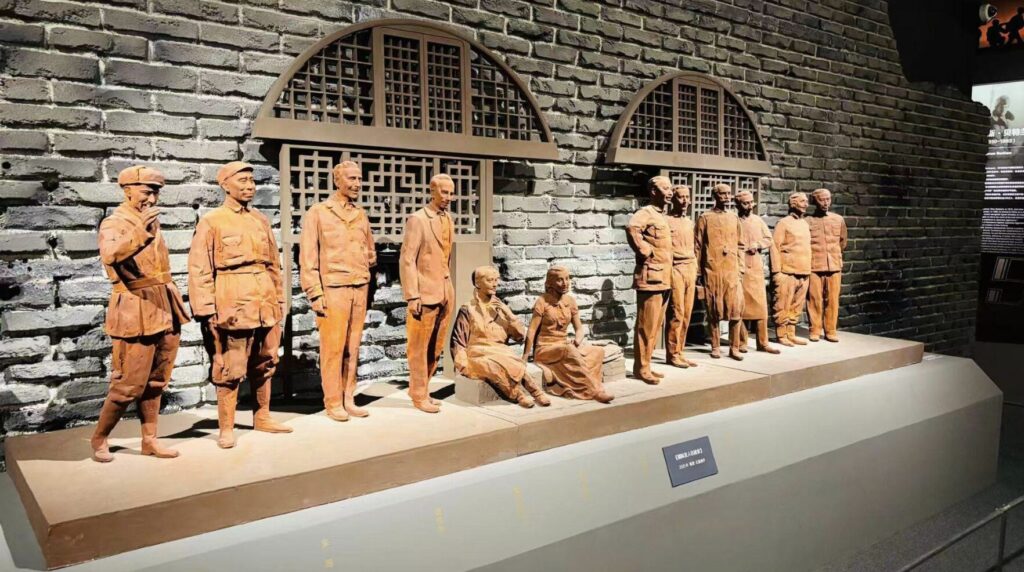
He was John Service, the son of missionaries who grew up in China and later became a key member of the Dixie Mission, a U.S. Army observer group sent to evaluate the Chinese Communists as potential wartime partners against Japan. In July 1944, the mission traveled to Yan’an, the Communists’ revolutionary headquarters. He was impressed by what he saw. It was, he later wrote, like entering another country, “one marked by hard work, cooperation, and the absence of banditry.” Shortly afterward, he reported to Joseph Stilwell, the commander of U.S. forces in the China-Burma-India Theater (CBI) during World War II, on the Kuomintang. “Recent defeats,” he wrote, “have exposed its military ineffectiveness and will hasten the approaching economic disaster.”
This name became widely known during the McCarthy era. Just like the trial in the film “Oppenheimer,” Service faced hearings held from March to July 1950. In Federal Bureau of Investigation (FBI) interviews, Service tried to have a secretary in the room, but they wouldn’t talk with a secretary present. Service wanted her to take notes. He said, “Well, you’re taking notes. Why can’t my secretary take notes?” They said, “Sorry, but we won’t talk to you on that basis.” So he was always alone, and there were two FBI agents. Service didn’t know what was written. In December 1951, he was dismissed by Secretary of State Dean Acheson on the grounds of “reasonable doubt” as to his loyalty.
Service’s wife, Caroline Service, spent that year in India, from April 1950 to the end of March 1951, struggling to make ends meet. In a 1987 interview, Caroline answered why Service and others were blamed.
“Well because he had had a lot to do with the so-called ‘loss of China,’ in quotes. But even without that the China Hands, as they were called—Edmund Clubb, John Carter Vincent, and John Davies—were easy targets. John Davies was finally fired out-of-hand, I think, right after the 1954 election. John Carter Vincent and Edmund Clubb, being over 50, were forced into retirement. It was because of China. Because China had gone communist. These people had ‘lost China.’ It was so crazy. You can just tear your hair sometimes,” Mrs. Service said.
The judgment of Service and other China Hands was shaped less by their conduct than by the political climate that followed the war.
“The Republican Administration was determined to get people out of the Foreign Service who had been in the China service. You can’t say it was a plot; it’s just that politically it was a good drum to beat. They wanted to show the public that Republicans weren’t ‘soft on communism,’” she recalled.
***
Theodore H. White testified in person on behalf of Service, but he was far luckier than him. As a history major at Harvard who studied under John Fairbank, White graduated summa cum laude in 1938. That distinction earned him a $1,200 fellowship from the Harvard-Yenching Institute, which would ordinarily have set him on the long path toward becoming a professor of Oriental history. However, he chose another life path, risky but charming, by accepting the university’s Frederick Sheldon Traveling Fellowship, a program designed to let “students of promise” travel for a year wherever their interests might take them.
He came to China in 1939, initially as a sightseer, with the idea of writing history as a newspaperman. White lived in Shanghai for several months. Beneath its surface image as the “unrivaled Paris of imperialism,” he discovered, during a single day’s tour of the city’s factories, that no one cared about Chinese workmen, least of all the Chinese rich. At that point, White decided that he had to join the action, whether as a revolutionary, a partisan, or an agitator.
When White first arrived in Chongqing, he was unstinting in his admiration, romanticizing those who had deliberately left the occupied coastal cities and chosen life inland over submission to Japanese rule. He used his position as an adviser to the Ministry of Information to stay and access key information. However, this did not mean that he could be manipulated. He remarked sarcastically, “The easiest of all to manipulate, however, were famous names, the trained seals, the swooping stars of major American and British newspapers who would fly in for a four-day visit and then send out pontifical dispatches about the war and the Chinese spirit of resistance.”
In the summer of 1942, White returned as a war correspondent in uniform. The role was new, yet his integrity and courage remained the same. A famine had struck Henan, a province roughly the size of Missouri, inhabited by 32 million peasants who grew wheat, corn, millet, soybeans, and cotton. The rains failed to come in 1942, and by 1943, reports reaching Chongqing said that peasants in Henan were dying. White flew to North China and obtained permission to investigate the famine firsthand. Night after night, he wrote up his notes after speaking with local officials. Technically, he also began to compile statistics in miniature, recording the yield of wheat per mu wherever he could find a peasant willing to talk.
Afterward, White’s article in Time tore a hole in the news blackout created by official collusion in Henan, the concealment of facts, and Chongqing’s severe underestimation of the gravity of the situation. The famine soon drew international attention. Song Qingling, who helped connect White with Chiang Kai-shek, told him, “I insisted that the matter involved the lives of many millions… .May I suggest that you report conditions as frankly and fearlessly as you did to me. If heads must come off, don’t be squeamish about it…otherwise there would be no change in the situation.” White did exactly that.
With professional training, cross-national empathy, curiosity, and courage, White later visited Yan’an and observed much the same realities as Service. He tried to persuade his boss at Time that “neither the Nationalists nor the Communists were democratic in the American sense, and that our immediate interest was to support those who could help us most against the Japanese. To aid Chiang against Mao, however, was to commit the United States to a disastrous ‘meddling’ in a civil war in which it could only lose.” But he failed.
Courage came at a cost. While testifying at the hearings involving Service and Davies, he tried to make one principle unmistakably clear: a State Department officer, he insisted, must report the truth to the government, no matter how unpleasant the facts may be. White, however, was also questioned as a witness about whether his wife was a communist. By the end of 1954, he withdrew from the line of fire. Freed from the threat to his journalistic license, he abandoned his earlier focus on America abroad and turned instead to what now fascinated him more: America at home. He excelled in this work as well, winning the Pulitzer Prize for General Nonfiction in 1962 for The Making of the President 1960.
Courage had its rewards. His curiosity, professional on-the-ground research, willingness to take risks, and ability to withstand pressure formed a methodology grounded in firsthand observation. By remaining loyal to what he saw and knew, this approach could be tested by history, making both himself and his work reliable and earning respect on both the American and Chinese sides.
***
History may be forgotten on the U.S. side and selectively remembered on the Chinese side, but the trap remains. Today, those engaged in U.S.–China exchanges are trying to find a position of their own, one that allows them to understand the other side without being perceived as hostile, while also ensuring that at home they are not labeled as drifting away from their own side or leaning toward the other.
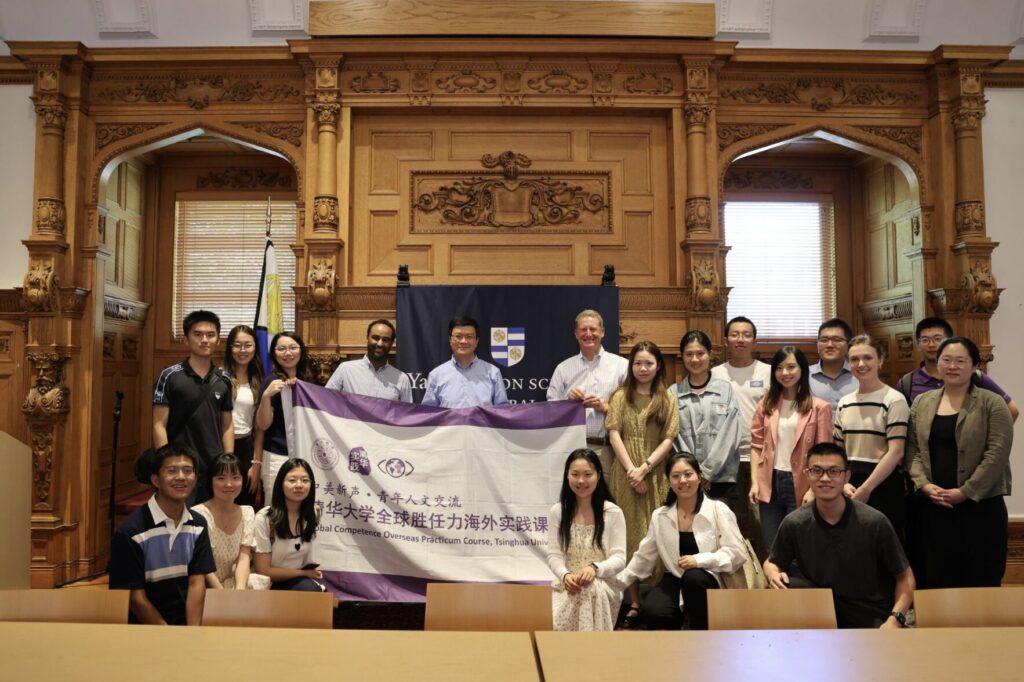
Huang Ying, a PhD student from the Department of International Relations at Tsinghua University, also a founder and leader of Tsinghua University Student Association of China–U.S. People-to-people Exchange, told The Politic, “There was one conversation in which I took part both as a participant and as an organizer. I realized that during exchanges, people may not only be attentive to the views of their counterparts—Americans paying attention to Chinese participants and Chinese participants to Americans—but also to those of their own peers, with Americans watching Americans and Chinese watching Chinese.” This dynamic may lead participants, during discussions, to weigh more carefully whether their remarks are appropriate within their own peer groups.
The good news is that some people are still making efforts to open up space for real but safe understanding and exchange. More and more youth leaders from both sides now have the awareness and tools to confront this trap.
Benjamin Nuland ’27, co-founder and co-president of the Yale Dialogue on U.S.–China Relations, an undergraduate initiative that advances student engagement with U.S.–China geopolitics and fosters dialogue with peers at leading Chinese universities, reflected on the stakes of student-led exchange.
“As challenges mount in the U.S.–China relationship, it is more important than ever to sustain channels of dialogue between emerging American and Chinese geopolitical thinkers. Undergraduate dialogue is politically low-stakes and relatively insulated from official scrutiny or performative posturing. It creates a rare space for honest exchange beyond the noise of state-level signaling. At the same time, launching an undergraduate dialogue now carries a quiet but meaningful statement that rising tensions between China and the United States need not foreclose relationships between a new generation of International Relations scholars and policy-minded students. By building sustained dialogue and fostering respectful engagement across differences, we aim to strengthen communication, trust, and mutual understanding of one another’s values, perspectives, and shared responsibilities. These exchanges help cultivate a generation of Chinese and American leaders better equipped to navigate strategic competition with nuance, restraint, and a sense of responsibility,” he told The Politic.
Huang told The Politic, “Dialogue organizers need to approach these exchanges with sophistication and intellectual empathy, and be prepared for guests to say things that may sound unpleasant. At the same time, we do not deliberately steer the other side toward saying things that benefit us. When something may be unfavorable to us, we tend to address it in private rather than in public. In those moments, it is possible to sense that the other side still respects our perspectives and does not seek to put us in an awkward position.”
***
For those navigating these exchanges today, the measure of genuine engagement may lie less in which side one appears to favor, and more in whether it is grounded in firsthand contact and constitutes verifiable intellectual labor based on real contact.
As Huang suggested, “Americans, even those who have engaged in China studies for many years, still know too little about China, just like me, and like every Chinese person. What is required, then, is sufficient humility. For those who want to understand China better, the answer is to make more Chinese friends. Every Chinese friend will show you a different China.”
With a shared commitment to staying clear of the trap, the next generation of U.S.–China youth exchange participants may again set out along a path that is not unfamiliar. From a distance, White might offer a quiet nod of recognition to young people much like his younger self. He knew that, with wise courage, intellectual curiosity, and reliable methods, an unexpected and sufficiently vivid panorama of a country would unfold before them.