
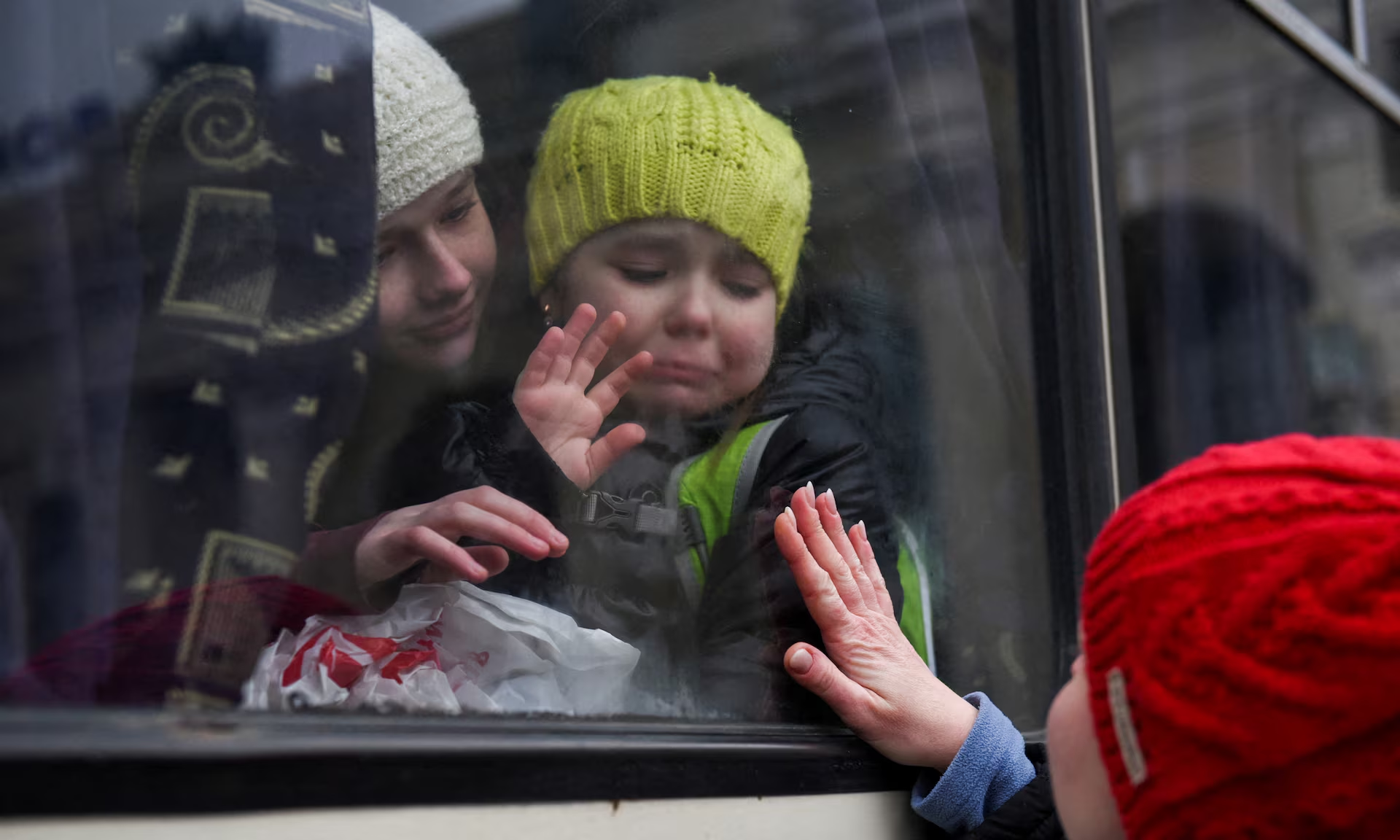
Alexandra, 12, holds her sister Esyea, 6, who cries as she waves at her mother Irina, while members of the Jewish community of Odessa board a bus to flee Russia’s invasion of Ukraine, in Odessa, Ukraine, March 7. Alexandros Avramidis / Reuters.
It was 8:43 a.m. on October 15, 2023, when Mariia heard someone banging on her door. Still in her bed, she could hear her mother’s heavy footsteps rushing towards the door. “We need to take her. Right now,” someone screamed. A deafening silence followed. Suddenly, Russian soldiers entered her room. “Mariia, come on. We are taking you to the bus right now. Bring your favorite toy and pajamas.” Mariia glanced at her parents, who stood silently as a man in a military uniform escorted her out. Mariia did not know that would be her last goodbye.
At just eight years old, Mariia was put on a bus crowded with other children. Adults repeated the same phrases in calm tones: “It would be safer there,” “Good people would take care of them,” “They would come back soon.” No one explained where they were going. For a while, the road looked like any other. Then, just as they were passing the city limits, Mariia noticed a change. The signs were no longer in Ukrainian. Then came the flags: the Russian white, red, and blue, hanging from buildings and posts. Mariia had never been to Russia. She had never seen these symbols so close. She felt her stomach drop. Only one thought consumed her mind: nothing would be the same again. For Mariia, the journey existed only in hours passed, instructions given, and the slow understanding that whatever came next would not be simple. As of April 2026, she has not been home nor seen her family since that morning in October of 2023.
Mariia’s story is not unique. Since Russia’s full-scale invasion of Ukraine in 2022, Russian authorities have transferred thousands of Ukrainian children from occupied territories into Russia, Belarus, North Korea, and other Russia-controlled regions. The Yale Humanitarian Research Lab (YHRL) identified and tracked more than 35,000 children taken to over 200 locations in Russia and Russian-occupied territory. Some kids were forcibly relocated 3,500 miles from their homes. Ukrainian authorities believe the true number is higher. YHRL established identities for over 8,000 kids who were taken to Russia. Only around 2,000 kids were returned to their homes. Under international law, the transfer of civilians from occupied territories is explicitly forbidden by the Geneva Convention. Alec Wargo of the Office of the Special Representative of the United Nations Secretary-General on Children and Armed Conflict argued that the transfers “became not just child trafficking, but a forcible transfer of minors from the temporarily occupied territories, which in international law is a greater criminal violation.”
***
Russian officials frame the abductions as humanitarian programs. They call it an effort to remove children from active combat zones and provide medical care. “Humanitarian rescue” has proven not to be the reality. Ukrainian officials, international investigators, and human rights organizations report a coordinated system in which children are placed into institutions, foster systems, and adoptive families designed to assimilate them gradually into Russian society. As one of five permanent members of the UN Security Council, Russia holds veto power and has blocked Security Council proposals responding to the transfers, whether in the form of binding resolutions, sanctions, or direct intervention. Radhika Coomaraswamy, former United Nations Special Representative for Children and Armed Conflict, stated that “the legal framework to addressing the transfers is clear, but the mechanisms to implement it are not.” She criticized the humanitarian framing Russia uses, arguing that it serves as a cover for Russia to continue forcibly and illegally transferring Ukrainian children while holding a permanent seat on the Security Council.
The Children’s Rights Commissioner for the President of the Russian Federation facilitates these forcible transfers. When a child enters the transfer system, their documentation undergoes initial changes. For children under 14, that means a new birth certificate in Russian, a Russian personal identification number, and a certificate of residence in Russian. For children aged 14 and above, it also includes a Russian passport. The passport is the most consequential: without it, accessing healthcare, legal services, or public institutions is nearly impossible. By assigning new names, documents, and identification numbers, the system erases the child’s original identity, making it extremely difficult for families or authorities to locate them or prove who they are.
Maria Lvova-Belova, Children’s Rights Commissioner for the President of the Russian Federation, herself stole a Ukrainian child, Pylyp, and adopted him into her family. Pylyp, who was 15 when the Russian full-scale invasion began, remained in Mariupol until spring 2022, when Russian emergency services took him to a hospital in Donetsk, and later a sanatorium outside Moscow. Afterward, Lvova-Belova visited the sanatorium and adopted Pylyp as her tenth child. By September 2022, he had a Russian passport. In interviews, she described Pylyp as watching Ukrainian content, singing Ukrainian songs, and telling her that Moscow irritated him. Rather than treating this as evidence that he did not want to be there, she characterized it as a problem to solve.
***
The Russian government chooses where each child is sent. Some end up in what Russian authorities call Temporary Accommodation Points—temporary camps or sanatoriums. Others are sent to boarding schools, foster care, or Russian adoption programs. Nathaniel Raymond, executive director of the YHRL, described the broader system as “an industrialized pipeline for children—from infants and toddlers all the way to the age of majority—to systematically erase their Ukrainian identity, and eventually make many of them soldiers in the Russian Army.” The Anti-Discrimination Center Memorial, a human rights organization based in Brussels, reported that the quality of Temporary Accommodation Points varies by location. The closer an institution is to the border with Ukraine, the stricter its institutional control, with more guards and fewer civic freedoms. All of them were opened in rest homes, hotels, or children’s camps that had been hastily converted for permanent residence.
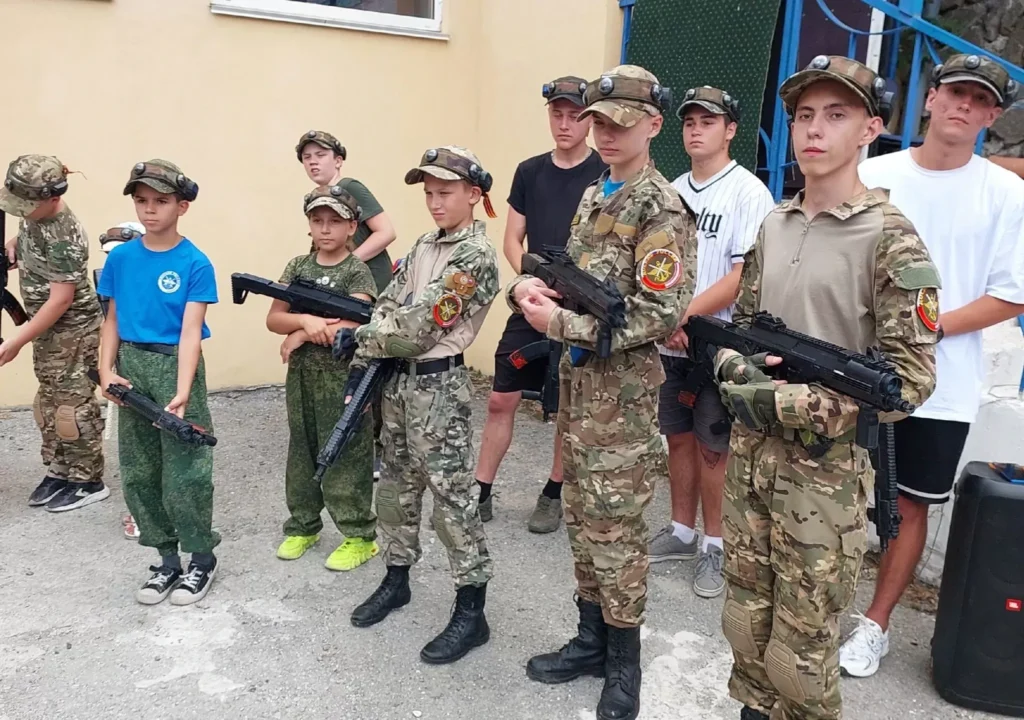
In these locations, re-education happens. Schools follow the Russian curriculum, and history is taught from the Russian perspective, with Ukrainians portrayed as neo-Nazis. YHRL has identified at least two military training programs resembling junior Military Officer Training, as well as an online program directly tied to combat preparation. Beyond formal schooling, some children are enrolled in military-patriotic youth organizations that combine physical training, civic education, and exposure to military culture.
The impact of this system is most visible in the treatment of individual children. For example, Anastasiia, a 15-year-old forcibly transferred to Russian-occupied territories, recalled how she was instructed to sing the Russian national anthem. “We were told: ‘Sing the anthem, if you don’t know, just open your mouth.’” The school director told them, “You are nobody here. We feed you, give you water, comfort, and you are ungrateful. Go back to your fascists.”
These policies shape children’s daily lives. Nine-year-old Illia from Mariupol, whose mother died from shrapnel during the shelling, was in a hospital in Donetsk receiving life-saving surgery. Already in the hospital, he was mocked by the Russian doctors, who told the child he should not say the national slogan, “Glory to Ukraine,” but instead, “Glory to Ukraine as part of Russia.”
***
Most forcible transfers begin with a lie. Russian authorities tell Ukrainian families their children are going to a summer camp, which in post-Soviet countries traditionally involves a 21-day program. However, once the 21-day period passes, instead of being returned to their families, the children are moved further into the Russian system: into foster care, institutional care, or adoption. The camp is never the destination—it is the first step in a longer process. By the time parents understand what has happened, their children are almost impossible to find. Simultaneously, children are already being indoctrinated. One girl from Kherson, who returned from the Russian-annexed Crimea, recalls that the Russian forces told her, “The Americans, the Germans are coming, and they will rape the girls.”
Some children resist. Mykola Kuleba, a Ukrainian social activist and former Presidential Commissioner for Children’s Rights, described a boy from the Kherson region whom he met while advocating for repatriation. The boy was orphaned after his grandmother died in a rocket attack. When the Russian military arrived, he was taken by force to a camp, where he was required to sing the Russian national anthem. He was then transferred to a rehabilitation center and issued a Russian birth certificate. He tore it up in front of the camp director. He was placed in solitary confinement. Officials issued a replacement. He tore that up, too. This cycle repeated four times. After the fourth, a birth certificate was placed in his file without being given to him at all, so he could not destroy it. He was then sent to a Russian military academy. He resisted again and was placed in solitary confinement once more.
Back in Ukraine, families search for answers. Parents submit information to government registries, contact humanitarian organizations, and rely on informal networks to track their children. Yet each new piece of information is incomplete: an address without confirmation, a record without context.
Mariia’s parents were able to track which exact orphanage their daughter was placed in. When they tried to reach out, the establishment’s administration said that Mariia had already been adopted. “We were calling orphanages, child affairs officers, and even the police department in that region. All they said was that Mariia couldn’t go back to the ‘pro-Ukrainian Nazis.’” Olena Zelenska, the Ukrainian First Lady, stated that none of the abducted children in Russia have the right to speak Ukrainian, recognize their culture, or contact their Ukrainian parents and friends in their homeland. Zelenska also stated that some children commit suicide in Russia, unable to withstand the pressure.
***
Even when a child’s location is known, returning them to their family is also a challenge. There is no consistent mechanism for repatriation. Each case unfolds individually, often relying on NGOs, private negotiators, or, in rare instances, diplomatic coordination. The process is slow and uncertain. Some children eventually return home. Most do not. The International Criminal Court issued arrest warrants related to the unlawful deportation of children, naming Russian President Vladimir Putin and Children’s Rights Commissioner Lvova-Belova. However, enforcement remains limited.
The most visible diplomatic interventions have come from unconventional paths. In August 2025, the U.S. First Lady, Melania Trump, sent a personal letter to Russian President Vladimir Putin calling for the return of Ukrainian children. President Donald J. Trump personally handed it to President Putin during bilateral talks. Since then, she has maintained “an open channel of communication with Putin’s team.” By early April 2026, her efforts had facilitated four rounds of reunifications, returning six Ukrainian minors to their families, with a seventh expected home later in April 2026.
Yet the broader U.S. approach to the issue is more complex. In early 2025, the Trump administration’s actions defunded the aforementioned Yale Humanitarian Research Lab. Representative Greg Landsman, D-Ohio, described the loss of the lab’s database as the difference between “showing up to a negotiation with a list of all the names and locations and not having any list at all.” In 2026, the U.S. State Department announced it had launched a $25 million program to track and rehabilitate Ukrainian children, following bipartisan criticism in Congress, with lawmakers pressing Secretary of State Marco Rubio to restore the funding and the data.
The $25 million, however, did not go back to the YHRL. Instead, the State Department launched its own parallel program. Raymond noted that despite the First Lady’s public advocacy on the issue, the White House had not been in contact with his team. The decision raised questions about whether the new initiative could replicate three years of accumulated data, satellite tracking, and institutional knowledge that the YHRL had gathered. As of April 2026, Ukraine had confirmed the return of 2,083 children overall, yet this still represents only a fraction of the tens of thousands that have been transferred.
***
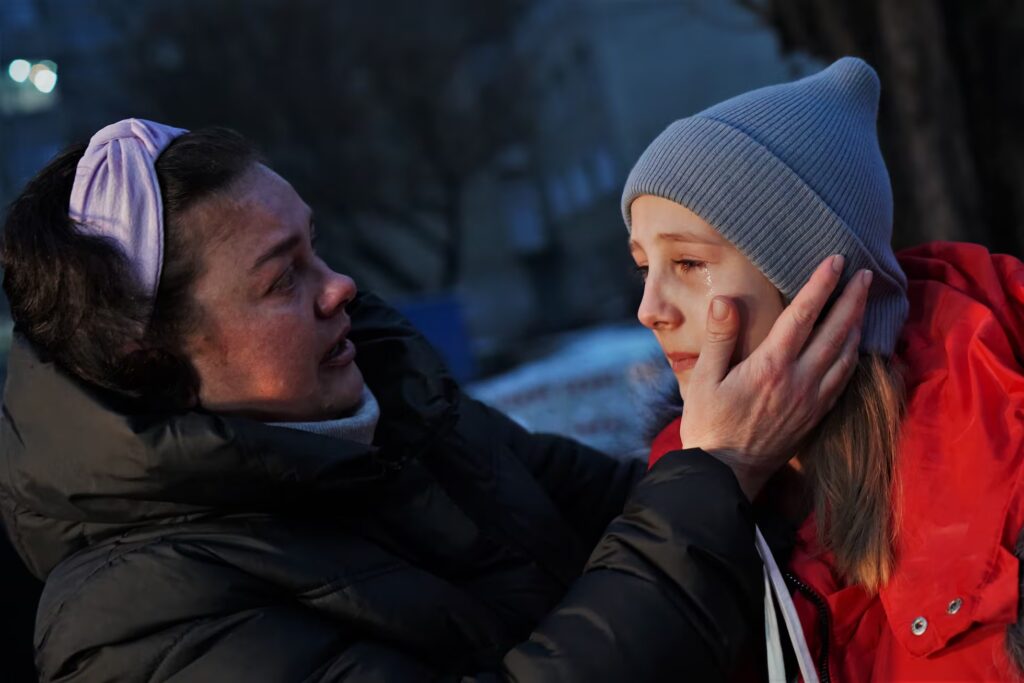
But even for those who returned, their forcible transfer has left a lasting impact on who they are. Many returned children show signs of post-traumatic stress, emotional disengagement, and lasting psychological impact—the invisible consequences of being placed into the system not of their choosing. “The children we’ve brought home…they can sit for five or six hours staring at one point. Just staring. Not communicating with anyone,” said Kuleba, former Presidential Commissioner for Children’s Rights.
For those who have yet to be returned, like Mariia, Anastasiia, and the boy from Kherson who tore up a birth certificate four times, the distance between home and where they are is measured not only in miles, but in everything else that has changed. Forced transfers and indoctrination fractured their mental and physical health, identities, perceptions of self, and national belonging.
Mariia, like thousands of other kids, has not been home since that cold morning of 2023. She longs for a hug from her father, a kiss on the forehead from her mother, and a shared play with her two younger brothers. Even as the days continue to pass by, the hope of returning home remains.