
Charly Triballeau / Al-Monitor
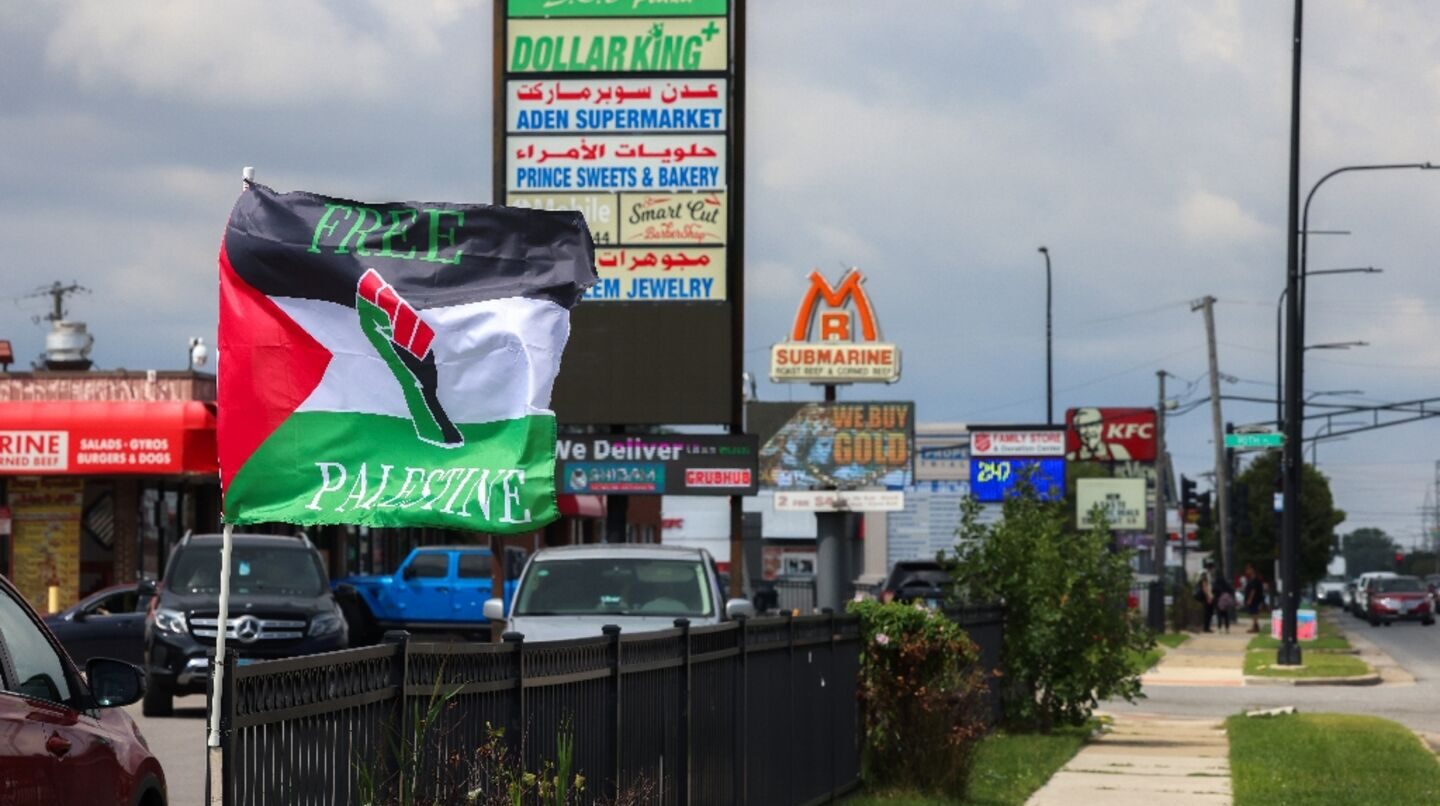
On the southwest side of Chicago, there is a stretch of shops and restaurants that locals recognize as “Little Palestine.” It is the place where geopolitics quickly turns personal. A seemingly average street transforms into conversations about family maps and what counts as home. For many of the Palestinian families living there, those maps run through Jordan. Jordan is not only a country next door but also where grandparents built lives after 1948 and where families head for summer trips.
“You hear it in the conversations,” said Ammar Sheikhi, a Palestinian who immigrated to the United States from Jordan at 20. “People are always talking about back home, about who’s visiting, who’s coming, who’s still there. [Little Palestine] is one of the closest connections to Palestine you can find in the States.”
It is not only through conversation that the neighborhood reveals itself. Small details reveal the Arabic script in bakery windows, trays of kanafeh glowing under the glass, older men outside restaurants late at night, or mothers calling after their kids as they head down the street. Home, here, is rarely singular. Palestinians can be from Chicago, tied to Jordan, and still feel that the truest version of belonging lies somewhere even farther away, in a place known mostly through memory and grief.
Sarah El-Debaghi, a Palestinian American from Chicago’s Little Palestine neighborhood, told The Politic that although her family is Palestinian, nearly all of her relatives immigrated to Jordan and still live there today. After the 1948 “Catastrophe”—during which more than 700,000 Palestinians were displaced or expelled in what is widely known as the Nakba—many fled east into Jordan. Because of that, Jordan is where El-Debaghi returns every summer.
“I go there instead of Palestine. It feels like my home away from home,” she said. But even that feeling is complicated. “It’s home,” she said, “but not really my home in the fullest sense.”
Her story is hardly unusual. For many Palestinians displaced after 1948, Jordan became both a place of refuge and a site of hostility: a country that welcomed a large number of refugees, eventually granting citizenship to many, while still limiting their access to political power.
A History of Presence Without Power
Jordan’s Palestinian question has been a central part of the country’s modern history since 1948. After the 1948 Nakba, Jordan incorporated hundreds of thousands of Palestinians into the kingdom, more than any other Arab state at the time. In 1950, it formally annexed the West Bank and granted citizenship to its Palestinian residents, binding the monarchy more closely to the Palestinian national question than most other Arab governments in the region. But incorporation did not translate into equal political power.
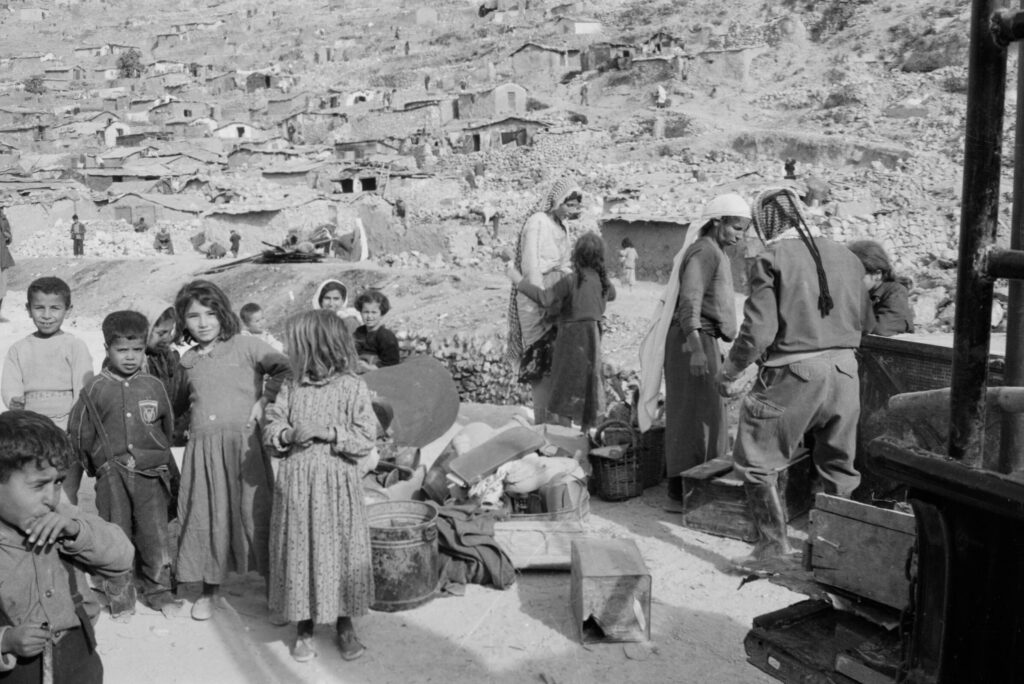
Photo via UNRWA Archive
Political exclusion is at the core of Jordan’s modern history. Yale professor and Postdoctoral Associate Samee Sulaiman reported, “Palestinians were excluded from the core centers of power. Real political authority and security control remained firmly in the hands of the Hashemite monarchy, ensuring that the Palestinian majority could not fundamentally reorient the state’s domestic or foreign policies.” The share of the kingdom’s population of Palestinian origin is significant, with higher-end estimates reaching as high as 50%. Yet, despite demographic weight, Palestinians remain underrepresented in Jordanian political institutions. Electoral districts have historically been drawn in ways that favor East Bank populations, with rural areas receiving greater representation than densely populated cities like Amman, where many Palestinians live. As a result, political authority is concentrated outside of the country’s most densely populated urban centers.
Progressive activist Yousef Halabi described this imbalance as one of the defining tensions of Palestinian life in Jordan. “Palestinians are everywhere in Jordan’s social and economic life,” he said, “but that has never meant they were allowed to shape the state in the same way. They are present, but not equally reflected in its institutions.”
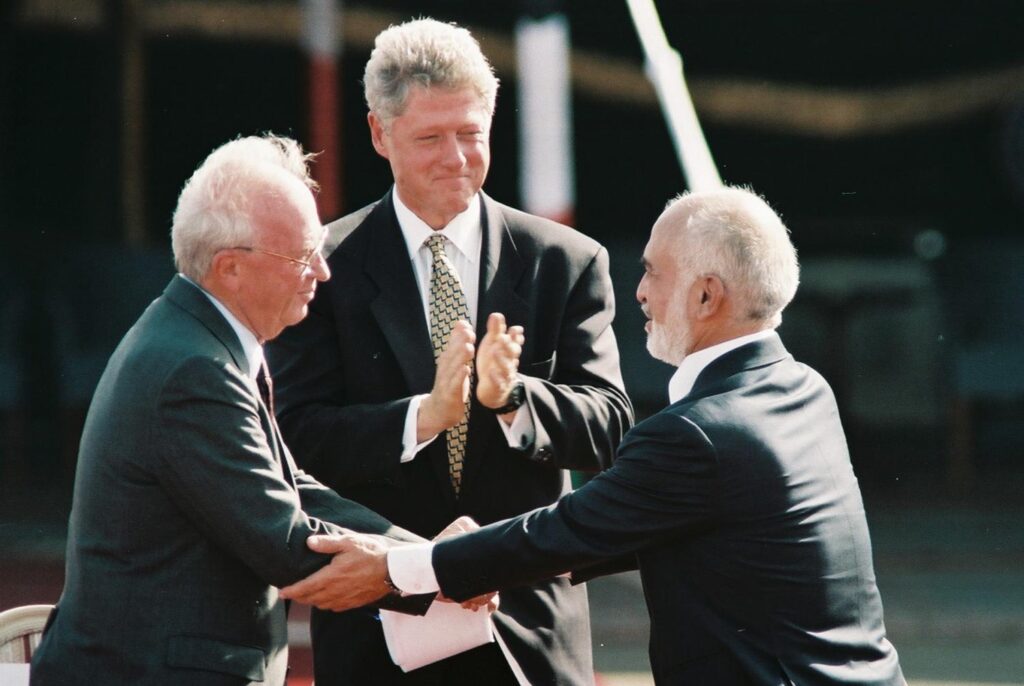
That imbalance helps explain a second incongruity, one that has shaped Jordan’s place in the region for decades. Jordanian officials frequently use strong pro-Palestinian rhetoric, including repeated condemnations of Israeli military actions in Gaza and warnings against the forced displacement of Palestinians. At the same time, Jordan maintains a formal peace treaty with Israel, signed in 1994, and continues cooperation on security and resource issues, particularly water sharing. That tension reflects deeper anxieties within the Jordanian state about who gets to shape political power. This contradiction has roots in the Jordanian monarchy’s belief that a large diaspora should not translate into proportional political power.
For a time, that arrangement gave Jordan regional leverage—the country was able to extend its power beyond its borders due to the crisis in Palestine. But, it also raised concerns within the monarchy about political balance and national identity, particularly as the Palestinian immigration continued.
These tensions became more pronounced as Palestinian nationalism gained momentum in the 1950s and 1960s, reshaping both regional politics and Jordan’s internal balance. At the same time, the kingdom was undergoing a demographic shift, as large numbers of Palestinians displaced after the 1948 Nakba settled in urban areas across the country. “Palestinians were generally better educated, more urbanized, and significantly more politicized than the original population east of the Jordan River, creating a discontented majority that challenged the traditional tribal foundations of the kingdom,” Sulaiman noted. While the monarchy continued to rely heavily on East Bank tribal networks and long-standing patronage systems for political stability, much of the population was composed of communities shaped by displacement and exile.
The situation grew more complicated after 1967, when Jordan lost control of the West Bank to Israel in the Six-Day War. Although the territory was no longer under Jordanian rule, the state remained closely tied to the Palestinians connected to it. In the years that followed, tensions grew as Palestinian political and militant groups expanded their presence inside the kingdom. Organizations like the Palestine Liberation Organization (PLO) established bases in Jordan and, at times, operated independently of state authority, challenging the monarchy’s control.
By the end of the decade, these dynamics had become increasingly unstable. Palestinian guerrilla groups were not only growing in size and visibility but also asserting political and military autonomy in ways that directly threatened the state. This culminated in the 1970-71 conflict known as Black September, when the Jordanian military moved to expel Palestinian armed groups and reassert control.
According to political scientist Curtis Ryan, this outcome marked a turning point, fundamentally reshaping the relationship between Palestinian demographic presence and political power within the kingdom. Despite their significant demographic presence, “the political landscape was carefully managed to prevent the emergence of cohesive Palestinian political organizations that could challenge the crown,” as Sulaiman detailed.
In the years that followed, the state adopted a more guarded political structure. Institutions such as the military and electoral system remained closely tied to East Bank constituencies. Palestinians continued to play a central role in Jordanian society, but the events of Black September solidified the boundaries around their participation in the country’s ruling order.
The long-term outcome was not one of total exclusion, but something more complex. As political scientist Jillian Schwedler has argued, Jordan developed a system that distinguished between social inclusion and political authority, particularly in its treatment of Palestinian communities.
Palestinians became deeply embedded in the country’s economic and urban life, especially in sectors like commerce and education. Amman, in particular, has been shaped by Palestinian communities and business networks, reflecting a form of integration that did not fully expand into political power. Palestinians were not absent from public life, but the state was built to ensure that demographic reality would not fully reorder the terms of rule.
That became even more apparent in 1988, when King Hussein formally severed Jordan’s legal and administrative ties to the West Bank. The disengagement was meant in part to clear political space for the PLO to serve as the representative for Palestinians. It was also meant to reinforce a distinction Jordan had become increasingly determined to preserve—Jordan was not Palestine, and it would not become a substitute for one.
The move was symbolically and politically significant. It ended a lingering Jordanian claim to the West Bank and clarified that the kingdom would continue supporting Palestinian rights without allowing the Palestinian national cause to dissolve Jordanian statehood. In practical terms, it narrowed the terms on which the state related to Palestinians under its authority. Jordan could speak in the language of solidarity and denounce displacement, but it was not willing to let the Palestinian cause redefine what Jordan was as a state.
That divide still runs through Jordanian politics today. It also helps explain the country’s relationship with Israel, which often appears paradoxical from the outside. How can a country with such a large Palestinian population and such vocal public sympathy for Palestine maintain peace with Israel?
The most-cited answer is that Jordan’s relationship with Israel was never primarily about affection but about survival. The 1994 peace treaty formalized ties that the monarchy saw as strategically necessary: access to U.S. support and cooperation on resources, especially water, in one of the most water-scarce countries in the world. Public hostility toward normalization of relations with Israel has remained intense, but for the Jordanian state, peace with Israel has mostly been about keeping the state secure.
Nati Shohat / NU-Q Views
Journalist Noor Sammi said that Jordan’s position has always felt torn between public opinion and what the state believes it has to do to survive. “There has always been real sympathy for Palestine in Jordan, because for so many people it is personal,” she said. “But the state has never moved entirely on feeling. It has moved on to what it thinks will keep the country stable, even when that puts it out of step with its own people.” Her point goes beyond Jordan. Across the region, many Arab governments have publicly backed Palestine while privately or strategically working with Israel when it suits them. In Jordan’s case, these decisions are shaped in part by its close relationship with the U.S., which provided the country with over $1.4 billion in annual aid, including military and economic support, alongside security concerns and resource needs such as water cooperation with Israel. In Jordan, though, the issue is also more internal. The monarchy has long feared that if Palestinian identity were allowed to reshape domestic politics too greatly, it could unsettle the balance the state has spent decades trying to maintain.
That fear has only grown in recent years. As Israeli politics have moved further right and speculation periodically resurfaces about forcing Palestinians out of the West Bank, Jordan has repeatedly treated mass displacement as a red line. This position is both partly moral and deeply strategic. Another major transfer of Palestinians into Jordan would threaten the kingdom’s demographic and political equilibrium. Every warning from Amman against displacement brings within it both solidarity and fear.
Photo via Wikimedia Commons
An Unresolved Sense of Home
For many Palestinians, Jordan has been a place where lives were rebuilt—where families settled, children were raised, and futures were imagined—but where political belonging has remained unresolved.
“Jordan feels like home to me because that’s where so much of my family is,” said Dr. Walaa Abualhuda, a Palestinian American from Chicago’s Little Palestine community. “But it never fully replaces Palestine.”
That tension often plays out differently across generations. While older generations may speak about Jordan with a sense of stability or pragmatism, younger Palestinians often have “this feeling of being connected to a place while also knowing there are limits to that belonging,” said undergraduate student Yasmine Al-Nahari.
What comes next is less certain. Jordan has long managed this balance, but the pressures shaping it are intensifying. Continued instability in Gaza, the possibility of further displacement from the West Bank, and rising public frustration inside Jordan all pose challenges to a system that has relied on keeping tensions contained rather than resolved.
Whether that balance can hold will depend not only on regional developments but also on how the state responds to a population that is increasingly vocal about the gap between public sentiment and political reality.
Maybe that is why places like Little Palestine in Chicago feel like more than a neighborhood. Little Palestine is where history shows up in regular life, in the people who go to visit over the summer, and in the way the definition of home feels unresolved generations later. For El-Debaghi, that complexity is not something she tries to resolve. It is simply part of how she understands home, something shaped as much by where her family is as by the place that still exists just beyond it.